.png)
Learn how presales is evolving and howyour team can stay ahead in atech-driven sales landscape.

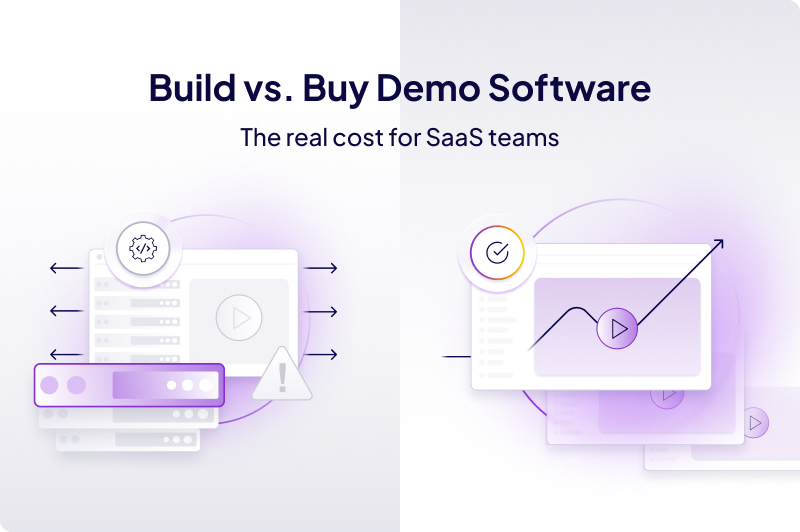
Most SaaS teams start by building demo environments internally — and for good reason. But as they scale, hidden costs begin to surface: increasing reliance on engineering, time-consuming manual setup, deteriorating demo data, and inconsistent experiences across the team.
Purpose-built demo platforms address these challenges by making demo creation and management self-service, allowing teams to scale their demo process without adding operational overhead.
In SaaS sales, the demo is where evaluation becomes real. It is the moment when a prospect stops hearing about your product and starts experiencing it. Done well, it accelerates deals. Done poorly — or inconsistently — it quietly kills them.
But while most sales organizations obsess over the quality of their demos, far fewer scrutinize the infrastructure behind them. Who builds the environment? Who keeps it running? Who resets it before each call, updates it when the product changes, and ensures the data inside it actually tells a convincing story?
For many SaaS teams, the answer to all of the above is: engineering. And that is where a quiet, expensive problem begins.
As companies scale, a question that once seemed purely technical becomes a genuine business decision: should you continue building and maintaining your demo environment internally, or adopt a purpose-built demo creation platform? The answer depends on where your company is, where it is going, and how clearly you can see the true cost of the path you are already on.
Building a demo environment internally is rarely the wrong decision at the start. In many cases, it is the most practical one.
In the early stages of a SaaS company, the conditions naturally support it. The sales team is small, engineering is accessible, and the product itself is still evolving. Keeping the demo environment close to the product makes it easier to reflect changes quickly and maintain alignment between what is being built and what is being shown to prospects.
Building internally also offers clear advantages: full control over functionality, deep integration with internal systems, and the ability to replicate production behavior without relying on external tools or additional vendors.
For technically complex products — such as infrastructure tools, computer vision platforms, or data-heavy B2B applications — this level of control can be especially important. Some products are simply difficult to demo without a highly tailored environment that mirrors real-world conditions closely.
It is important to acknowledge this honestly: building is not a mistake. For many teams, it is the right starting point.
The challenge is not the decision itself — it is what happens to that decision as the company grows.
Scaling a sales organization is rarely accompanied by a parallel conversation about demo infrastructure. It should be. Because the operational costs of maintaining an internally built demo environment do not grow linearly — they compound.
Across conversations with Demoboost customers, four patterns come up repeatedly when teams reflect on what their "build" decision actually cost them.
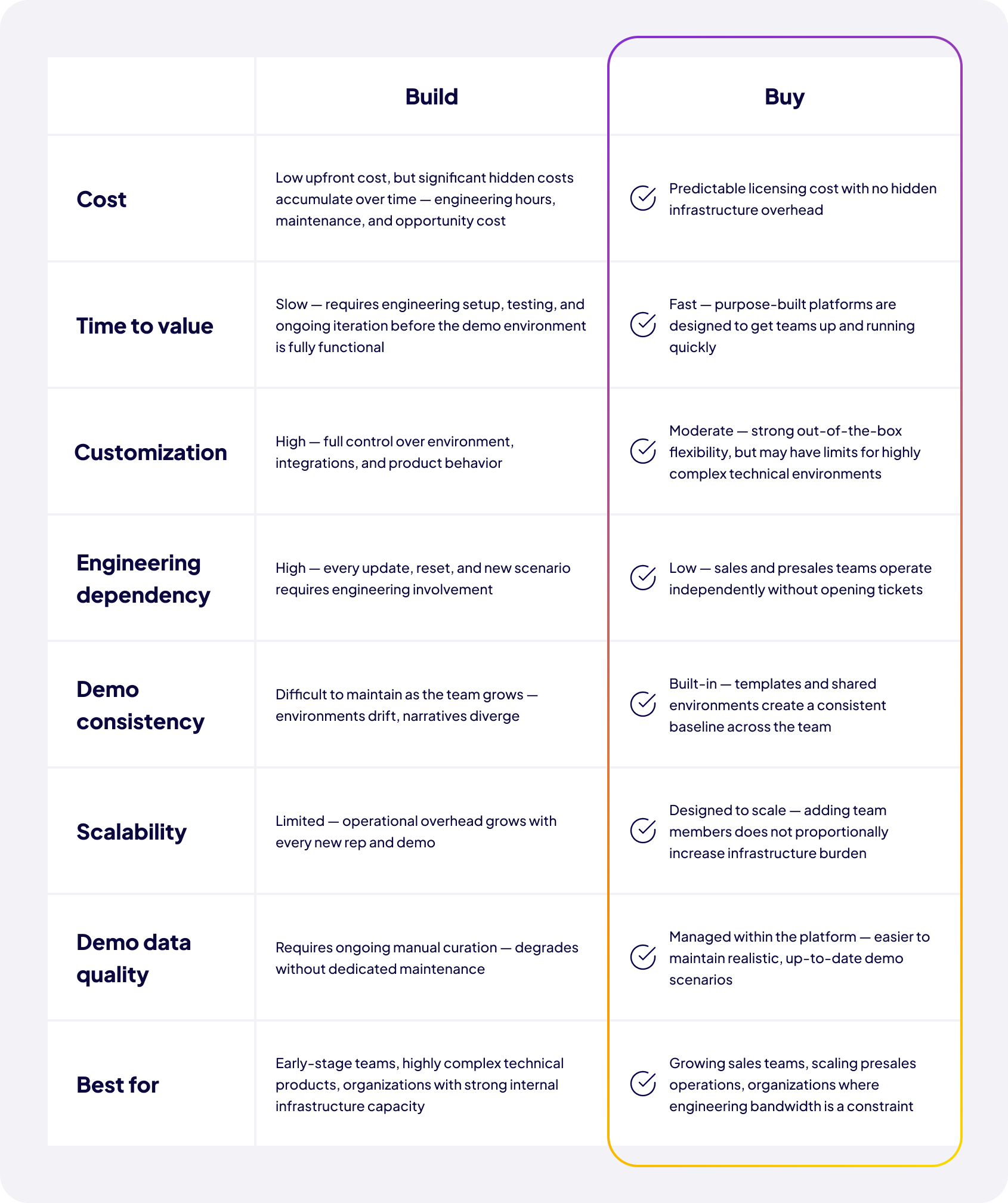
Demo environments need constant attention. Every time a new feature ships, someone needs to update the demo. Every time the environment breaks — and it will — someone needs to fix it. Every time the sales team wants a new scenario, someone needs to build it.
That someone is almost always engineering.
Voxel, a computer vision and safety platform, experienced this directly. As a tenant within their own production infrastructure, maintaining a functional demo environment required ongoing engineering effort. Resources that should have gone toward product improvements were being diverted to demo upkeep instead. Their team described it as a cascading problem — and that framing is accurate. When engineering is on the hook for demo maintenance, the cost is not just the hours spent. It is everything those hours could have built instead.
A demo environment is only as good as the data inside it. Realistic, believable demo data — the kind that makes a prospect think "this is exactly our situation" — does not maintain itself.
One Demoboost customer in the healthcare SaaS space ran a demo environment where production changes were mirrored to a demo instance that had to be manually wiped and reseeded with synthetic data every week. Week after week, someone had to make sure the environment looked credible enough to put in front of prospects.
The result of skipping or rushing that process is predictable: demos populated with placeholder data, empty fields, or scenarios that do not reflect real-world usage. For a prospect evaluating whether your product can handle their complexity, a thin demo is a red flag — even if the product itself is capable.
Even with a functioning environment and clean data, the pre-call ritual remains. Configuring accounts, setting up the right product scenario, inserting demo data, checking that nothing is broken from the last session — a single demo can easily require 20 to 30 minutes of preparation before the call even begins.
Individually, that is manageable. Multiplied across a team of five sales engineers running three demos a day, it becomes thousands of hours per quarter spent on setup rather than selling. And that is before accounting for the resets required after each session, or the time spent troubleshooting when something goes wrong mid-demo.
As the sales team grows, so does the number of people touching the demo environment — and the number of ways it quietly diverges from itself.
Individual reps make small customizations to suit their own style or a specific prospect. Datasets drift. Narratives across the team start to conflict. What was once a controlled, consistent demo experience becomes something that looks slightly different depending on who is running it and what state the environment happens to be in that day.
This is not just a quality problem. It is a coaching and management problem. When demos cannot be standardized, they cannot be improved systematically — and every new hire has to figure out the demo environment from scratch.
Not every team will recognize themselves in the patterns above, and that is worth acknowledging.
For early-stage startups with small, tightly integrated sales and engineering teams, building internally can remain a practical and cost-effective approach. When there are only two or three people selling and the product is still finding its shape, the overhead of adopting and learning an external platform may genuinely outweigh the benefit.
Similarly, for products with highly complex or specialized technical environments — those requiring deep internal integrations, custom infrastructure configurations, or tightly controlled data environments — a purpose-built demo tool may not offer the level of customization needed. In those cases, internal builds can be the more viable path, provided the engineering capacity to support them exists and is sustainable.
The key question is not whether building is possible. It is whether it is still the most efficient use of your resources given where your sales organization is today.
Each of the challenges described above — engineering dependency, fragile demo data, manual preparation, and inconsistency across the sales team — stems from the same root cause: demo environments were never designed to operate as a scalable part of the revenue engine.
Purpose-built demo platforms change that.
They are designed around a simple shift in ownership. Instead of relying on engineering to build and maintain demo environments, they put control directly in the hands of sales and presales teams — the people who actually use them.
In practice, this means that environments can be created, cloned, and tailored to specific prospects without writing code or waiting for development cycles. Teams can work with reusable templates that reflect different industries, use cases, or product narratives, and reset them instantly between calls. Updates no longer require engineering bandwidth, and new scenarios can be introduced as the sales strategy evolves — not when roadmap capacity allows.
The operational impact is immediate and measurable. Preparation time drops from 20–30 minutes to a matter of minutes. Demo consistency improves because teams work from shared, controlled environments rather than individual setups. Engineering teams are no longer pulled into demo maintenance, and as the sales organization scales, the demo process scales with it — without multiplying internal overhead.
But the more meaningful shift happens at the level of how demos are delivered.
When the mechanics of environment setup are no longer a constraint, teams can focus on what actually drives outcomes: understanding the prospect, shaping the narrative, and adapting the demo in real time. Instead of working around the limitations of the environment, they can design experiences that reflect the buyer’s context more closely — and do so consistently across the team.
This is where purpose-built platforms create the most value. They do not replace thoughtful demo design or strong sales execution. They create the conditions in which both can happen reliably, at scale, and without the operational friction that typically holds teams back.
If you are currently building and maintaining your demo environment internally, the most useful way to assess that decision is to translate your current process into time, ownership, and cost.
Start with engineering involvement. How much time is spent each month on demo-related work — updates, resets, bug fixes, and building new scenarios? More importantly, what is not being built because of it?
Then look at the sales side. How long does it take the average sales or presales team member to prepare a demo before a call? How much of that time is spent on setup rather than thinking through the narrative, the use case, or the specific context of the prospect?
Consistency is another signal. Do demos look and feel the same across your team, or do they depend on who is delivering them and what state the environment happens to be in? And if a new hire joined tomorrow, how long would it take them to confidently run a demo without support?
Finally, consider scale. If your sales team doubled in size over the next twelve months, would your current demo infrastructure support that growth — or would the operational burden grow with it?
These are not trick questions. For some teams, they will confirm that building internally is still the most practical approach. For others, they will make visible a set of costs that have been absorbed gradually — and make it clear that what once worked is no longer sustainable in the same way.
The build vs. buy decision for demo environments is not a question of which option is objectively better. It is a question of what your organization actually needs at this stage of growth — and whether the infrastructure you built for an earlier version of your company is still fit for purpose today.
Building internally made sense when it was the right choice. The question worth asking now is whether it still is.
For teams with significant engineering capacity and genuinely complex technical requirements, maintaining an internal demo environment may remain the most practical path. But for most SaaS companies scaling their sales motion, the hidden costs of that approach — engineering overhead, demo data maintenance, manual preparation time, and consistency challenges — add up faster than they appear on any single budget line.
Purpose-built demo platforms do not replace good sales judgment. They remove the operational friction that gets in the way of it. For many growing teams, that is the point where control stops being an advantage — and starts becoming a cost.
At a certain point, the question is no longer whether you can build and maintain your own demo environment. It is whether doing so is still the most effective use of your time, resources, and focus.
If you’ve decided that building a demo solution in-house isn’t the right path, the next step is choosing a platform that fits your team, use case, and scale.
Compare how leading demo platforms stack up:
Choose the one that matches how your team actually runs demos.
Book a live demo to see how Demoboost helps your team cut demo prep time, qualify buyers faster, and focus on real opportunities.
Book a Live Demo

.png)
.png)
