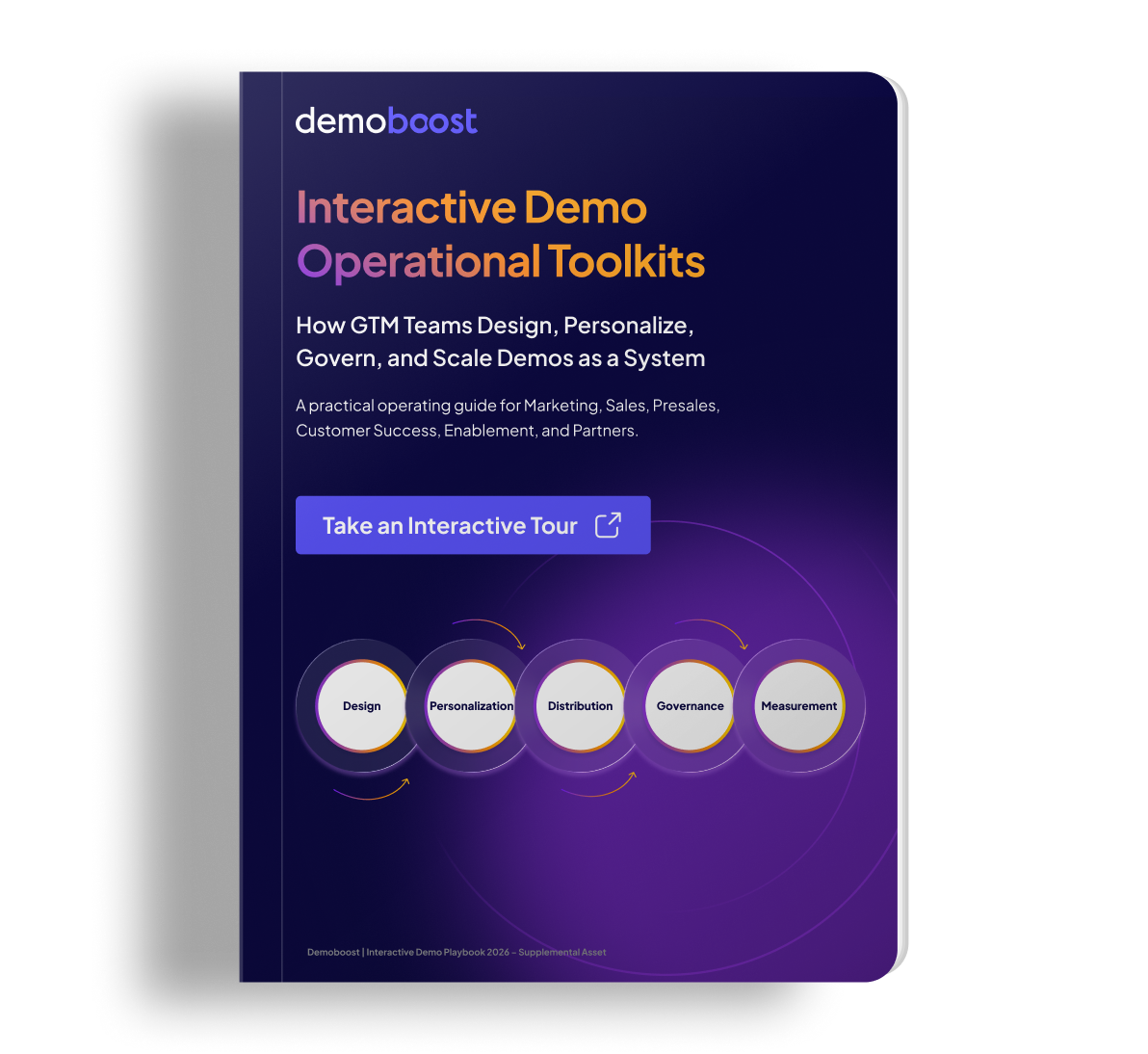
How to Use This Playbook
The rest of this guide is organized by buyer journey stage:
- Awareness
- Consideration
- Conversion
- Adoption
In each section, you'll find:
- Why demos matter at this stage
- Which GTM teams own them
- The demo types and features that work best
- Practical implementation steps using Demoboost
- The metrics and signals that actually matter
This isn't a theory. It's an execution guide for teams building demo programs that scale.
1. Why Demos Became GTM Infrastructure
For years, product demos lived in a box labeled "sales activity." They happened live, on demand, delivered by presales teams—but only after a buyer had already committed to a conversation.
That was fine when buyers followed a predictable path. But they don't anymore.
Today's B2B buyers research independently, loop in stakeholders from across the organization, and expect to experience your product long before they're ready to talk to sales. They move sideways through your funnel, jump between stages, and share what they find with colleagues you've never met.
In this world, demos aren't just a sales moment. They're a go-to-market system.
They educate prospects before the first meeting. They help champions sell internally. They onboard new customers and drive feature adoption. They enable partners to sell on your behalf.
Interactive demos now function as three things at once:
- A product experience layer for buyers
- An education layer for teams and partners
- A revenue enablement layer for your entire GTM organization
But to work at this level, demos need to scale beyond live meetings. They need to be relevant to different roles and use cases. They can't be rebuilt for every conversation. And critically, they need to be measurable—connected to pipeline, deals, and revenue.
This is why interactive demo automation has emerged as GTM infrastructure, not just a tactic.
2. Modern Buyer Journeys & GTM Constraints
How Buying Actually Happens Now
If you've been in B2B sales for more than a few years, you know the old playbook is dead.
Buyers don't discover your product through outbound, book a demo, sit through discovery, and then move neatly toward a decision. Instead, they:
- Find you through content, referrals, or competitors
- Explore your product independently before raising their hand
- Share what they learn with colleagues before you know they exist
- Circle back to earlier questions when new stakeholders get involved
- Make decisions as committees, not individuals
And those committees? They're not small. A typical mid-market or enterprise deal involves at least six to eight people, each entering the conversation at different times with different priorities:
- Decision makers (CEO, CRO, VP-level leaders who care about revenue, efficiency, and risk)
- Champions (the VP Sales or Head of Presales who's already sold internally on the idea)
- End users (the people who'll actually use the product every day)
- Enablement and ops teams (who need to train everyone and make it all work)
- IT, security, and legal (who evaluate feasibility, governance, and compliance)
- Partners (resellers or integrators who co-sell and influence the outcome)
Each of these people expects to experience the product. Not read about it. Not sit through a generic pitch. Experience it.
Why Most GTM Teams Can't Keep Up
The problem is, most GTM organizations weren't built for this reality. Here's what breaks:
Presales become a bottleneck.
Your SEs get pulled into every early-stage call, even when the prospect isn't remotely qualified. They spend hours setting up environments, personalizing demos, and answering the same questions over and over.
Discovery happens too late.
By the time you're demoing, you don't actually know what the buyer cares about. So you show everything and hope something sticks.
Demo environments are fragile.
They break. They need constant maintenance. Personalizing them for each deal takes forever, and when something goes wrong during a live call, it kills the deal momentum.
Messaging stays inconsistent.
Different reps, different regions, different partners—everyone tells a slightly different story about what your product does and why it matters.
Partners can't scale.
You want your channel to sell your product, but they don't have the training, the environments, or the confidence to demo effectively.
You have no visibility into what's working.
Demo activity is disconnected from pipeline data. You don't know which demos influence deals, which stakeholders engage, or what content actually moves buyers forward.
The result? Lower pipeline quality. Longer sales cycles. Burned-out presales teams. And friction—lots of it—for buyers and sellers alike.
3. What Interactive Demo Automation Solves
There's a fundamental question most B2B companies still haven't answered: Why are your reps doing all the work?
Your product exists. Buyers want to see it. Yet somehow, we've built an entire process around having salespeople describe what the product does instead of just... showing it.
The best GTM teams have realized something obvious: the product can qualify leads, educate buyers, and move deals forward—without requiring a salesperson to be in the room every single time. So the focus shifted from people delivering demos to products delivering experiences.
What Changes When Your Product Does the Work
When you automate the demo experience properly, three things happen fast.
Deals move faster.
Buyers don't wait for your calendar. They explore on-demand, learn at their own speed, and come to sales calls already educated. What used to take six months now takes three—not because you're pushing harder, but because the friction is gone.
Deal size grows.
When buyers can explore multiple products through interactive playlists, they discover solutions themselves. Your reps aren't limited to what they're trained to pitch. Cross-sell stops being a separate motion—it just happens.
Win rates improve.
Here's the thing about buying committees: they rarely all show up to the same meeting. But when each stakeholder can experience the product directly—on their schedule, focused on their priorities—value stops being theoretical. Objections come out earlier. Decisions get made with actual confidence.
The System Behind It
Interactive demo automation works because it solves a structural problem: you build the demo experience once, then use it everywhere.
You capture your product flows. You personalize them by role, industry, or deal stage. You distribute them across every channel—your website, email sequences, sales calls, partner portals. And critically, you measure what happens: which demos get viewed, which stakeholders engage, which ones influence the pipeline.
This replaces two things that don't scale:
Screen recordings sit there passively. They're outdated the day your UI changes. Buyers watch them, learn nothing interactive, and you get zero signal about what resonated.
Static product tours show everyone the same generic walkthrough. No context for their role. No connection to their use case. No insight into which parts they actually cared about.
Interactive demo automation takes what works from all three—visual product experiences, hands-on exploration, guided narratives—and makes it scalable, personalized, and measurable.
Here's what that means in practice:
- Buyers explore at their own pace, but you control the story and guide them toward value
- Personalization happens automatically—by industry, role, or where they are in the buying process
- Every interaction generates data that connects to your CRM, so you know which demos influence which deals
- The same core demo gets reused across awareness, sales, partner enablement, and onboarding
Suddenly, demos can do things they never could before:
- Educate buyers before they're ready to talk to sales
- Qualify prospects so your reps spend time on real opportunities
- Align buying committees across stakeholders who'll never be in the same room
- Enable partners to sell confidently without rebuilding demos from scratch
- Onboard customers so they actually use what they bought
All from one system.
4. Measuring Demo ROI: From Activity to Revenue Impact
Let's talk about a problem most teams ignore: you can't prove your demo program is working.
Sure, you can count how many demos you delivered or how many requests came in. But those are activity metrics. They don't tell you if demos are influencing revenue.
And if you can't tie demos to revenue, you can't optimize them. You can't justify investment. You can't scale intelligently.
Interactive demo automation fixes this. It makes demo influence measurable and attributable in ways traditional demos never were.
Why "Demos Delivered" Doesn't Mean Anything
Most teams track the wrong things. They measure:
- Number of demos delivered
- Number of demo requests
- Time spent in demos
These might feel important, but they don't answer the questions that matter:
- Are demo-engaged deals closing faster?
- Do buyers who interact with demos convert at higher rates?
- Is your demo program reducing CAC or just adding to it?
- Are demos driving better customer outcomes after the sale?
Activity doesn't equal impact. You need to connect demos to actual business outcomes.
The Four Dimensions of Demo ROI
To measure interactive demo ROI properly, track how demos influence revenue across these four areas:
1. Pipeline Generation & Quality
Not all leads are created equal. Demos help you generate better ones.
Track:
- MQL-to-SQL conversion rates (demo-engaged vs. not)
- Pipeline velocity (how fast leads move from awareness to opportunity)
- Opportunity quality (deal size, stakeholder engagement, fit scores)
2. Sales Efficiency & Productivity
Demos save time. Lots of it.
Track:
- Reduction in unqualified meetings (demos filter out tire-kickers)
- Presales capacity freed up (AEs handle intro calls without SE support)
- Time saved per deal (fewer repetitive demo requests)
- Self-serve qualification (buyers disqualify themselves early)
3. Win Rates & Deal Velocity
This is where ROI gets real. Do demo-engaged deals close faster and at higher rates?
Track:
- Close rates: demo-engaged opportunities vs. baseline
- Sales cycle length: deals with early demo touchpoints vs. without
- Deal size: expansion driven by demo-based product discovery
Customer Success & Expansion
Demos don't stop working after the sale. They drive adoption, reduce churn, and create expansion opportunities.
Track:
- Time-to-value (how fast customers onboard with demo-based learning)
- Feature adoption rates (demo viewers vs. non-viewers)
- Support ticket deflection (knowledge base demos reducing support load)
- Net Revenue Retention impact (expansion demos driving upsells)
What Good Demo ROI Looks Like
The financial case for demo automation comes from two sources: revenue acceleration and cost reduction.
Revenue acceleration:
- Higher conversion rates at every funnel stage
- Shorter sales cycles compounding revenue per rep
- Larger deals from better product discovery
Cost reduction:
- Lower CAC through demo-driven qualification
- Presales efficiency (more deals per SE)
- Reduced support costs through self-serve learning
Making Attribution Real
To measure any of this, you need to connect demo engagement to your CRM and revenue data.
That means:
- Tagging opportunities with demo touchpoints
- Tracking which stakeholders engaged at the account level
- Attributing influenced pipeline and revenue to specific demos
- Comparing cohorts (demo-engaged vs. not) across every metric that matters
Demoboost does this natively. Demo engagement syncs to CRM opportunities. You can track individual and account-level behavior. You get opportunity-level dashboards showing exactly which demos influenced which deals.
The result: Demos become a measurable revenue channel, not a marketing expense.