
.png)
Learn how presales is evolving and howyour team can stay ahead in atech-driven sales landscape.

Most sales teams already know that live demos and interactive demos both have a role. The real questions are more specific: what is the right balance, what is the right sequence, and what should you actually be presenting when you are in that meeting?
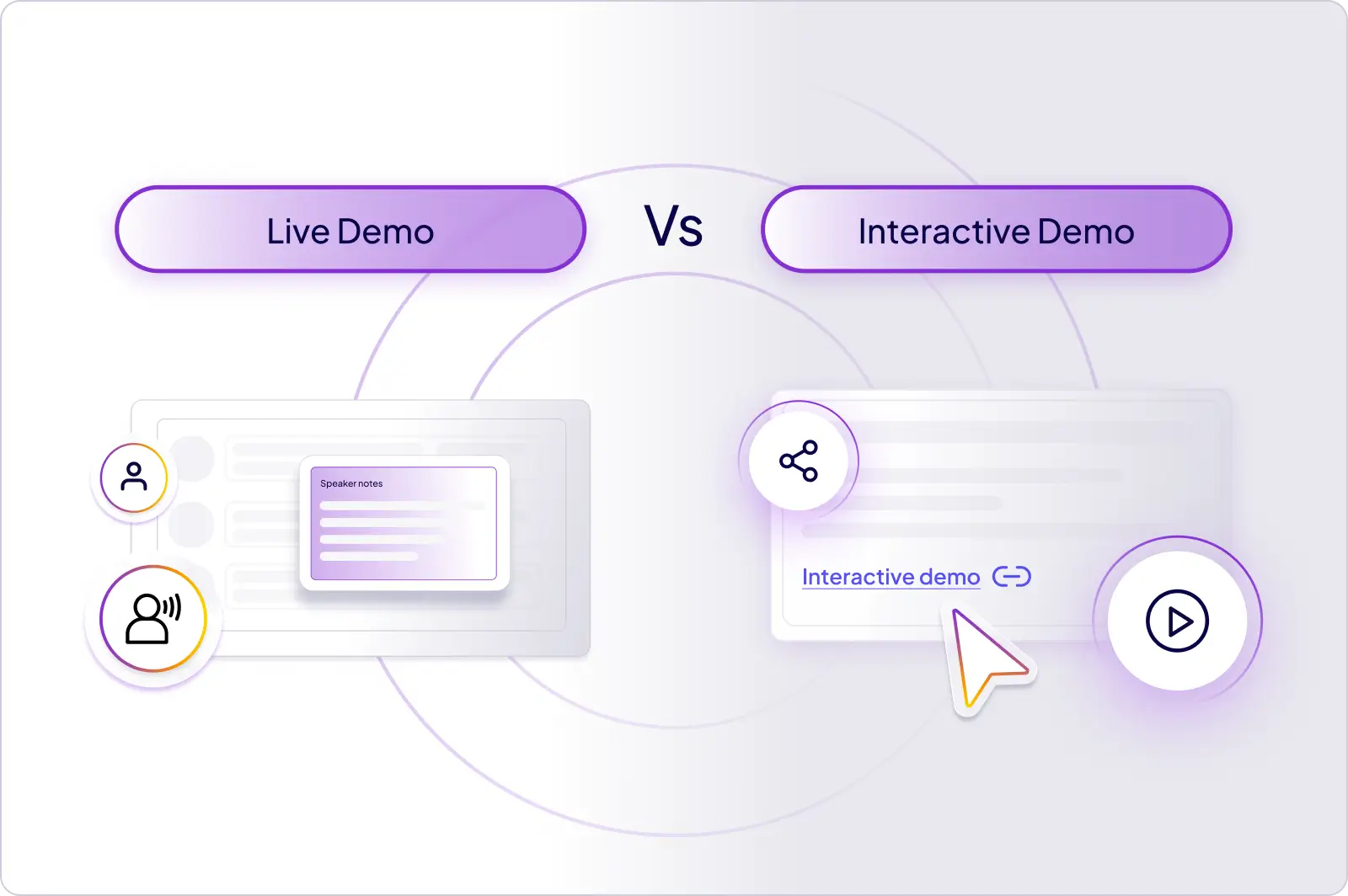
A live demo is a meeting. An interactive demo is the controlled layer teams use to present, personalize, share, and track the product story — before that meeting, during it, and after it ends. The live demo answers "how do we have the sales conversation?" The interactive demo answers "how do we control, personalize, share, and track the product story?"
That distinction matters in 2026 because AI is not replacing the live sales conversation. It is making the surrounding demo workflow faster: easier to personalize, translate, narrate, update, and turn into a shareable asset the champion can use to sell internally.
The best teams are not debating live demos versus interactive demos. They are using interactive demos to run better live demos, qualify buyers before the call, and help champions reach stakeholders who were never in the room.
This article is for presales leaders, solutions engineers, and sales managers who run live demos as their primary motion and want to understand how interactive demos — and AI — fit into that workflow without disrupting it.
For teams building a structured demo program around a live demo motion, the Demoboost interactive demo playbook is the right starting point.
The phrase "live demo vs interactive demo" implies a choice between two competing formats. It is the wrong frame — and the teams that treat it as a genuine either/or tend to underuse both.
A live demo is a meeting. It is the real-time conversation where relationships are built, edge cases get answered, and deals advance. For teams with dedicated presales and SE functions, this is the primary motion. It is not being replaced.
An interactive demo is a tool — one that can operate as a presentation layer inside a live call, as a qualification mechanism before the meeting starts, or as a shareable asset that continues the buying conversation after it ends. It works with the live demo motion, not against it.
The right question for 2026 is not which format wins. It is: how do interactive demos make the live demo motion work harder?
This distinction is where a lot of demo strategy goes wrong.
When teams say "we run live demos," they usually mean two things at once: (1) we have a live meeting with the prospect, and (2) we present in a live product environment during that meeting. These are not the same thing, and conflating them is expensive.
The meeting — the real-time conversation with a rep or SE present — is irreplaceable for mid-market and enterprise deals. The relationship built in that session, the rep's ability to adapt to what the buyer actually cares about, the trust developed through live Q&A: none of this is automated away.
What is worth examining is the second part: what is being presented during that meeting?
Presenting directly from a live product environment introduces unnecessary risk. Production bugs, unexpected UI changes, and slow load times happen — and when they happen during a sales call, the credibility hit is immediate. This is the problem that using an interactive demo as the presentation layer solves. The meeting stays live. The presentation layer becomes controlled, stable, and governed.
Real-time Q&A. Buyers can ask about edge cases, integrations, specific workflows — and get an answer immediately. No on-demand format replicates this.
Relationship-building. For mid-market and enterprise deals, the connection between the SE and the buyer's technical team is itself a factor in the decision. A live call builds something async formats cannot.
Adaptability. The rep reads the room in real time and adjusts. If a buyer shows strong interest in one area or confusion about another, the live session pivots immediately.
Credibility for complex products. When a product is genuinely complex and evaluation requires live dialogue about real use cases, an SE with deep product knowledge signals competence in a way a click-through tour cannot.
They don't scale without headcount. Every live demo requires a human. The output is capped by the size of the presales team.
Scheduling friction creates delay. Every reschedule is a window for a competitor with a shareable on-demand demo to engage the buyer on their own timeline.
Inconsistency is a structural problem. One SE closes at 40%. Another closes at 15%. The difference is often demo quality. Live demos make that variance impossible to control at scale unless every rep is presenting from the same governed template.
Stakeholders beyond the first call are invisible. Decision-makers who didn't attend the live session are making purchasing decisions based on second-hand information. There is no visibility into their questions, objections, or level of engagement.
An interactive demo is a controlled product experience that lets teams present, guide, or share a product story without relying on a live production environment.
In an on-demand context, the buyer explores it independently in a browser — no rep required, no scheduling needed. In a live context, the SE uses it as the presentation layer during the sales call, guiding the buyer through a structured product story while still handling questions in real time.
Interactive demos exist on a spectrum. Lightweight click-through tours work well for website embedding and early-stage product awareness. At the higher end, sandbox environments replicate complete product workflows — buyers can explore complex functionality, enter data, and experience realistic navigation without accessing a live production environment.
For presales teams specifically, interactive demos serve three distinct functions: as a pre-call qualification mechanism, as the presentation layer inside a live session, and as a post-call asset for champion-led internal selling. Each of these is covered in detail in the sections below.
Recorded video demos are a separate, lighter format within the broader on-demand category. A video is passive — the buyer watches but does not interact. Videos work well for top-of-funnel awareness and simple product explanations. They sit at the lighter end of the on-demand spectrum, while interactive and sandbox demos occupy the higher-fidelity end where qualification and presales work happens.
AI has made interactive demos faster to produce, personalize, translate, narrate, and update. It has not changed the fundamental role of the live demo.
The live demo remains the real-time sales conversation. AI does not replace the SE's ability to read the room, answer edge-case questions, build trust, or adapt to what a buyer actually cares about in that session.
What AI changes is the operating model around that conversation. Teams can now create more relevant demo assets faster — with industry-specific data, persona-specific storylines, localized language, updated dates, and tailored visual context — without rebuilding every demo manually.
That means AI strengthens all three stages of the demo workflow:
What AI does not change about personalization:
Showing a prospect relevant industry data, the right persona, appropriate datasets, and current dates has always been what good demo prep looks like. The best SEs have done this for years without AI. What AI changes is the time it takes — hours become minutes. The output is the same; the path to it is faster.
The most useful way to think about interactive demos in a live demo motion is not as an alternative to the meeting — it is as the layer that makes each stage of the meeting more effective.
A self-guided interactive demo sent before the discovery call — or embedded on the website for inbound traffic — educates buyers on the product's core value before anyone has scheduled a call.
Buyers who arrive at a live session having already explored the product skip the orientation phase. They ask better questions, they are further along in their evaluation, and the discovery call can move directly to the parts of the conversation that matter for the decision.
The qualification layer goes further. Platforms like Demoboost support a Choose Your Own Journey mechanism — where the buyer selects their use case from a structured menu before exploring the demo. The SE receives a pre-call engagement summary in their CRM: what the prospect selected, what they engaged with, how long they spent. Discovery starts with this data, not from zero.
This is the shift that most directly affects live demo quality — and it is often the least visible in format comparisons.
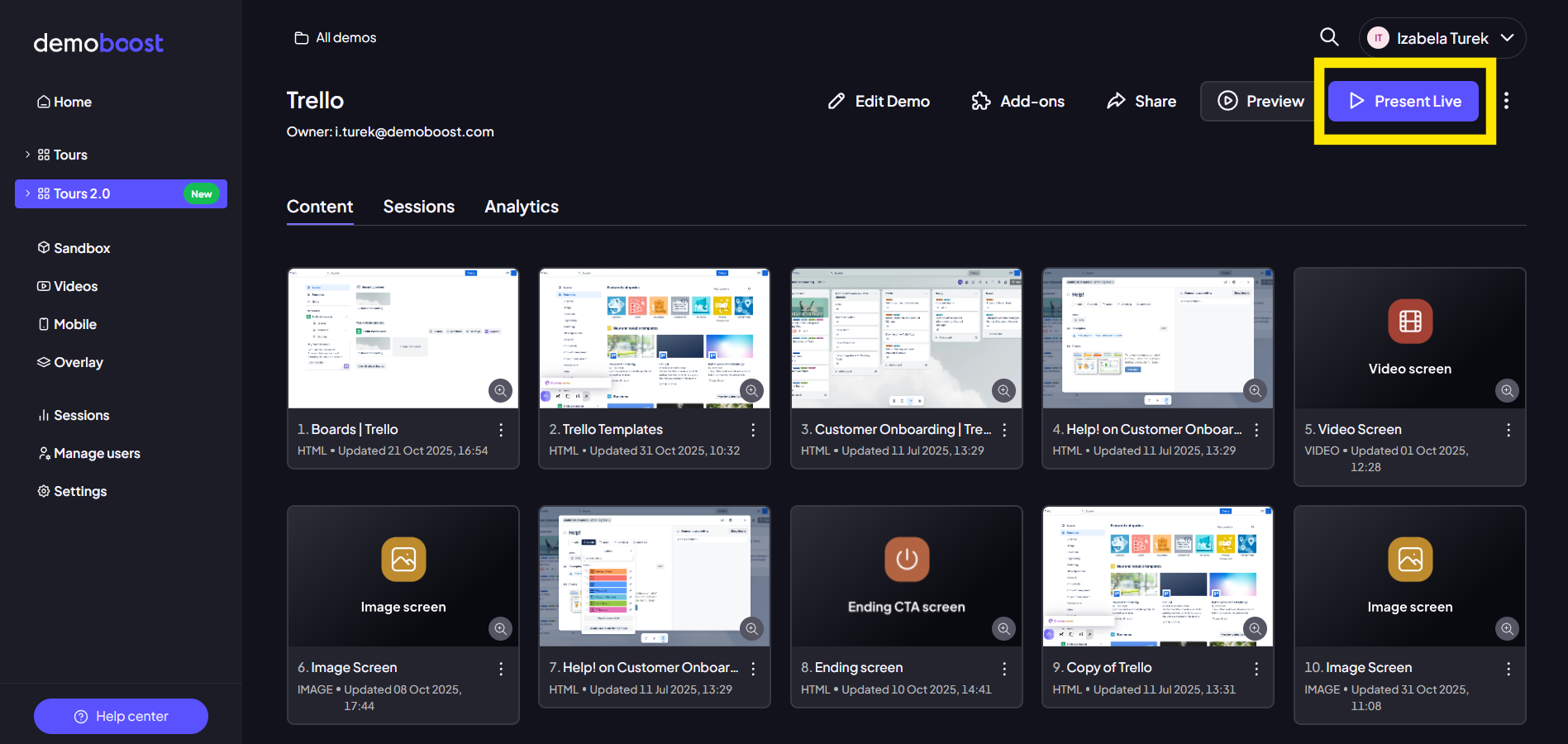
Using an interactive demo as the presentation tool inside a live call keeps all the benefits of the meeting (real-time Q&A, relationship, adaptability) while eliminating the risks of a live product environment (bugs, downtime, UI changes in production). The SE is still driving. The conversation is still live. The presentation layer is controlled.
Speaker notes surfaced alongside each demo screen keep reps on message. New hires ramp faster. Senior SEs deliver more consistently. And when the meeting ends, the same demo is automatically available as a post-call share — no additional production required.
After a live call, the champion typically needs to bring additional stakeholders into the evaluation. In a live-demo-only workflow, this usually means a slide deck, a recording, or a second call. None of these scale, and none of them track who actually engaged.
A shareable interactive demo solves this. The champion gets a link to distribute internally. Each stakeholder who opens the link is tracked at the individual level — sales sees who engaged, what they looked at, and how long they spent. The buying committee that was invisible after the first call becomes visible. That is a qualification signal the live session alone cannot produce.
The practice of presenting via a structured interactive demo inside a live call — rather than directly from a live product environment — is increasingly standard among high-performing presales teams. It is worth understanding why.
Consistency across the team. When every SE presents from the same governed demo template, the best story becomes the standard story regardless of which rep is on the call. Win rate variance across individuals drops because the narrative is no longer dependent on individual performance.
No technical risk from production. The demo environment is stable. The buyer sees the product's best state — not whatever happened to be deployed in production that morning.
Speaker notes and scripting. Structured demo tools surface speaker notes alongside each screen, keeping reps on message without relying on memory. This is particularly valuable for new hires and for complex multi-persona demos where the narrative needs to shift based on who is in the room.
The demo becomes a shareable post-call asset automatically. The same interactive demo used in the live call can be sent to the champion immediately after — no additional production work, no additional version to maintain.
Governance and approvals. Presales leaders control what goes into the demo library, when demos are archived, and which version is current. Nobody presents from an outdated or off-message demo without knowing it.
On-demand interactive demos in a structured demo program serve two distinct roles outside the live meeting. Both are high-value; neither requires changing the primary live demo motion.
A self-serve interactive demo — embedded on the website, sent in an outbound sequence, or triggered after a prospect books a call — qualifies intent before the meeting. Buyers self-select their use case. Sales receives engagement data. Discovery starts informed.
This is not about replacing the meeting. It is about making the meeting more productive by removing the orientation phase from the first call entirely.
Enterprise deals usually involve multiple stakeholders, many of whom never attend the live demo. The champion is selling internally between every live call — and in a live-demo-only workflow, they are doing it with slides and verbal descriptions.
A post-call interactive demo changes this. The champion shares a link. Every stakeholder who opens it is tracked at the individual level. Sales now knows who in the buying organization has engaged with the product, which sections they spent time on, and whether they have returned. That intelligence shapes follow-up strategy and surfaces risk before it derails the deal.

The live demo leads where human conversation matters most: trust, real-time Q&A, adaptability, and complex evaluation. The interactive demo leads where scale and visibility matter most: pre-call education, post-call sharing, stakeholder tracking, and consistent presentation. These are not competing rows — they are complementary ones.
Technical failure during the call. Bugs, slow load times, and unexpected UI changes in a live product environment happen at the worst moments. The solution is presented via a structured interactive demo rather than a live environment — the demo layer is controlled regardless of what is happening in production.
No-shows and rescheduling. Each reschedule is a delay. Each delay is a window for a competitor with a shareable on-demand demo to engage the buyer. No-show rates above 20% signal that scheduling friction is actively costing pipeline.
Inconsistency across reps. Win rate variance that exceeds 15 percentage points across the SE team usually has demo quality as a contributing factor. The solution is not better hiring — it is governed demo templates that every rep presents from, with the same story, the same sequence, and the same speaker notes.
Invisible stakeholders. Decision-makers who did not attend the live demo are making purchasing decisions based on what the champion told them. Post-call interactive demos with contact-level tracking make those stakeholders visible before the deal closes.
Low engagement without proper guidance. A self-guided demo with poor copy, too many steps, or no clear narrative gets abandoned before the buyer reaches the value moment. Completion data tells you where drop-off happens — use it to improve.
Generic experience without personalization. An interactive demo that shows everyone the same story regardless of persona or industry is less compelling than one that reflects the buyer's context. Relevant industry data, the right persona, appropriate datasets, and current dates are the standard for effective demo personalization — AI makes producing this faster, not different.
The highest-risk approach is treating the live demo as both the first and last touchpoint. Without a pre-call qualification layer, discovery starts cold. Without a post-call shareable demo, the buying conversation stops at the edge of the room. The result is more meetings needed per deal, slower cycles, and a buying committee that remains largely invisible to sales.
Live demos and pipeline velocity. A live-demo-only program creates a linear bottleneck: every qualified lead needs a human to advance. At scale, this means longer time-to-demo, more deals waiting, and a higher sales cost per closed deal. Adding a pre-call qualification layer and a post-call share removes both bottlenecks without changing the primary motion.
Interactive demos and lead quality. Buyers who engage with a qualification demo before a live call arrive measurably more prepared. They have answered their own basic questions. Discovery can focus on deal-specific qualification rather than product orientation. Calls run shorter and advance further.
The real cost of presenting in a live environment. SE prep time, call logistics, note-taking, follow-up, and CRM work mean a single live demo often represents four to six hours of total effort. Governed interactive demo templates reduce the per-demo prep load significantly — SEs customize a template rather than rebuilding from scratch for each account. That time compounds across a quarter.
Post-call stakeholder discovery. Enterprise deals involve an average of six to ten stakeholders. Most never attend a live demo. A post-call interactive demo with contact-level tracking shows sales exactly who in the buying organization has engaged — often revealing stakeholders the champion never mentioned. That intelligence changes follow-up strategy and surfaces risk early.
Analytics as a sales signal. When a stakeholder spends three minutes on the security section and skips the reporting module, that is actionable. When they return to the demo twice in a week and share it with two colleagues, that is a buying signal. Live demos generate notes. Interactive demos generate data.
If SEs are presenting directly from a live product environment, the transition to presenting via a governed interactive demo template improves consistency and eliminates technical risk without changing anything about the meeting itself. The call stays live. The presentation layer changes.
If sales has no insight into what happens internally after a live demo, a post-call interactive demo with contact-level tracking is a high-priority addition. The value is not in the demo itself — it is in knowing who else in the buying organization has seen it.
If the best rep and the newest hire are telling different stories in their live calls, governed demo templates with speaker notes are the structural fix. The best narrative becomes the standard narrative regardless of who is on the call.
If demo volume is growing faster than SE headcount, pre-call qualification demos must be in the workflow. They absorb early-stage inbound without consuming SE time, and the engagement data they produce makes each live call more productive.
If the market spans multiple time zones, pre-call interactive demos remove scheduling friction by default. AI translation extends this globally — one demo template, 170+ languages, no additional production work.
Demoboost's AI capabilities are built around the production workflow — accelerating the steps between "I need a demo for this account" and "the demo is ready." The fundamentals of what makes a demo persuasive do not change. The time it takes to produce one does.
Any visual element inside a demo — buttons, images, headlines, layouts, data in charts — can be updated using a natural language prompt. No coding required. An SE preparing for a logistics prospect updates the product UI to reflect that industry's terminology and visual context in minutes, not hours.
Rather than adapting a generic demo flow for each account after the fact, teams build distinct demo narratives organized by persona, industry, or use case. Each storyboard encodes the right sequence, emphasis, and language for that segment — presales expertise that moves from individual SEs into a governed, deployable architecture the whole team can activate. The best story stops living in one person's head and starts living in a template every rep can use.
Placeholder numbers that do not reflect a prospect's world undermine credibility. AI-assisted screen editing replaces generic dummy data with industry-relevant figures, scenario-specific metrics, and contextually appropriate content. No developer access required.
Find more AI insights in our AI playbook
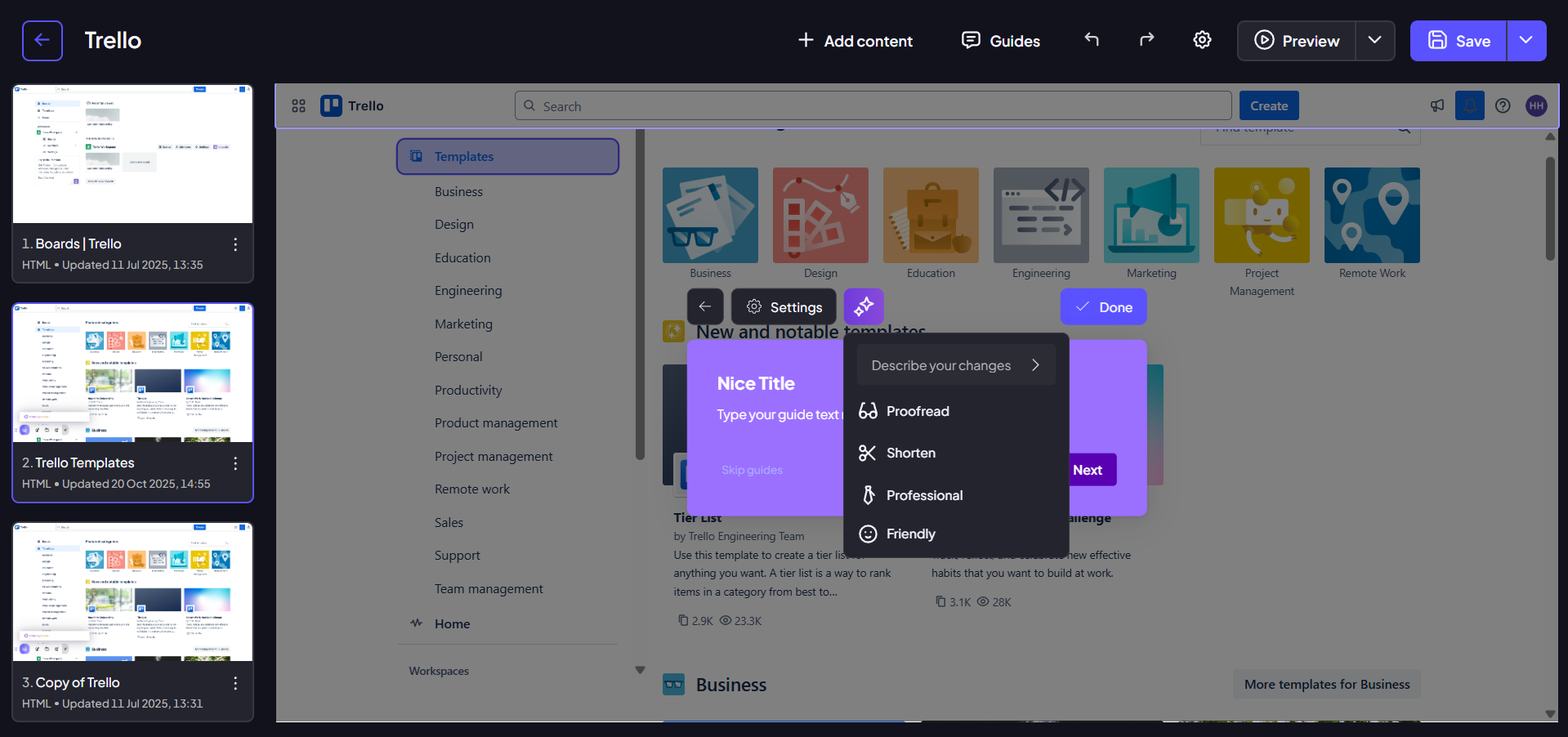
Tooltip and instruction copy is rewritten across four modes — Proofread, Shorten, Professional, Friendly — in a single action. Consistent, polished guide copy across every demo regardless of who built it.
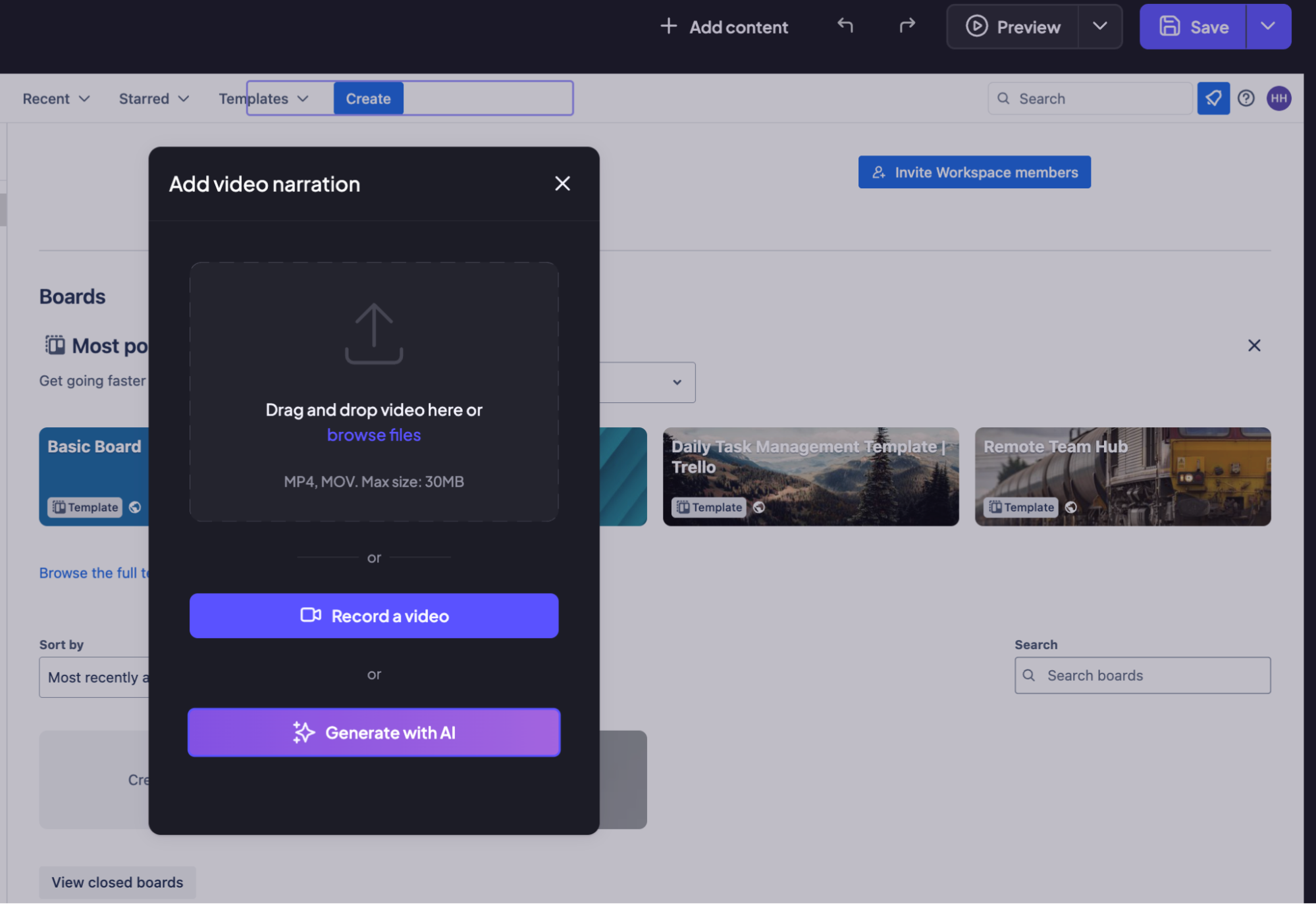
Professional video narration generated via Synthesia or HeyGen integration without a recording session. Consistent presenter voice at scale.
KPIs, charts, and dashboards inside demo templates are edited directly — adjusting values, labels, and visual formatting to match a specific prospect's scenario without using real customer data.
Demo UI, guide copy, tooltips, and speaker notes translate automatically from a single template. One demo, all markets, no translation team required.
For presales teams building a structured demo program around a live demo motion, five criteria separate platforms that deliver from those that don't.
Live presentation support. Does the platform work well as the presentation layer inside a live meeting? Speaker notes, structured navigation, and controlled demo flows are essential when an SE is presenting to a prospect in real time.
Template governance. Can presales build approved templates that reps customize without rebuilding from scratch? Role-based permissions and demo lifecycle management prevent sprawl and keep the library current.
Contact-level analytics. Feature-level engagement tracking that identifies individual viewers is what turns post-call demos into qualification signals. Session counts are not enough — sales needs to know who viewed, what they engaged with, and when they returned.
CRM integration. Demo engagement data is most valuable when it flows automatically into Salesforce or HubSpot, where it triggers follow-up sequences and informs pipeline prioritization.
AI production capabilities. AI editing, narration, translation, guide refinement, and synthetic data adaptation determine how quickly the team can produce personalized demos at volume.
Strengthen live calls by:
Add value before the meeting by:
Extend the meeting's reach after it ends by:
The live demo vs interactive demo question is ultimately a workflow question, not a format debate.
For teams with dedicated presales and SE functions, the live demo is the primary motion. It is where relationships are built, complex products are evaluated, and deals advance. Demoboost is built for exactly these teams — not as a replacement for the live meeting, but as the platform that makes each part of the demo workflow more effective.
Interactive demos strengthen the live motion at every stage: qualifying buyers before the first call so discovery starts informed, serving as the controlled presentation layer inside the call so the story is consistent and the environment is stable, and enabling the champion to sell internally after the meeting ends so the buying committee that was never in the room becomes visible.
What AI has changed is how quickly teams can produce the demo assets that power this workflow. Relevant industry data, the right persona, updated dates, appropriate datasets — this has always been what effective demo personalization looks like. AI means the team produces it in minutes rather than hours. The fundamentals do not change. The operating cost of doing them well does.
For teams building a structured demo program around a live demo motion, the Demoboost interactive demo playbook is the right place to start.
1. What is the difference between a live demo and an interactive demo?
A live demo is a real-time meeting where a sales rep or SE presents the product and handles questions on the spot. An interactive demo is a self-guided experience the buyer explores on their own timeline, with no rep required. Critically, these are not mutually exclusive: the best presales teams use interactive demos as the presentation layer inside live calls — keeping the meeting live while eliminating the risks of a live product environment.
2. Should you use a live demo or an interactive demo?
For most B2B sales teams with dedicated presales functions, the answer is both — in sequence. Interactive demos qualify buyers before the meeting, serve as the stable presentation layer during it, and enable champions to share the product internally after it ends. The question is not which format to choose — it is where each one does its best work.
3. Can interactive demos replace live demos?
No — and that is not what they are for. The live demo is the meeting: the real-time conversation, the relationship, the SE's ability to adapt to the buyer in the room. On-demand interactive demos work around that meeting, not in place of it. For presales teams whose primary motion is the live demo, interactive demos extend the value of each meeting without disrupting the motion.
4. Why do high-performing presales teams present via interactive demos in live calls?
Because presenting from a live product environment introduces unnecessary risk. Production bugs, unexpected UI changes, and slow load times happen — and when they happen during a sales call, the credibility hit is immediate. An interactive demo used as the live presentation layer is stable and controlled regardless of what is happening in production. It also delivers consistent story quality across every rep, surfaces speaker notes to keep the SE on message, and automatically becomes a shareable post-call asset.
5. How do interactive demos help with stakeholders who were not on the live call?
After a live session, the champion needs to bring additional stakeholders into the evaluation. A post-call interactive demo sent as a shareable link lets those stakeholders explore the product on their own timeline. Contact-level engagement tracking shows sales exactly who opened the demo, what they engaged with, and when they returned — turning invisible stakeholders into visible buying signals.
6. What does AI actually change about interactive demos?
AI accelerates production — it does not change what good personalization looks like. Showing a prospect relevant industry data, the right persona, current dates, and appropriate datasets has always been the standard for effective demo prep. AI means teams produce this result faster: updating visuals, copy, and data with a natural language prompt rather than hours of manual work. The output is the same; the path to it is shorter.
7. How do interactive demos help shorten the sales cycle?
Primarily by improving what happens before and after the live meeting. Pre-call qualification demos mean discovery starts informed rather than from zero, compressing the orientation phase. Post-call shareable demos keep the buying conversation active between live sessions. Together, these reduce the number of calls needed per deal and the total time between first engagement and decision.
8. What is a Demo Qualified Lead (DQL)?
A Demo Qualified Lead is a prospect who has demonstrated genuine purchase intent through their demo engagement behavior — returning to a demo multiple times, spending significant time on specific sections, or sharing the demo with additional contacts from their organization. DQLs are a more reliable indicator of purchase readiness than traditional MQL scoring because they are based on product engagement behavior, not content consumption.
9. What is the best software for building interactive demos in 2026?
It depends on the use case and team structure. For presales teams who need live presentation capability, governed templates, pre-call qualification, and post-call analytics — all connected to pipeline data — Demoboost is built specifically for that combination. For self-serve marketing tours and PLG website embedding, Navattic and Storylane lead the category. For a full comparison, the best sales demo software guide covers the full category in depth.
10. How does Demoboost support both live and on-demand demo use cases?
Demoboost covers the full demo lifecycle for presales teams. Governed templates are used as the presentation layer in live calls — with speaker notes, structured navigation, and a consistent story. The same demo becomes a shareable post-call asset tracked at the contact level. Pre-call qualification demos use the Choose Your Own Journey mechanism to capture use-case selection before discovery. Every touchpoint connects to Salesforce or HubSpot as a pipeline signal. For a full walkthrough, see the Demoboost interactive demo playbook.
11. Can an interactive demo be used inside a cold email?
Yes — and it is one of the higher-converting uses of on-demand demos for outbound. A link to a personalized interactive demo gives the prospect a way to engage with the product immediately, without scheduling friction. Engagement analytics show who clicked and how far they explored, giving the rep a warm signal before the follow-up call.
12. How do you measure ROI from an interactive demo program?
Key metrics: time-to-demo from first request; qualified demo rate (demos resulting in a next step); demo-influenced pipeline; SE prep time saved per week; post-call stakeholder discovery rate (new contacts surfaced via champion sharing). For a full breakdown of how to build a demo-driven pipeline measurement framework, see the Demoboost interactive demo playbook.
Book a live demo to see how Demoboost helps your team cut demo prep time, qualify buyers faster, and focus on real opportunities.
Book a Live Demo

.png)
.png)
