.png)
Learn how presales is evolving and howyour team can stay ahead in atech-driven sales landscape.


You're evaluating demo automation software. You've done the research, sat through a couple of discovery calls, and now you're staring at the same three tools on every shortlist: Navattic, Storylane, and Demoboost.
Each of them will tell you they're the best. Each of them has impressive G2 scores and a polished website. And if you're reading this, you probably suspect the real differences are harder to find than a feature matrix suggests.
Navattic and Storylane are both legitimate platforms — they dominate this category for good reasons, and they show up on every comparison list because they've earned it. But "good platform" and "right platform for your team" are different things. The decision usually comes down to something more specific than feature count: what motion are you running, who's building the demos, and what happens to engagement data after a prospect clicks through.
This comparison is written for GTM teams actively shortlisting. We cover pricing, demo capture, sandboxes, AI, analytics, presales workflows, and governance — so you can walk away with a clear verdict, not more questions. We'll also tell you exactly where each platform falls short, including Demoboost.
Sales demo automation done right should connect demo engagement to pipeline outcomes — not just get a tour embedded on your website. That distinction is what separates the platforms here.
Let's get into it.
Platform summaries:
Key feature differentiators:
What the decision actually comes down to:
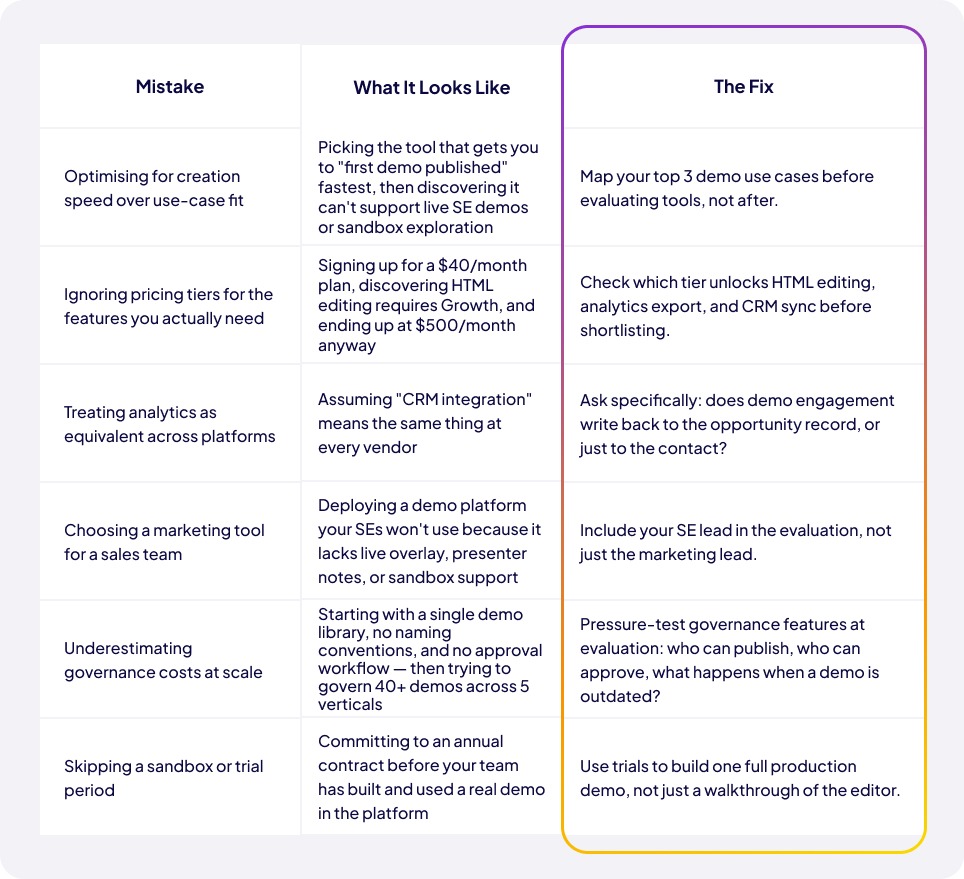
Common evaluation mistakes:
If your team is actively building or rebuilding a demo program, the Interactive Demo Playbook is the most practical starting point we've seen.
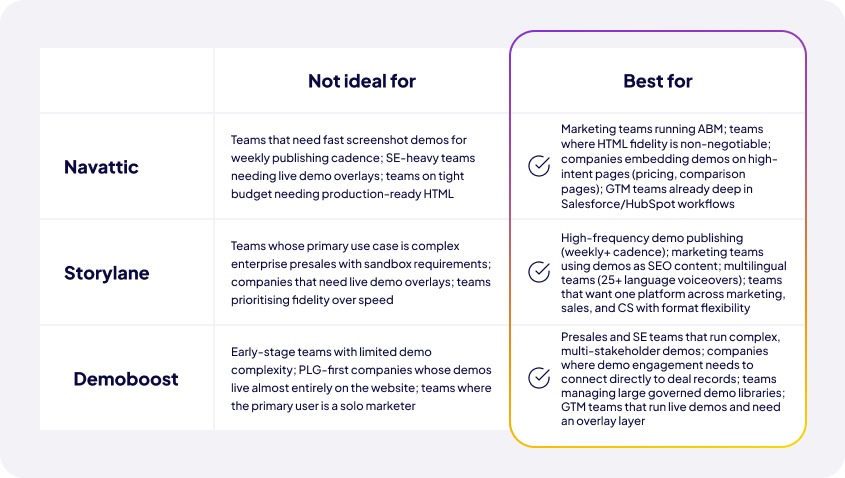
Navattic captures HTML/CSS exclusively. That means your demo is a pixel-perfect replica of your live product — hover states, animations, transitions, and dynamic UI preserved exactly. The tradeoff is setup time: building a multi-flow Navattic demo is more manual than screenshot-based alternatives, and when your product UI changes, every affected screen needs to be recaptured. For teams where demo fidelity is a non-negotiable — enterprise prospects who'll dismiss a slightly off demo as a red flag — that tradeoff is worth it.
Storylane takes a different stance. Screenshot-based capture is the default on entry plans, getting teams to a published demo in minutes. Paid plans unlock HTML capture similar to Navattic, and the Growth tier adds a fully editable HTML demo environment. The flexibility is genuinely useful: a marketer can ship a screenshot tour for a blog post while the presales team builds an HTML version for late-stage demos — all from the same platform. Storylane's benchmark data suggests HTML fidelity produces meaningfully better engagement, but speed is the differentiator that keeps teams on the platform.
Demoboost supports HTML, screenshot, video, sandbox, and overlay formats — the widest capture range of the three. The sandbox format is where Demoboost genuinely stands apart: rather than a guided click-through, sandbox demos let prospects explore the product in an unconstrained environment, using their own data scenarios. This is a fundamentally different experience to an interactive tour, and it's the format complex enterprise prospects increasingly request. Demoboost also offers a Live Demo Overlay — a tool that lets SEs guide real product sessions with presenter notes and telestration without switching between tools.
Verdict: Navattic wins on fidelity for HTML-only teams. Storylane wins on speed and format versatility. Demoboost wins for teams that need sandbox and live overlay formats alongside standard interactive demos.
Navattic introduced sandbox demos on the Growth tier ($1,000/month). Prospects can explore a cloned product environment without guided steps. It's a genuine addition to the platform, but it sits at the top pricing tier, and teams report it's still primarily used for specific late-stage evaluation moments rather than as a core demo format.
Storylane does not currently offer sandbox demos. The platform is strong at guided tours and buyer hubs, but if sandbox exploration is a required use case, you'll need another tool or tier to cover it.
Demoboost was built with sandbox demos as a core offering rather than a later addition. The Global Linking feature allows demo creators to link multiple product screens and states into a freely explorable environment without re-engineering the product. This is a meaningful architectural difference: sandbox demos in Demoboost scale without requiring individual screen recapture for every possible exploration path. For presales teams running complex products, this is often the capability that closes the evaluation.
Verdict: Demoboost wins clearly. Navattic offers sandboxes at the $1,000 tier. Storylane doesn't offer them.
Navattic has the Launchpad feature — a seller-first workflow that lets SEs personalise and distribute demos quickly via email, LinkedIn, or Salesforce. The workflow is clean and practical for presales teams that primarily use Navattic for async leave-behinds and pre-call preparation. Where it falls short is live demo support — there's no overlay or live guidance layer, so SEs running real product sessions need a separate setup.
Storylane positions itself as a cross-functional platform and has native apps for Gmail, HubSpot, Salesforce, and desktop Mac — a broader distribution footprint than Navattic. For sales teams using demos as part of their outreach workflow, these native integrations meaningfully reduce friction. Presales teams using Storylane typically use it for async demos and Buyer Hub packages; the platform isn't designed around the live demo workflow.
Demoboost is the only platform in this comparison built specifically for the presales and SE motion. It offers a speaker notes system, a live overlay for guiding real product sessions, sandbox demos for POC-stage prospects, and a governed demo library that ensures reps always run approved, on-brand experiences. For teams with dedicated SEs running complex, multi-stakeholder deals, Demoboost removes the need to stitch together a separate live demo tool with a separate async demo tool.
Verdict: Demoboost for teams with SE workflows. Navattic Launchpad is solid for async-first presales. Storylane is better suited to sales-assisted rather than SE-led motions.
Navattic offers step-level engagement tracking, drop-off rates, CTA click rates, and CRM sync on all paid plans. Account Reveal (identifying the company viewing your demo without a form fill) and A/B testing are gated to the $1,000/month Growth tier. Users have noted that analytics dashboards can be limited in export capability at the Base tier — a meaningful gap for teams that report demo ROI to leadership on a regular basis.
Storylane includes account identification at the Growth tier ($500/month) — one tier lower than Navattic's equivalent. The platform's analytics cover the expected metrics (views, engagement, CTA clicks), and the AI-assisted creation suite means teams can run A/B tests between demo versions without building both from scratch. For teams whose reporting needs are standard (engagement rates, CTA conversion, drop-off), Storylane's analytics are sufficient and more accessible than Navattic's at the same price point.
Demoboost takes a different architecture to analytics: demo engagement is connected to deal records and opportunity stages, not just anonymous view counts. Contact-level data, CRM integration that writes back to specific opportunities, and pipeline attribution reporting are what differentiate Demoboost's analytics for revenue teams. If your VP of Sales asks "show me how demos impacted Q2 pipeline," Demoboost's analytics are designed to answer that question. Navattic and Storylane are not.
Verdict: Demoboost for deal-level attribution. Storylane for accessible team analytics at mid-tier pricing. Navattic for ABM-grade accounts revealed at Growth tier.
Demoboost includes a native Digital Sales Room — a purpose-built environment for sharing demos, tracking multi-stakeholder engagement, and managing the post-demo phase of complex deals. If you're evaluating digital sales room software alongside your demo platform, this matters: the Demoboost DSR isn't a separate product bolted on — it's integrated with demo analytics and CRM sync, so every stakeholder interaction inside the room writes back to the deal record. For enterprise deals where multiple decision-makers review content asynchronously before a decision, this is a differentiated capability neither Navattic nor Storylane currently matches.
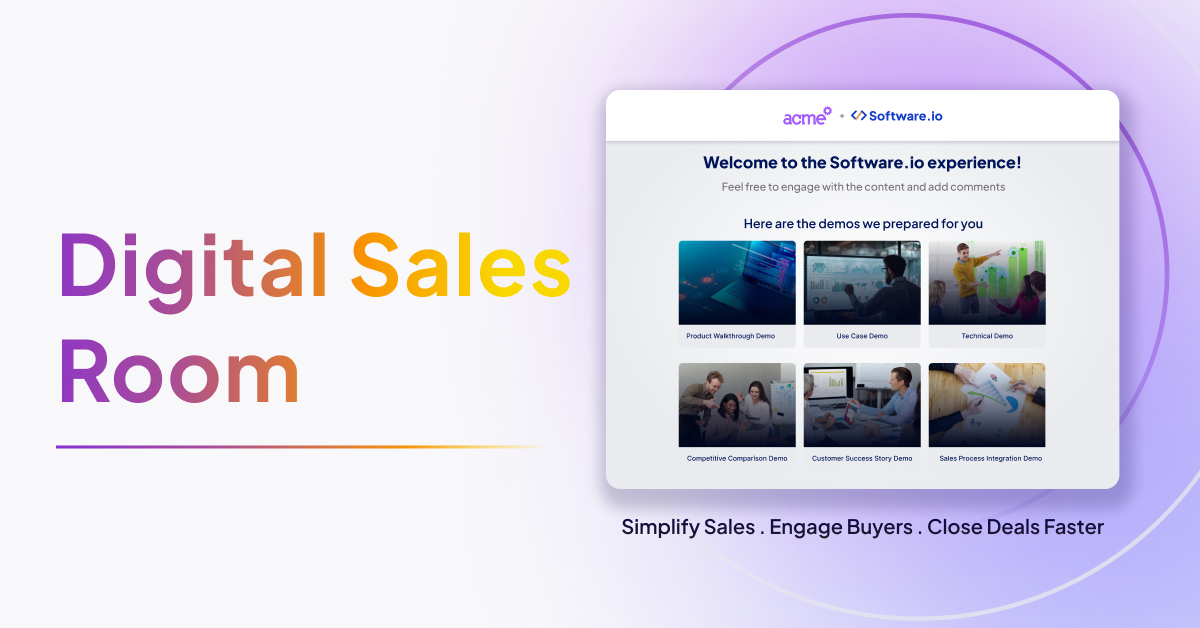
Verdict: Demoboost for enterprise deal delivery and teams evaluating digital sales room software alongside demo automation. Storylane's Buyer Hub is the best lightweight option for packaged content sharing. Navattic is link + embed only.
Navattic starts at Free (1 demo, 1 user), then jumps directly to $500/month for Base (5 seats, unlimited HTML demos, basic analytics). The gap is steep — there's no mid-tier between free and $500. The Growth tier at $1,000/month unlocks sandboxes, account identification, and A/B testing. Enterprise pricing is negotiated. Navattic recently removed their entry-level paid tier, which means teams that want production-ready HTML demos and basic CRM integration start at $6,000/year minimum.
Storylane starts at approximately $40–50/month per user (Starter), making it the lowest entry point in this comparison for teams that want a paid plan. The Starter tier uses screenshot-based demos; HTML capture unlocks at Growth ($500–625/month). For teams budget-testing the interactive demo channel, Storylane's Starter plan is a genuine trial path, not just a feature-limited preview.
Demoboost starts at $375/month (Startup, 2 seats, HTML, screenshot, and video). The Essentials tier at $600/month adds dedicated CSM support and professional services hours. Sandbox demos and overlay formats unlock at higher tiers. Demoboost's pricing is not the cheapest option in this comparison — it's positioned as an investment for teams that need the full SE workflow stack. There's no free plan; the right entry point is a live demo call to scope your use case before committing.
Verify current pricing at demoboost.com/pricing.
Verdict: Storylane wins on entry-level accessibility. Navattic is mid-tier for HTML-first marketing use cases. Demoboost's pricing reflects its SE and presales positioning — it's the right investment when the SE workflow justification is clear, and a harder sell when it isn't.
For teams that have already narrowed to these two, here's the direct comparison.
The synthesis: Navattic wins when HTML fidelity is the priority and your team values a seller-first workflow (Launchpad). Storylane wins when you need faster publishing cadence, format flexibility across screenshot and HTML, AI-assisted creation at scale, or a lower entry point for marketing-led use cases. At the same $500/month price point (Base vs Growth), Storylane unlocks more features — including account identification and A/B testing. The gap that matters most is which format your team will actually use: if HTML-only suits your product, Navattic's depth in that format justifies the tradeoff. (Arcade is sometimes mentioned alongside these two — it's a strong fit for design-first teams that want polished visual assets quickly, but it doesn't cover revenue intelligence or sandbox use cases, which is where Demoboost separates.)
1. Sandbox demos at scale via Global Linking
Most platforms that offer sandbox demos treat them as a separate product or a premium add-on — a single cloned environment you build once and reuse carefully. Demoboost's Global Linking architecture allows demo creators to connect multiple screens and product states into a freely navigable sandbox without individual recapture for every possible user path. For presales teams that run product-qualified prospects through hands-on evaluation environments, this is a structural advantage, not just a feature checkbox. It matters for teams running 10+ demos a week, not just occasional POC scenarios.
2. Governed demo library with role-based access
Demo governance is the invisible cost of scaling a demo program. Without it, reps run outdated demos, brand inconsistencies accumulate, and tracking what's being used becomes a spreadsheet project. Demoboost's library management includes role-based access controls, approval workflows, and template management — the infrastructure that lets a presales team of 10+ operate from a single source of truth. Navattic and Storylane offer basic tagging and version history; they don't offer governance at this depth.
3. Digital Sales Room with native demo integration
Demoboost's Digital Sales Room connects demo delivery, multi-stakeholder engagement tracking, and deal data in a single environment. Unlike Storylane's Buyer Hub (which packages content for sharing) or Navattic's distribution (link-based), the Demoboost DSR is built for deals where multiple decision-makers review content asynchronously before a decision, and where you need visibility into who viewed what, when, and for how long. See how the Digital Sales Room works →
Who this doesn't matter for: If your primary use case is a website embed for inbound prospects, or you're running a marketing-led PLG motion where demos rarely touch a sales or SE team, Demoboost's governance and sandbox depth are overkill. Navattic or Storylane will serve you better at a lower total cost.
Navattic and Storylane are both strong platforms. If you're reading this comparison hoping to disqualify them, you probably won't — they've each earned their G2 rankings and their positions on every shortlist in this category.
The honest answer is that Navattic is the right call if HTML fidelity and ABM-grade analytics are non-negotiable for your marketing team, and you can live with the $500/month floor and a setup process that takes longer than screenshot-based alternatives. Storylane is the right call if you need speed, format versatility, and the lowest barrier to testing the interactive demo channel — or if your team will actually use the Buyer Hub workflow for deal packaging.
Demoboost is the right call when the evaluation goes beyond marketing. If your SEs are building demos, if governance is a real operational challenge, if your CRO is asking whether demos are driving pipeline — Demoboost's architecture was designed for that motion. It's not trying to be the fastest tool or the cheapest tool. It's trying to be the right tool for the revenue teams that need demo engagement to connect to deal outcomes.
Use the ROI Calculator to model what a more governed, pipeline-connected demo program could return for your team size and deal volume.
Now that you've seen how Navattic, Storylane, and Demoboost compare — the fastest way to know which fits your team is to see Demoboost in action.
1. What is the main difference between Navattic and Storylane?
The core difference is capture method and production philosophy. Navattic captures HTML only, producing pixel-perfect interactive demos that take longer to build but deliver high fidelity. Storylane supports screenshot, HTML, and video formats — prioritising speed and versatility over pure fidelity. Both are interactive demo platforms competing in the same category, but the right choice depends on whether your team values throughput or precision more.
2. Does Navattic support sandbox demos?
Yes, but only on the Growth plan at $1,000/month. Navattic's sandbox lets prospects explore a cloned product environment without guided steps. For teams that need sandbox demos at a lower price point — or as a core workflow rather than an occasional use case — Demoboost offers sandbox demos through Global Linking from its Startup tier. See Demoboost's sandbox demo approach →
3. Is Storylane good for enterprise presales teams?
Storylane is well-suited to sales-assisted motions but is primarily designed for marketing-led workflows. It doesn't include a live demo overlay, sandbox demos, or a governed demo library with role-based access. Enterprise presales teams that run complex, SE-led demos typically find Storylane covers async demos and buyer hubs well, but need a separate tool for live and sandbox scenarios — which is where a presales-first platform like Demoboost covers the full workflow.
4. How does Demoboost compare to Navattic on pricing?
Demoboost starts at $375/month (Startup, 2 seats), versus Navattic's $500/month Base (5 seats). At entry level, Navattic offers more seats for a slightly higher price. At scale, Demoboost's pricing reflects its SE workflow features (sandbox, overlay, Digital Sales Room) which unlock at higher tiers. For teams comparing on features per dollar, the relevant question is which use cases you're paying for — not just the headline price. Check current Demoboost pricing at demoboost.com/pricing.
5. What is Global Linking in Demoboost and why does it matter?
Global Linking is Demoboost's architecture for building sandbox demos — it lets demo creators connect multiple product screens and interaction states into a freely navigable environment without recapturing every possible user path individually. The practical result is a sandbox demo that scales: you can build a rich exploration environment in hours rather than engineering sprints, and update it without rebuilding from scratch. For SE teams running POC-stage or late-stage evaluation demos, it's the capability that differentiates Demoboost most clearly from alternatives.
6. Which interactive demo platform is easiest to set up?
Storylane is generally the fastest to a first published demo — screenshot capture on the Starter plan means a team can be live in under an hour. Navattic typically takes 1–2 weeks to set up a polished HTML demo program, and G2 users note that complex multi-step demos require upfront capture planning. Demoboost has a structured onboarding process with dedicated CSM support from the Essentials tier, which adds time but also reduces the "built it wrong and have to start over" risk.
7. Which platform has the best CRM integration for sales teams?
All three platforms integrate with Salesforce and HubSpot. The difference is depth. Navattic syncs engagement events to contacts and accounts. Storylane's native apps for Salesforce and HubSpot surface demo engagement in the sales workflow. Demoboost writes demo engagement data to opportunity records, enabling pipeline attribution reporting — a meaningful step beyond contact-level sync for revenue teams tracking demo impact on deal outcomes.
8. Can I embed an interactive demo on my website with Navattic or Storylane?
Yes — both Navattic and Storylane are designed for website embedding as a primary use case. Both offer inline, modal, and full-page embed options. Navattic's HTML demos are particularly well-suited for embedding on high-intent pages (pricing, comparison pages) where the fidelity of the experience matters. Storylane's screenshot-based demos are faster to build and lighter in file size. Demoboost also supports website embedding, though its primary strength is in the sales and presales workflow rather than marketing-led website demos.
9. What is the best demo automation platform for a small presales team?
For a small presales team (2–5 SEs), the right answer depends on your demo complexity. If you run mostly async demos and email leave-behinds, Navattic's Base plan or Storylane's Growth tier will cover you. If your SEs run live demos with complex products, need sandbox environments for technical prospects, or manage a demo library that multiple reps need access to, Demoboost's Startup plan at $375/month gives you the SE workflow features at a lower cost of entry than building them with separate tools.
10. How do I evaluate Demoboost before committing?
Demoboost offers a live demo and a guided platform walkthrough with their team — the most efficient way to assess whether the SE workflow features, sandbox depth, and CRM integration match your needs before signing. Book directly at demoboost.com/book-a-demo. The session is structured around your use case, not a generic product tour.
11. Is Storylane's AI (Lily) production-ready?
Lily's core creation features — AI voiceovers, HTML editing via prompts, AI avatars, demo storyboarding — shipped in 2025 and are in production across Storylane's customer base. The AI Sales Agent (RepX) was still in beta as of Q1 2026, meaning live buyer-facing AI experiences aren't fully available at scale. For AI-assisted demo creation, Lily is a genuine differentiator. For AI-powered buyer engagement, check Storylane's current release notes before building your workflow around it.
12. What's the best interactive demo platform for presales engineers specifically?
For presales engineers specifically, Demoboost is the platform built around that workflow. Features like sandbox demos, the live overlay for guided product sessions, presenter notes, governed library access, and pipeline attribution analytics are all designed for the SE use case. Navattic's Launchpad is the closest competitor for async presales distribution. Storylane serves the sales team broader motion but lacks the live demo and sandbox depth that SEs need for complex, late-stage evaluation scenarios. For a deeper look at the presales use case, see the Future of Presales resources at Demoboost.
Book a live demo to see how Demoboost helps your team cut demo prep time, qualify buyers faster, and focus on real opportunities.
Book a Live Demo

.png)
.png)
