Wait! Before You Leave…
Not sure how interactive demo will work best for your business? We can guide you!
Not Ready Yet? Check out our Interactive Demo report.

Voxel's computer vision platform monitors physical environments in real time — catching forklift near-misses, flagging unsafe behavior, and surfacing safety risks before they become incidents. The product is visually compelling and immediately impactful. The demo experience, historically, was neither.
The sales team relied on a live product instance — unpredictable, environment-sensitive, and vulnerable to the kind of technical issues that derail a call at exactly the wrong moment. Account executives were walking prospects through every feature, every button, every admin setting in a pattern that insiders candidly described as "spray and pray."
Leadership recognized the problem: a product this powerful deserved a demo that matched it. Prospects were getting lost in feature depth before they'd understood the value. Reps with years of experience were locked into the same walk-through, unable to tailor the experience to the buyer in front of them. And new AEs — many of whom were still developing confidence in virtual selling — had no structured framework to follow.


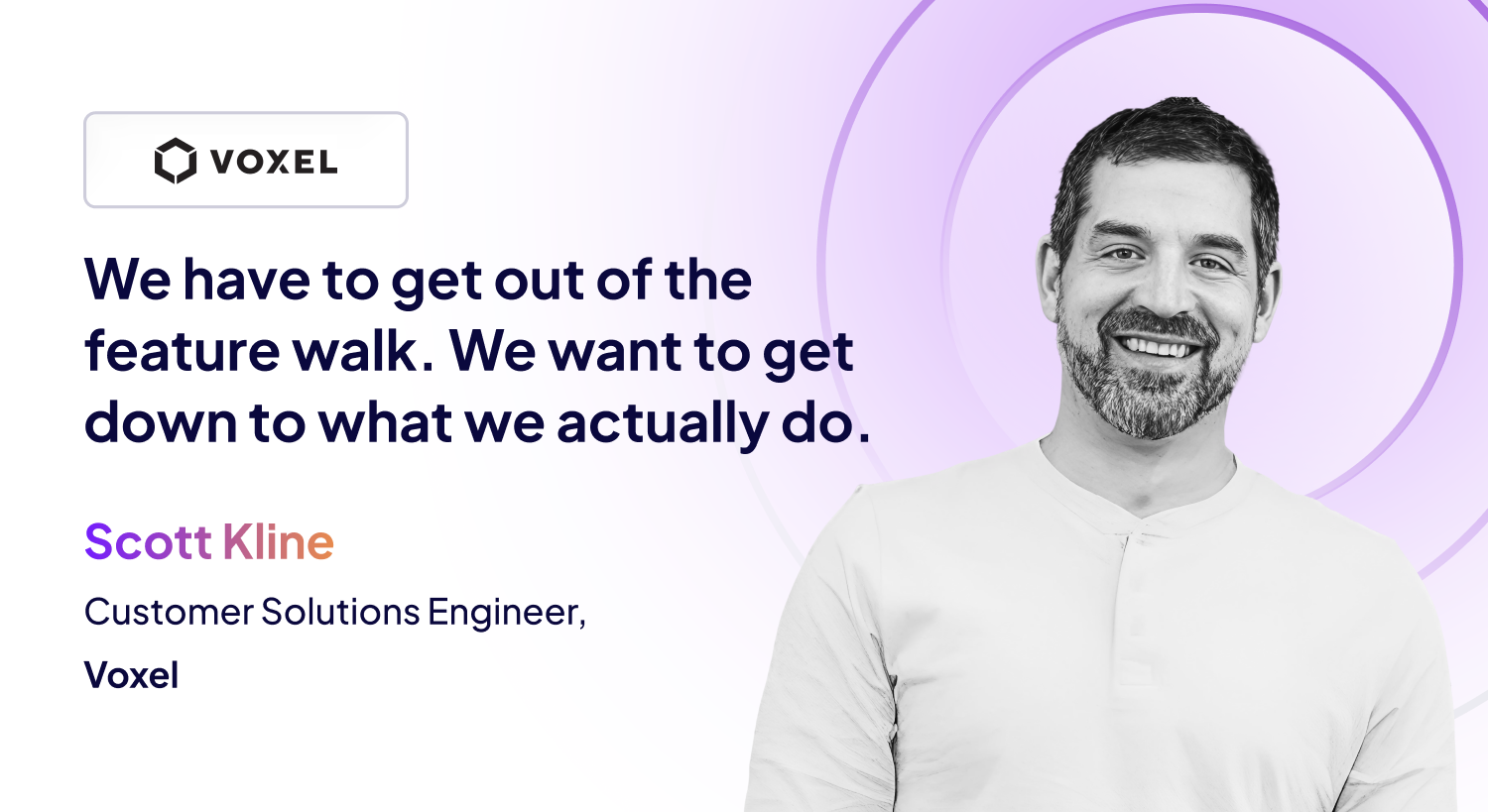
We have to get out of the feature walk. We want to get down to what
we actually do - and providing the framework for reps to be
successful with a linear demo is actually pretty effective in building
that confidence.
Voxel needed a demo environment that could tell a story — one with real customer footage, authentic workflows, and the kind of moments that make a safety platform sell itself. And it needed to run flawlessly on a field sales rep's MacBook at a prospect site.
Scott, Voxel's Solutions Engineer, built the company's first fully custom sandbox demo environment using Demoboost — a 400+ screen, multi-vertical, video-rich experience designed from the ground up for enterprise sales.
Rather than one monolithic demo, Scott took a deliberate modular approach: building mini-demos for each functional area — Actions, Boards, Browse, Reports, Dashboards — then assembling them into a master supply chain demo. This architecture made a daunting project manageable and, crucially, set the foundation for rapid duplication across new industry verticals.
Real customer footage was integrated throughout. The demo doesn't simulate Voxel's value — it shows it. Forklifts. Near-misses. Behavioral patterns flagged in real time across hundreds of hours of warehouse footage. The moments that make a safety platform impossible to ignore.
Performance was the critical challenge. A 400-screen, video-heavy sandbox with complex linking structures placed real demands on the browser. For field AEs running dozens of tabs on standard-issue hardware, that was a problem that had to be solved before a single rep could rely on this in front of a customer.
Demoboost's team worked through it systematically: video screens were migrated to S3 hosting to cut load times dramatically; a rendering engine update shifted the heavy lifting from the user's browser to Demoboost's servers; and the blank loading screen was replaced with a smooth progress indicator that keeps the demo feeling alive even during transitions.
Scott also pushed the boundaries of what the platform could do. Voxel's complex stacked bar charts — incident counts by type, by zone, across rolling date ranges — were being captured as static graphics. Scott used AI to write a custom tool that identified individual chart elements in the HTML and made each bar independently clickable, enabling direct navigation to specific footage, action items, or trend analysis. Demoboost's team took note and flagged it as a direction their own product roadmap would follow.

I just love to see how an experienced user gets into the product and
thinks about how to make even more out of it. This is very inspiring —
I'm going to share the recording with our team.
The supply chain demo went live with Voxel's QA team while two major industry conferences were running simultaneously — not ideal timing, but a testament to how much confidence had built in the environment. The feedback was immediate and consistent.
Voxel's Australia-based AE used the sandbox on a live expansion call — showing real customer footage from a port operator's sister facilities to support an upsell conversation. He reported it performed flawlessly. He didn't need to be asked to spread the word. He told his colleagues unprompted. That kind of organic peer-to-peer adoption is the strongest signal that something has genuinely changed.
He said it performed flawlessly — and that was huge. He was able to
go into our system and look at specifics from sister sites they're
looking to expand into. He said it was a really nice one-two. It was a
huge win.
Performance issues that had made the previous environment "almost unusable" — click to click to click — were resolved. The manufacturing vertical was built in a fraction of the time it took to build the original, thanks to the modular architecture Scott established from day one. A port and terminal vertical is next.
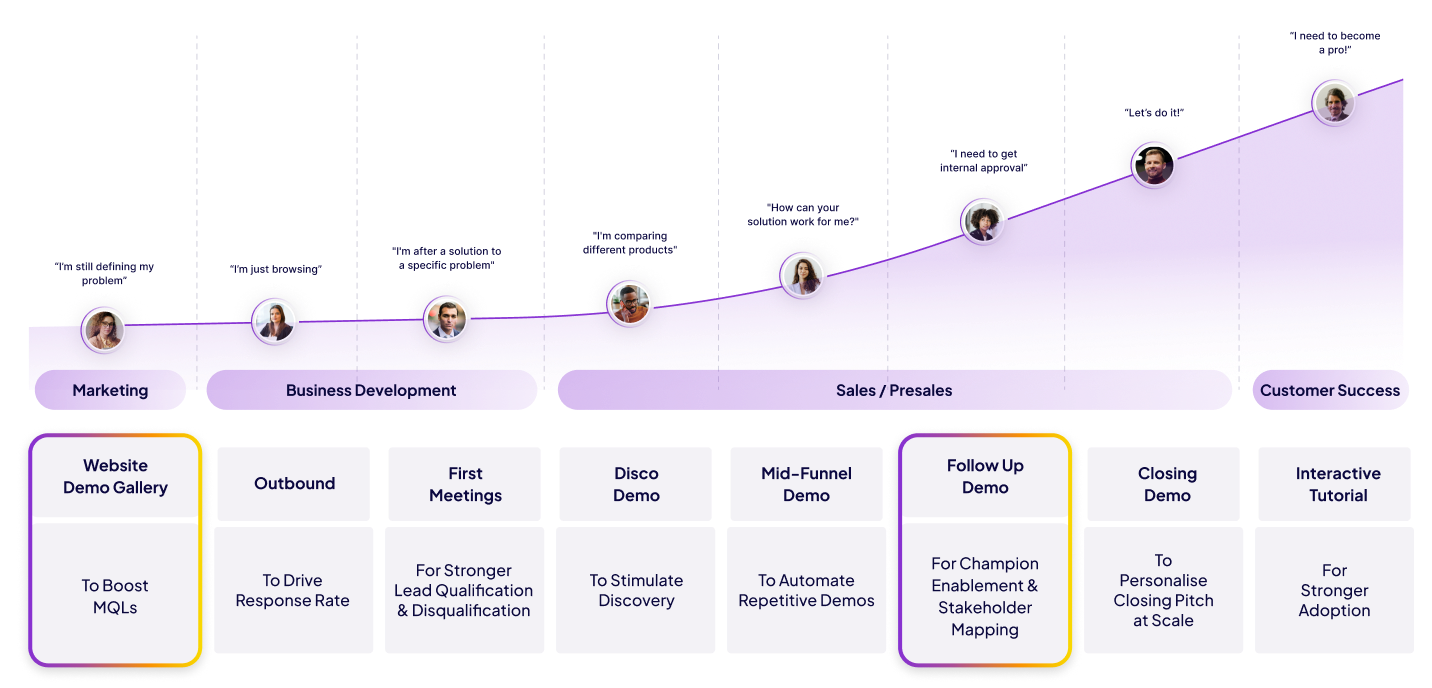
Executive and sales leadership are now actively engaged. The VP of Sales is evaluating how to use the demo infrastructure to reshape the company's entire go-to-market approach — building persona-specific demo tracks for executive buyers versus safety practitioners, potentially informed by AI-driven meeting prep that recommends the right demo sequence based on who's in the room.
What started as a single Solutions Engineer's project has become the commercial infrastructure for how Voxel goes to market.