
.png)
Learn how presales is evolving and howyour team can stay ahead in atech-driven sales landscape.


TL;DR:
Artificial intelligence sales tools are software products that apply machine learning, predictive models, or generative AI to specific sales tasks. That is a broad definition, so it helps to separate two things vendors often blur together.
True AI tools make decisions or generate output without a human writing the rules. A model that drafts a personalized email, transcribes a call and flags objections, or predicts which accounts are likely to buy is doing AI work.
Rules-based automation executes steps a human defined in advance. Send this sequence, wait three days, move the record. Useful, often essential, but not AI, no matter what the landing page says.
Both belong in a modern stack. The mistake is paying AI prices for automation features, or expecting automation reliability from generative output. Throughout this guide we say which is which, including for our own product.
The adoption question is settled. According to Salesforce's State of Sales report, 7th edition (2026), 87% of sales organizations already use some form of AI for tasks like prospecting, forecasting, lead scoring, or drafting emails, and nearly nine in ten sellers plan to use AI agents by 2027.
The pressure behind that number is structural. Gartner research finds that B2B buying groups now range from five to 16 people across as many as four functions, each arriving with their own priorities and opinions. No rep can manually track, personalize for, and follow up with that many stakeholders across a full pipeline. AI tools exist because the buying side scaled and the selling side had to respond.
Four questions separate tools that earn their subscription from tools that become shelfware.
Where in the funnel does it work? Most AI sales tools cluster at the top: finding contacts, enriching data, sending messages. Fewer help mid-funnel, where buyers evaluate the product. Map your current stack against your funnel before buying anything new. The gap is usually not another outreach tool.
Is the AI real or is it packaging? Ask the vendor what the model actually does. If the honest answer is "executes if-then rules you configure," that can still be worth paying for, just not at an AI premium.
How does it connect to your CRM and the rest of your stack? Check whether data flows both ways, whether the connection is direct or runs through middleware like Zapier, Make, or Workato, and what fields actually sync. Vendors describe very different architectures with the same word "integration."
Can you trust it in front of a buyer? Internal tools can be wrong occasionally. Anything that generates buyer-facing output, from emails to demo environments, needs review workflows and guardrails.
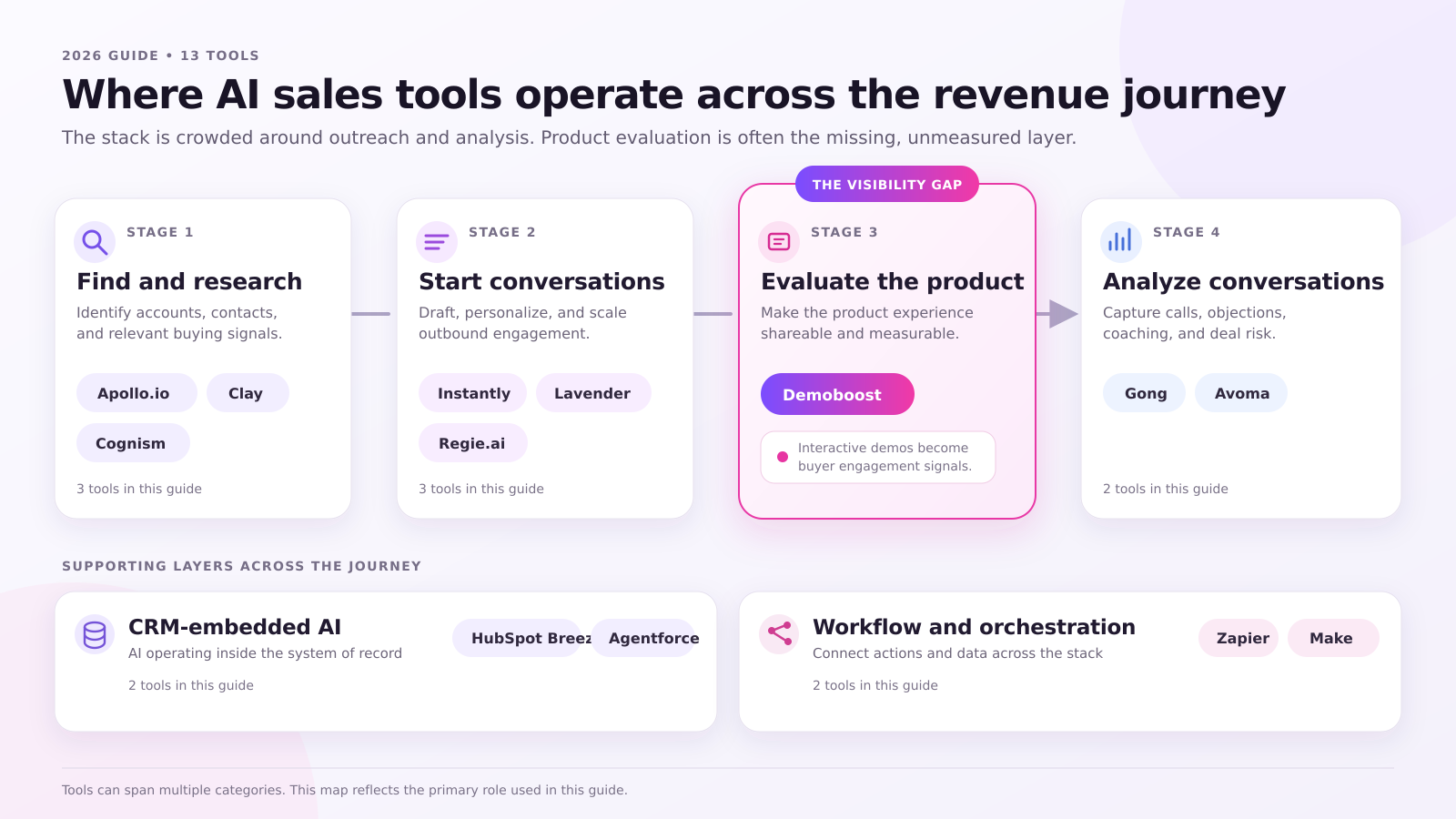
Below, 13 tools grouped by the funnel stage they serve. Disclosure up front: Demoboost is our product. We have placed it in the category it competes in and described what it does and does not do, including where our own features are rule-based rather than AI.
1. Demoboost
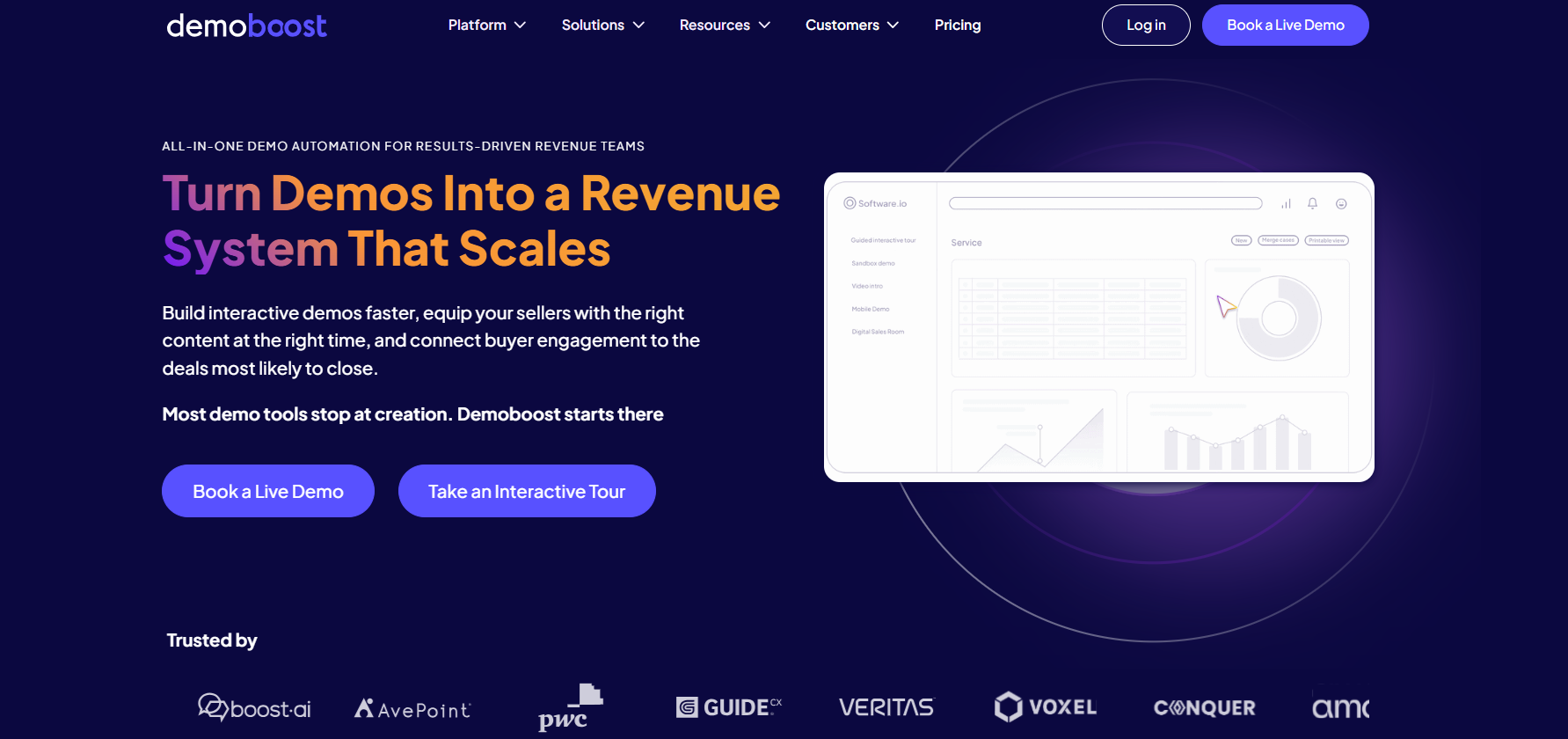
Most AI sales stacks go dark at the exact moment a deal is decided: when the buyer evaluates the product. Outreach tools got them to the meeting. Conversation intelligence will analyze the call afterward. But the evaluation itself, the demos, the async sharing among a buying group of five to 16 people, the follow-up materials, usually runs on screenshots and PDF attachments that tell you nothing about what buyers did with them.
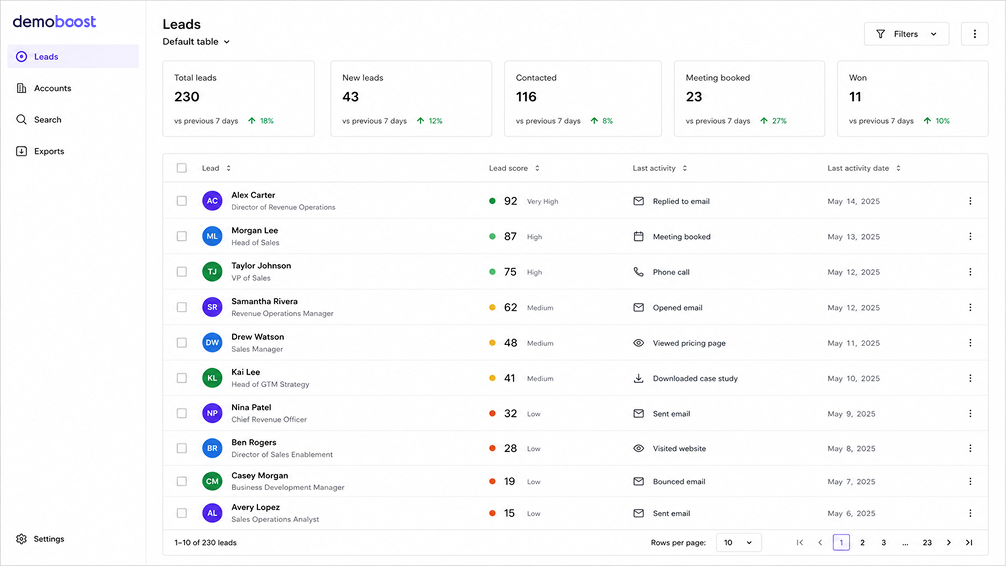
Demoboost is demo automation software for that stage. Teams build interactive product demos without engineering help, personalize them per prospect, and share them through personalized demo links or lead forms. Every demo becomes a data source: Revenue Intelligence assigns each lead a hot, warm, or cold score based on demo engagement, shows lead-level engagement detail, and lets you filter, compare periods, and export to CSV.
The AI in Demoboost lives in demo creation and personalization. Demoboost AI applies prompt-based edits across an entire demo at once, swapping data, regions, industries, currencies, and dates for each prospect, refines guide copy, generates brand-matched themes from an uploaded image, and translates demos into 170+ languages. AI avatar narration is available through Synthesia or HeyGen using your own API key. The newest addition is Demoboost Wingman, an AI agent that rebuilds a demo screen from a single prompt, replacing content on the entire screen in one pass rather than element by element. Wingman is the first step toward agent-driven demo building, with multi-screen editing and demo actions.
Engagement data flows into the rest of your stack through Global Webhooks with Demo Tags included in the payloads and routing through middleware such as Zapier, Make, or Workato, plus the built-in connections listed on demoboost.com/integrations for creating leads and syncing engagement data.

Best for: B2B teams whose product is the pitch, and who want the evaluation stage instrumented instead of invisible.

2. Apollo.io
A large B2B contact database combined with engagement features. Its AI assistant can run prospecting queries and outbound workflows from natural language prompts, and generative AI drafts sequences and subject lines. A common consolidation pick for smaller teams that want data and outreach in one place.
3. Clay
Data enrichment infrastructure rather than a database. Clay chains dozens of enrichment providers in waterfall logic and adds an AI research agent that can answer questions about accounts, so teams build custom prospect tables instead of buying static lists. Powerful, with a learning curve to match.
4. Cognism
A compliance-first sales intelligence platform with phone-verified contact data and particularly strong European coverage. Its Sales Companion assistant surfaces recommended contacts and buying signals daily. The fit is strongest for teams doing call-heavy outbound into the UK and EU, where data compliance is not optional.
5. Instantly
Cold email infrastructure at scale: unlimited connected inboxes, automated warmup, and an AI copilot for writing and testing templates. Built for volume senders and agencies rather than teams running a handful of sequences.
6. Lavender
An AI email coach that lives in the rep's inbox, scoring drafts and suggesting improvements before send. Lavender has also launched Ora, an autonomous agent that researches prospects and runs cold email end to end. Coaching-first teams start with the core product.
7. Regie.ai
A sales engagement platform where AI agents and human reps work the same pipeline. Agents source and enroll prospects based on intent signals while reps handle the conversations. Aimed at mid-market and enterprise teams, with seat minimums to match.
8. Gong
The category benchmark. Gong records and analyzes calls, meetings, and emails, detects pricing discussions and objections, and feeds deal-risk signals into forecasting. Priced and packaged for mid-market and enterprise revenue teams with meaningful call volume.
9. Avoma
A meeting assistant purpose-built for sales: transcription, AI summaries, topic detection, and performance scorecards against your own criteria for a good call. A more accessible entry point to conversation intelligence than the enterprise platforms.
10. HubSpot Breeze
An AI layer across the HubSpot platform: an assistant available on every plan plus specialized agents for prospecting, support, and account research. The strength and the limitation are the same thing, it only works inside HubSpot.
11. Salesforce Agentforce
Salesforce's agent layer inside Sales Cloud. Agents handle lead nurturing, CRM updates, quoting, and coaching directly inside the CRM, with consumption-based pricing on top of base licenses. Relevant only to organizations already committed to Salesforce.
12. Zapier
The connective layer for everything above. Beyond classic Zaps, Zapier now offers AI agents and an MCP server that exposes thousands of app actions to external AI tools. This is also the layer through which webhook-based tools, Demoboost included, route data into CRMs and Slack.
13. Make
A visual automation builder that tends to be more cost-efficient than Zapier at volume, with support for complex logic and custom AI model connections. Preferred by ops teams comfortable building and maintaining scenario logic.
Look at the list above and count. Six of the thirteen tools help you find people and start conversations. Four help you analyze conversations or manage records. That distribution mirrors the market, and it explains a common frustration: teams adopt AI, book more meetings, and watch win rates stay flat.
The stage those tools skip is evaluation. Salesforce's 2026 State of Sales research found that sellers expect AI agents to cut prospect research time by 34%, which is real value, but research time was never why deals stalled. Deals stall when a buying group of five to 16 people cannot experience the product on their own terms, when the champion has nothing better than a recorded call to forward, and when the seller has no signal about who inside the account engaged with what.
Instrumenting that stage is the highest-return move for most teams that already have outreach covered. It is also, not coincidentally, the problem Demoboost was built for.
1. What are artificial intelligence sales tools?
Artificial intelligence sales tools are software products that apply machine learning or generative AI to sales tasks such as prospect research, email drafting, call analysis, and buyer engagement scoring. They differ from rules-based sales automation, which executes predefined steps rather than making model-driven decisions.
2. What is the difference between AI sales tools and sales automation?
Sales automation follows rules a human configured: send, wait, move. AI sales tools generate output or make predictions from data, such as drafting a personalized email or scoring an account's likelihood to buy. Most modern platforms combine both, so it is worth asking vendors which features are which.
3. Which AI sales tools help during the product demo stage?
Demo automation platforms cover this stage. Demoboost, for example, lets teams build and personalize interactive product demos, share them with buying groups, and score leads as hot, warm, or cold based on demo engagement through its Revenue Intelligence feature.
4. Do AI sales tools integrate with CRMs like Salesforce and HubSpot?
Most do, but the architecture varies widely. Some tools are built inside a CRM, some offer direct connections, and others send data through webhooks and middleware platforms like Zapier, Make, or Workato. Before buying, confirm which fields sync, in which direction, and whether the connection type fits your ops team's setup.
5. How should a team measure ROI from AI sales tools?
Tie each tool to one funnel metric it should move: meetings booked for outreach tools, evaluation-to-proposal conversion for demo tools, forecast accuracy for conversation intelligence. Salesforce's State of Sales research reports high adoption, but adoption is not a result. A tool that cannot be tied to a stage metric within a quarter is a candidate for cutting.
Book a live demo to see how Demoboost helps your team cut demo prep time, qualify buyers faster, and focus on real opportunities.
Book a Live Demo

.png)
.png)
