
.png)
Learn how presales is evolving and howyour team can stay ahead in atech-driven sales landscape.

Picking the wrong interactive demo tool costs more than a subscription fee. It costs pipeline.
Arcade, Supademo, and Demoboost each appear on most shortlists for interactive demo software in 2026. All three let you build product walkthroughs without engineering resources. All three have real customers who value them. That's exactly what makes the comparison tricky - the platforms solve adjacent problems, but they don't solve the same problem.
The real question isn't which platform has the most features. It's which one matches your go-to-market motion. A marketing team building product walkthroughs for a PLG website needs something fundamentally different from a presales team managing a library of 300 enterprise demos across ten SEs.
This comparison is written for B2B SaaS teams - presales leaders, heads of sales enablement, VP Sales, and marketing leads - who are narrowing down their shortlist and want a grounded breakdown. It covers demo quality, sandbox environments, analytics, pricing, and the specific use cases where each platform genuinely leads.
By the end, you'll know which of these three tools fits your team - or whether none of them do.
Arcade in short:
Supademo in short:
Demoboost in short:
What the decision comes down to:
Quick comparison table
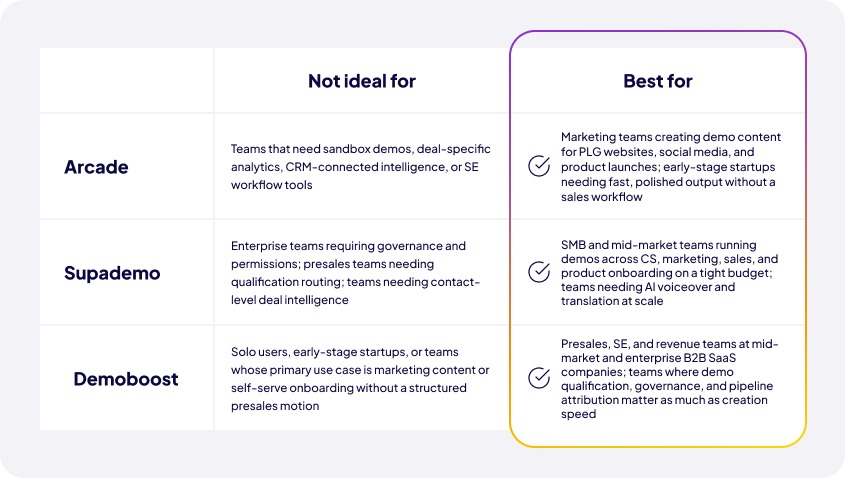
Arcade's single strongest differentiator is time-to-publish. With a median of 6 minutes from capture to a shareable demo, it's the fastest tool in this comparison for getting a product walkthrough out the door. The visual output is consistently polished - clean frames, smooth step transitions, and well-applied branding that set the category benchmark for design quality.
Customers like Zapier reported 70% more booked meetings after implementing Arcade for website demos. OpenAI, Red Hat, and Salesforce use the platform. For marketing-led teams running PLG motions - where the goal is creating content that helps buyers self-educate at scale - Arcade delivers.
But Arcade is a product storytelling tool at its core. Its roadmap prioritizes design and content speed over sales enablement. If your team's primary goal is enabling presales engineers to manage personalized demos, qualifying buyers through demo engagement, or connecting demo data to Salesforce, Arcade won't get you there.
Supademo has the largest user community in this comparison - over 150,000 professionals across 3,000+ paying organizations. That scale shows up in product breadth: Supademo handles CS onboarding, product walkthroughs, sales demos, and marketing content from one platform without forcing you into an expensive tier.
The AI voiceover and voice cloning features are genuinely strong, available on paid plans starting at $27/creator/month. AI translation covers 25+ languages, with broader coverage at higher tiers. For teams that need to produce multilingual demo content at speed, Supademo competes directly with much more expensive alternatives.
The main friction point is the tiered feature wall. HTML capture, sandbox demos, and account-level analytics all require the Growth plan ($350/month for 5 creators). Teams starting on Pro ($27/creator) will hit this ceiling as their use cases mature.
Demoboost is built around a different premise: the demo is not just a product tour. It's a qualification and pipeline event. It's the only platform in this comparison with a native demo qualification system (CYOJ + Playlist), which routes buyers to the right demo path based on their use case and captures engagement data before a discovery call happens.
Revenue and presales teams at enterprise B2B SaaS companies are Demoboost's core buyers - teams where demo governance, SE productivity, and deal intelligence matter as much as creation speed. The platform holds the highest G2 satisfaction score in this comparison: 4.9/5 from 104 reviews (94% five-star), including a 9-month median ROI window per G2 data.
It is not the right fit for a two-person marketing team that needs fast demo content for a PLG website. The entry price of $375/month reflects the enterprise-grade feature depth. Teams evaluating Demoboost should assess it against the ROI of a structured presales demo motion, not against a per-user SaaS subscription.
Arcade's capture experience is the category benchmark for simplicity. The Chrome extension and desktop app record your screen, apply step formatting automatically, and produce a shareable link in minutes. The output is polished well above the average in this space. GIF and MP4 export is Arcade's unique advantage. No other tool in this comparison produces a format optimized for email embeds or social posts.
Supademo added a built-in screen capture tool in 2025, which closed a gap it previously had against Arcade. Screenshot, video recording, desktop recording, and a Figma plugin give teams more capture formats than Arcade out of the box. AI-powered text editing and hotspot generation make it faster to produce polished demos from raw captures.
Demoboost's primary creation path is HTML capture via Chrome extension, with screenshot upload as a secondary option. There is no built-in screen recorder. For teams building sandbox demos or running complex product environments, this is not a limitation - the HTML capture at the Growth tier is robust. For teams whose first instinct is to hit record and produce something quickly, the workflow requires more setup than Arcade.
Verdict: Arcade wins on capture simplicity and output speed. Supademo wins on format variety. Demoboost wins on demo depth for teams building sandbox or HTML environments.
This is one of the sharpest points of differentiation in this comparison. Sandbox demos - fully interactive environments that simulate the live product without requiring engineering access or a test instance - are not a commodity feature
Arcade does not offer sandbox demos. The platform's DNA is screenshot and video-based product storytelling. Teams that need an environment where a prospect can click freely, explore multiple paths, and experience the product as if they were in it will need to look elsewhere.
Supademo added sandbox capability in 2025, which is a genuine addition to the platform. However, sandbox demos are locked to the Growth plan ($350/month) - teams on Pro or Scale cannot access them, and the implementation is newer than Demoboost's.
Demoboost has built its core differentiation around sandbox depth. The Global Linking feature, unique to Demoboost in this comparison, allows a team to create a master sandbox library with interconnected screens, then manage all updates from a single location. Change the pricing screen once and it propagates across every demo that references it. For presales teams managing dozens of demos across multiple product areas and personas, this is the difference between a scalable demo library and a maintenance nightmare.
Verdict: Demoboost leads on sandbox depth and scalability. Supademo offers sandbox functionality on the Growth tier. Arcade does not support sandbox demos.
Arcade is not designed for presales teams. There are no speaker notes, no live demo overlay, no qualification routing, and no workflow features for managing an SE team's demo library. It is a content creation tool, and its product roadmap reflects that.
Supademo serves sales teams broadly, but its presales-specific feature set is limited. Demo collections (Showcases and Demo Hubs) allow teams to package multiple demos, and conditional branching enables some degree of buyer routing. But there is no mechanism for qualification routing, no live overlay for SE-led calls, and no deal intelligence that feeds back into CRM.
Demoboost is the only platform in this comparison designed explicitly for presales and SE workflows. Speaker notes for live delivery, a live demo overlay for presenter-led calls, the CYOJ qualification system for routing buyers pre-call, and the Playlist framework for structured self-guided journeys are all part of the core product. Complimentary onboarding consulting is included on all plans - the platform assumes a structured implementation, not just self-serve adoption.
Verdict: Demoboost is the only meaningful choice for teams with a dedicated presales or SE function. Arcade and Supademo serve sales teams broadly, but neither is designed for SE-led deal motion.
Analytics quality varies dramatically in this comparison, and it is one of the most consequential feature gaps for revenue teams.
Arcade's analytics are surface-level by the standards of teams with active pipeline management. View counts, step completion, and basic engagement data are available, but there is no account identification, no engagement scoring, no CRM attribution, and no deal-level intelligence. For a marketing team tracking content engagement, this may be adequate. For a presales team trying to understand which demos are driving deal progression, it falls short.
Supademo added account-level analytics in April 2026, a meaningful upgrade from the view-count-only baseline it had previously. View counts, completion rates, drop-off points, and CTA clicks are tracked, with HubSpot, Salesforce, and Marketo sync available. Account analytics is a step toward deal intelligence, but contact-level identification still requires a form fill, and there is no DQL scoring or engagement-to-pipeline attribution.
Demoboost's analytics layer is built around Demo Qualified Lead (DQL) detection - tracking how individual contacts engage with specific demos, which screens they viewed, how many times they returned, and how that engagement correlates with deal progression. Salesforce and HubSpot integration means this data surfaces in the tools revenue teams already live in. The contact-level intelligence requires a form fill for identification (no account deanonymization), but once a contact is identified, the engagement trail is detailed.
Verdict: Demoboost leads on revenue intelligence and pipeline attribution. Supademo is catching up on account analytics. Arcade's analytics are not built for deal-stage tracking.
All three platforms support shareable links, embeds, and basic access controls. The meaningful differences are in distribution depth.
Arcade produces clean shareable links and embeds well-optimized for website embedding, email, and Slack. The GIF export creates a format no other tool in this comparison supports, making Arcade the best choice for teams distributing demo content through email campaigns or social channels.
Supademo's Showcase collections and in-app Demo Hubs (launched October 2025) let teams package multiple demos into a single interactive collection - useful for CS teams managing product education, or marketing teams building demo landing pages. Password protection and trackable share links are available on paid plans.
Demoboost's distribution architecture is built around the deal. Personalized demo links with AI Branding, Playlist frameworks for qualification, and CYOJ routing are all distribution mechanisms with a sales motion embedded in them. Live overlay supports SE-led calls. Mobile demos are supported - a format neither Arcade nor Supademo offers.
Verdict: Arcade leads for marketing content distribution. Demoboost leads for sales-motion distribution. Supademo covers both reasonably well.
This is where the comparison gets consequential. These three platforms are not priced at the same level, and the differences reflect genuinely different buyer profiles.
Arcade and Supademo both offer free plans and low entry-price tiers. Arcade's Pro is $32/user/month; Supademo's Pro is $27/creator/month. Both platforms' more advanced features: HTML capture, sandbox, analytics - are locked to higher tiers.
Arcade's 2026 pricing change: the Growth plan shifted from per-user pricing to a $297.50/month flat rate. For teams of 1–2 users, this is cheaper than the previous model. For teams of 5 or more, the flat rate is more expensive than the old per-seat pricing. Worth checking Arcade's current pricing page before deciding.
Demoboost does not offer a free plan. The entry point is $375/month (Startup plan), with Essentials at $600, Growth at $1,200, and Enterprise custom. This is a deliberate choice - the platform's complimentary onboarding consulting, enterprise governance, and revenue intelligence capabilities are not designed for solo use or low-volume experimentation. G2 data puts the median ROI window at 9 months. Teams evaluating Demoboost should assess it against the value of a structured presales motion, not against a per-user subscription.
Verdict: Supademo and Arcade are more affordable at entry. Demoboost is priced for enterprise motions and the ROI case is strongest when demo-driven pipeline activity is measurable.
For teams that have decided Demoboost is more than they need right now, here is the direct head-to-head:
Arcade is the better choice if visual quality and creation speed are your top priorities - particularly for teams producing demo content for PLG websites, product launches, or social channels. If you need sandbox demos, a broader feature set at a comparable price, or account-level analytics, Supademo's Growth tier pulls ahead.
Three specific differentiators set Demoboost apart from Arcade and Supademo - each tied to a concrete use case.
1. The only platform with a native demo qualification system
CYOJ (Choose Your Own Journey) and Playlist are qualification mechanisms, not just demo formats. When a prospect requests a demo, they receive a Playlist that routes them to the demo path matching their use case, team size, and role - before the discovery call. The SE walks into that call knowing exactly what the buyer explored, how long they spent on each screen, and which features drove the most engagement. Leads who complete self-guided CYOJ tours are significantly more likely to qualify and close, because the demo does the qualification work that used to happen on the call. Neither Arcade nor Supademo offers a comparable mechanism.
2. The only platform with AI Graphs - generative chart data from a prompt
Static dashboard data in demos kills deal credibility. Showing a €1 billion revenue chart to a 50-person company signals that you don't know your audience. Demoboost's AI Editing feature generates synthetic, context-appropriate chart data from a natural language prompt - changing the numbers in a demo dashboard in seconds, without any manual editing. This is a specific pain point for SEs demonstrating data-heavy products, and it is a capability no other tool in this comparison offers.
3. Enterprise-grade governance that scales with a demo library
As a presales team grows, so does the problem of demo drift - outdated messaging in the field, SEs sharing the wrong version, demos that haven't been updated since the last product release. Demoboost's folder structure, role-based permissions, approval workflows, and demo status controls give presales leaders visibility over what is being shared and who has access. Combined with Global Linking (update a shared screen once and propagate everywhere), this is a governance layer that Arcade and Supademo simply do not have. This does not matter for a 3-person team. It matters enormously for a 15-person SE organization managing 200+ demos across enterprise accounts.
Honest caveat: these three differentiators matter specifically to teams with structured presales motions. If your use case is faster demo content creation, smaller-team workflows, or lighter sales processes, Demoboost's depth may be more than you need at this stage.
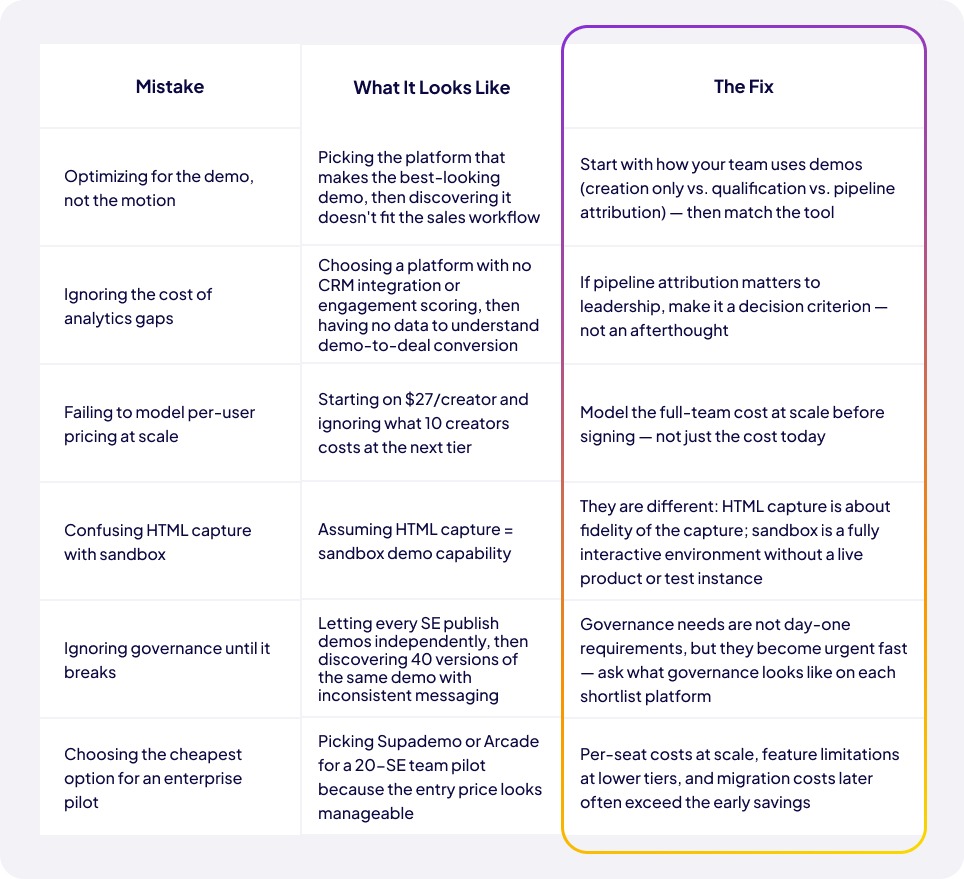
Does the capture method match your product type? Screenshot, HTML, and sandbox capture have different fidelity levels and different requirements. Know which you need before you evaluate.
Can it scale with your team's demo library? Ask how demo governance, version control, and permissions work, specifically when your team doubles in size.
Does it connect to your CRM? If demo engagement data doesn't surface in Salesforce or HubSpot, it won't influence deal prioritization or SE time allocation.
Does it support your delivery workflow? Async sharing, live overlay, qualification routing, and mobile demos are different capabilities. Know which you need before evaluating.
Is the analytics depth sufficient for your use case? View counts are not deal intelligence. Know what you need before you accept what you're offered.
What does the pricing look like at scale? Model the full-team cost at 10 users, 20 users, and growth-stage team size. Per-creator pricing escalates quickly.
Does the vendor's success model match yours? Fully self-serve (Arcade, Supademo) vs. guided implementation with consulting (Demoboost) - this affects adoption speed and time to value.
Have you tested with your actual product? Do not evaluate a demo platform on generic demo content. Capture your own product during the trial period.
Arcade, Supademo, and Demoboost are all credible platforms with real customers and legitimate use cases. The comparison is not about which is objectively better. It's about which matches your team's go-to-market motion.
If you're a marketing-led team at an early or mid-stage PLG company and your primary need is fast, visually polished demo content for your website and campaigns, Arcade is probably the most efficient choice. The creation experience is the best in class for that specific use case.
If you're a mixed-function team: CS, sales, marketing, and product - that needs a flexible demo tool across multiple use cases at a reasonable price point, Supademo is a strong option, especially at the Growth tier where HTML capture, sandbox, and account analytics become available.
If your team runs a structured presales or SE motion - where demo engagement should qualify buyers, where governance matters, where analytics need to inform deal prioritization, and where demos are part of a revenue system rather than a content library - Demoboost is built for that problem. The entry price reflects the enterprise-grade depth, and the G2 satisfaction data (4.9/5 from 104 reviews) reflects the outcome when that depth is used well.
The fastest way to know which fits your team is to see it in action with your product, your use case, and your actual workflow.
Now that you've seen how Arcade, Supademo, and Demoboost compare…
…The clearest next step is to see Demoboost's qualification and revenue intelligence capabilities in the context of your own presales motion.
1. What is the main difference between Arcade and Supademo?
Arcade is optimized for speed and visual quality. Its core strength is producing polished demo content, including GIF and MP4 exports, in under 10 minutes. Supademo covers more use cases from a single platform: six demo formats, AI voiceover with voice cloning, conditional branching, in-app Demo Hubs, and deeper analytics at higher tiers. For teams that need both speed and feature breadth, Supademo's Growth plan generally offers more at a comparable price. For teams whose primary output is website or social demo content, Arcade's design quality is hard to match.
2. Does Arcade support sandbox demos?
No. As of 2026, Arcade does not offer sandbox demo environments. The platform is built around screenshot and video capture, with HTML capture available on the Growth plan. Teams that need fully interactive environments where prospects can explore a product freely, without a live instance or test environment, should evaluate Supademo (Growth tier) or Demoboost instead.
3. Is Supademo suitable for enterprise presales teams?
Supademo serves sales teams broadly but is not purpose-built for enterprise presales workflows. It does not offer a demo qualification routing system, speaker notes for live delivery, a live demo overlay for SE-led calls, or enterprise-grade governance such as folder permissions, approval workflows, and demo status controls. For smaller presales teams with lighter workflow requirements, Supademo's Growth tier is workable. For organizations with structured SE teams managing a governed demo library, the feature gaps become significant.
4. How does Supademo pricing compare to Demoboost and Arcade?
Supademo is the most affordable option at entry, with a free plan (5 demos) and paid plans starting at $27/creator/month. The Growth plan at $350/month (5 creators) unlocks HTML capture, sandbox, and account-level analytics. Arcade's free plan covers 3 demos, with Pro at $32/user/month and a Growth plan at $297.50/month flat. That Growth pricing changed in 2026 and is now more expensive for teams of five or more than the old per-seat model. Demoboost starts at $375/month with no free tier. The price difference between Demoboost and the other two is substantial, and the ROI case is measured differently: Demoboost is priced for teams where demo-driven pipeline activity is measurable, not for low-volume experimentation.
5. Which demo tool is best for presales teams?
For dedicated presales and SE teams at mid-market or enterprise B2B SaaS companies, Demoboost is the strongest option in this comparison. It is the only platform with a native demo qualification system (CYOJ + Playlist), speaker notes for live delivery, a live demo overlay, enterprise governance features, and contact-level revenue intelligence. It holds a 4.9/5 G2 rating from 104 reviews, with 94% five-star. Supademo and Arcade work for broader sales team use, but neither is designed for SE-led deal motion at scale. For a deeper look at presales-specific use cases, see the Demoboost presales team page.
6. Which is better, Arcade or Demoboost?
For most presales and SE teams, Demoboost is the stronger choice. It offers sandbox demos, demo qualification routing via CYOJ and Playlist, contact-level revenue intelligence, and enterprise governance that Arcade does not have. Arcade is the better choice for marketing teams that need fast, design-quality demo content for websites, campaigns, and social channels. Its median 6-minute publish time and GIF export are genuinely useful for that workflow. The two platforms solve different problems for different buyers. If your goal is pipeline-connected demo activity, Demoboost leads on the features that matter for that motion. If your goal is high-volume marketing demo content at speed, Arcade is the faster path.
7. What is CYOJ (Choose Your Own Journey) and why does it matter for B2B sales teams?
CYOJ is Demoboost's demo qualification routing framework. It allows a prospect to self-select their use case, role, or pain point at the start of a demo experience, then routes them to the most relevant demo path. Combined with Playlist, a structured sequence of demos, it turns the demo-request step into a qualification event. The buyer explores what matters to them, and the SE walks into the discovery call knowing exactly what the prospect engaged with, how long they spent, and which screens they returned to. For presales teams, this means fewer unqualified first calls and more precise deal qualification before SE time is committed. Neither Arcade nor Supademo offers a comparable mechanism.
8. Which interactive demo platform has the best CRM integration?
Demoboost has the deepest CRM integration in this comparison. It connects to Salesforce, HubSpot, and the broader GTM stack via webhooks, passing contact-level engagement data through to deal records. Supademo integrates with HubSpot, Salesforce, and Marketo for account-level engagement tracking. Arcade's native CRM integration is limited and not built for pipeline attribution. If CRM-connected demo analytics and deal intelligence are requirements, Demoboost is the clear leader. For more detail on Demoboost's integration stack, see the integrations page.
9. Can I embed an interactive demo on my website using Arcade or Supademo?
Yes. Both Arcade and Supademo support website embedding. Arcade's embeds are fast-loading and well-suited for PLG website demo sections. Supademo's embeds support Showcase collections, so you can embed a multi-demo experience rather than a single walkthrough. Demoboost also supports website embedding, with the same personalization and analytics layer that applies to all shared demo links.
10. How does Demoboost's AI Branding compare to Supademo and Arcade for demo personalization?
Demoboost's AI Branding automatically applies a prospect's visual identity to a demo template in seconds, producing a personalized demo without manual editing for each account. This is most useful for presales teams running high volumes of account-specific demos at enterprise accounts. Supademo offers dynamic variables for personalization (company name, role, data values) that can be swapped per link. Arcade has limited personalization controls by comparison. For teams running systematic, account-level personalization at scale, Demoboost's AI Branding is the most automated approach in this comparison.
11. What is the best interactive demo platform for a small team or startup?
For early-stage teams or startups without a formal presales function, Supademo and Arcade are the more practical starting points. Supademo's free plan (5 demos) and Pro tier ($27/creator/month) offer the lowest barrier to entry and the most feature breadth at that price. Arcade's free plan (3 demos) is well-suited for teams whose primary need is fast, polished website or marketing demo content. Demoboost starts at $375/month and is designed for organizations with structured demo motions. It is not the right fit for solo users or teams in the early stages of building a demo strategy.
12. Can I try Demoboost before committing?
Demoboost does not offer a self-serve free trial or free plan. The recommended starting point is a 30-minute call with the Demoboost team, who will walk through the platform in the context of your specific use case and team structure. Complimentary onboarding consulting is included on all plans. If you want to explore the product before that conversation, visit Demoboost website.
Book a live demo to see how Demoboost helps your team cut demo prep time, qualify buyers faster, and focus on real opportunities.
Book a Live Demo

.png)
.png)
