

.png)
Learn how presales is evolving and howyour team can stay ahead in atech-driven sales landscape.

How can sales engineering and presales teams reduce the time they spend maintaining demo environments?
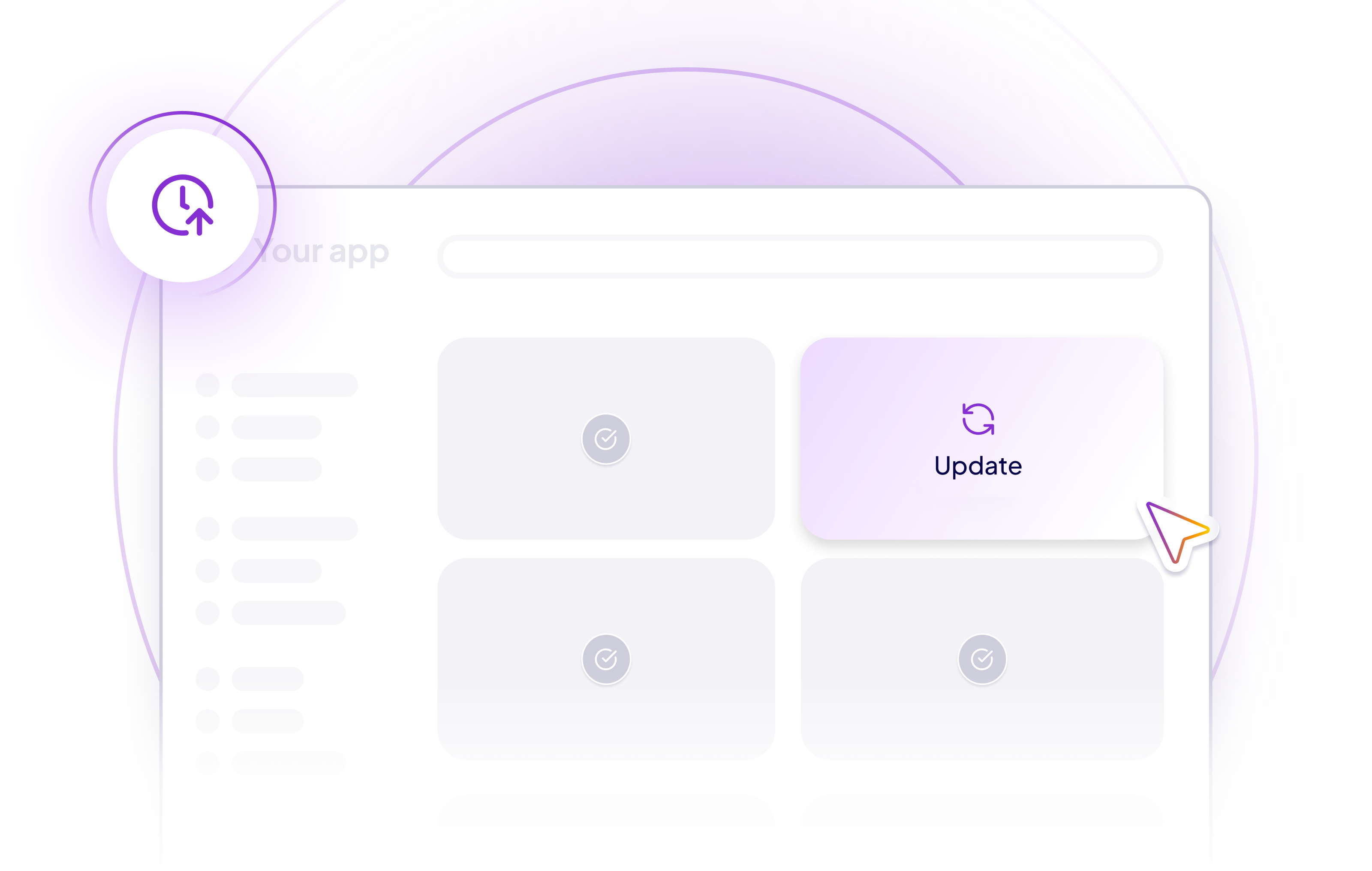
By changing the unit of work from the environment to the screen. Demo maintenance time is the hours a presales or sales engineering team spends keeping a demo environment current after the product changes, and for most teams it is larger than the hours spent presenting demos. The usual culprits are a single cloned environment that has to be rebuilt whenever anything changes, demo content scattered across tenants nobody can combine, and no way to update one screen without touching the rest. Teams that fix it stop rebuilding and start patching. They update only what changed, pull the best examples from wherever they live, and route product currency directly into the demo instead of around it.
Demo automation is the practice of building demos as reusable, updatable assets rather than one-off environments or recordings, so a product change becomes an edit instead of a rebuild.
A demo that takes days to update is not a maintenance backlog. It is a pipeline decision your team is making without anyone calling it one.
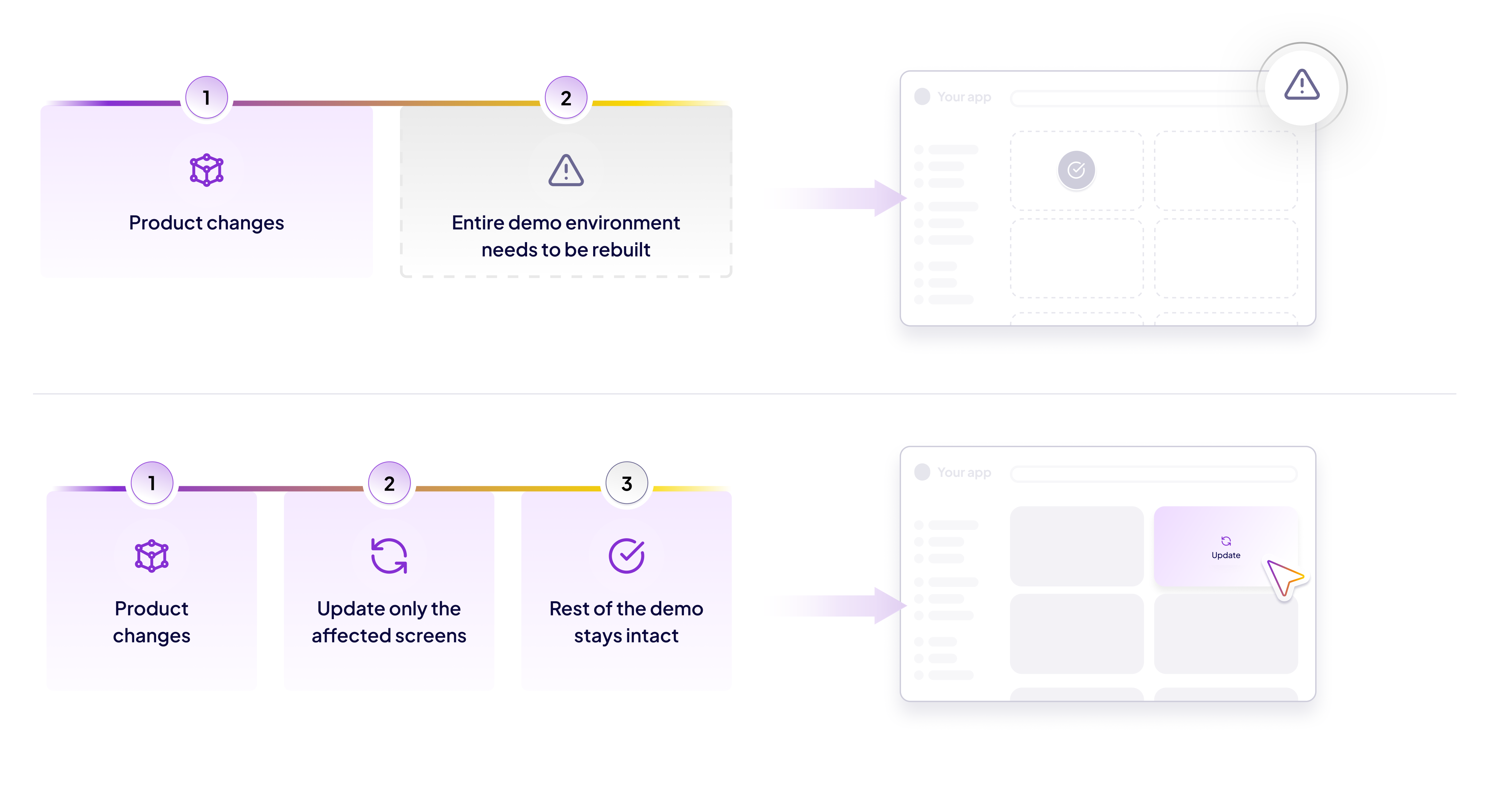
Demo maintenance takes so long because most demo environments are built as a single cloned instance rather than a set of independent, updatable pieces. When one part of the product changes, the whole clone is treated as compromised, so the instinct is to rebuild rather than patch.
That instinct gets expensive fast in categories that ship often. A UI change, a new workflow, a renamed feature: any of these can force a full rebuild if the environment is not modular, because there is no reliable way to isolate what actually needs to change. The team ends up choosing between two bad options. Spend the hours to rebuild, or let the demo quietly fall behind what the product can do.
There is a second, less obvious cause. In complex products, the most convincing examples (the sharpest alert, the cleanest workflow, the scenario that lands with a specific buyer) are rarely all sitting in one environment. They are spread across production, staging, different customer tenants, and partner instances. Without a way to pull those pieces into one coherent demo, teams either settle for whatever exists in a single clone or maintain a growing pile of smaller, disconnected demos that each cover one gap and none of which tell the full story.
Slow demo maintenance costs a sales team pipeline, not just SE hours, because every outdated demo is a live product being sold with a stale version of itself.
The direct cost is time. Hours or days per update cycle spent rebuilding instead of running discovery calls, coaching AEs, or supporting complex deals. The indirect cost is harder to see and bigger. A demo that is months behind the real product understates what the product does, in front of exactly the audience deciding whether to buy it.
Buyers are also doing more of that evaluation on their own terms before a rep is involved. 67% of B2B buyers prefer a sales rep-free buying experience, based on a survey of 646 B2B buyers (Gartner, 2026). A demo environment that cannot be trusted to self-explore, because it is out of date or was clearly cloned in a hurry, closes off exactly the motion buyers are already leaning toward.
There is also a team cost. Small SE teams supporting large, distributed sales organizations feel this hardest, because they are the bottleneck every demo has to pass through. When maintenance eats their week, everything downstream slows with it: coaching, competitive response, partner enablement.
Modular, composable demo automation reduces demo maintenance time. Rebuild-based methods do not, because their cost scales with how often the product ships rather than with how well the team executes.
Teams usually try one of three things first, and each stalls for a structural reason. Rebuilding cloned environments faster does not remove the rebuild, it just compresses it, and the work still scales linearly with release frequency. Screen-recorded videos sidestep live-environment risk but freeze the moment they are recorded, so the day the UI changes the video is already wrong and there is no way to patch one frame. Adding SE headcount buys relief for individuals but leaves the rebuild cycle intact, spread across more people.
Screen-recorded video is still a reasonable fit for pure top-of-funnel awareness content, a landing-page teaser or a social clip, where the asset does not need to reflect this week's UI and a refresh once a quarter is acceptable.
Two changes make the modular approach possible. Modular updates, so a UI change only touches the screens it affects. And multi-environment composition, so the best examples from production, staging, or a specific tenant can be pulled into one demo regardless of where they originated. Together they turn a rebuild into a patch. The team confirms what changed, updates the affected screens, and moves on.
Radiant Security is an AI-powered security operations center, and its small sales engineering team, led by Laurenz Nascimento, supports a sales organization spread across several countries. Every demo a prospect sees runs through that team first.
For over two years, Radiant Security ran its demos on a cloned sandbox platform. It held for a while, but the product moves fast: new alert types, new investigation workflows, frequent UI changes. The demo environment fell six months behind what the product could actually do (Demoboost customer story: Radiant Security, 2026). The team's best examples, the sharpest alerts and the clearest investigation flows, were scattered across different tenants and staging environments with no way to combine them into one story.
After moving to Demoboost, Radiant Security rebuilt its approach around modular updates and multi-environment composition. When a UI change ships, the team updates the affected screens and leaves the rest intact.
Radiant Security reduced demo maintenance time by 75% after making that switch (Demoboost customer story: Radiant Security, 2026). The team gets back 10 to 20 hours per demo update cycle (Demoboost customer story: Radiant Security, 2026). The flagship sandbox has grown to more than 500 demo screens composed from multiple environments, and within two weeks of adopting the new approach every prospect-facing demo at Radiant Security ran through it.
Radiant Security is not the only proof of the pattern. Voxel, a computer vision workplace safety platform, built a modular sandbox of more than 400 demo screens and rolled out to new verticals 3x faster (Demoboost customer story: Voxel, 2026).

A demo library that stays current becomes something sellers will actually use without an SE in the room, which is where the returned hours turn into pipeline rather than slack.
That is the part most maintenance conversations stop short of. Faster updates are the entry point, not the outcome. When demos are trustworthy enough to hand to an AE, the demo stops being an SE deliverable and becomes a seller-ready asset. Spryker reduced presales involvement in top-of-funnel calls by 95% after moving to that model, and its SEs get back an average of 3 hours per week (Spryker, Demoboost customer story, 2026).
The second thing a current library makes possible is visibility. Once demos are shared rather than performed, demo analytics shows which screens buyers viewed, where they spent time, what they skipped, and whether they came back. Demoboost Global Webhooks send demo events (demo created, demo completed, and lead form completed) into middleware such as Zapier, Make, or Workato, which routes them into CRM, Slack, and sales engagement tools. That turns demo engagement into a signal the revenue team can act on rather than a story the SE tells afterward.
Reducing demo maintenance time is worth doing on its own. It is worth more when the demos it protects become reusable, trackable assets that keep working after the meeting ends.
Your demo maintenance process needs fixing if a single product update forces a full environment rebuild, if your best demo examples live in tenants nobody can combine, or if nobody on the team can say what the rebuild hours are costing in selling time.
A quick gut check: track how long your last three significant update cycles took, end to end. If that number is measured in days rather than hours, and it has not moved even as your release cadence has picked up, the process is the constraint, not the team.
Cloned environments and screen-recorded videos both force a full rebuild every time the product changes, and that cost scales with release frequency, not team size. Modular updates and multi-environment composition change the unit of work from rebuilding the environment to patching the screen that changed. That is the shift that cut Radiant Security's demo maintenance time by 75%, and it is the same shift that makes a demo library durable enough for sellers to run on their own.
What counts as demo maintenance for a presales team?
Demo maintenance is any work needed to keep a demo environment reflecting the current product: updating screens after a UI change, refreshing data, fixing broken flows, and rebuilding environments that have drifted too far from what the product actually does. For most presales teams it consumes more hours than presenting demos does.
Why do demos fall behind the product so quickly?
Most demo environments are a single cloned instance. When any part of the product changes, teams either rebuild the whole environment or leave it as-is, because there is usually no way to update just the affected piece. Products with frequent releases fall behind faster than teams can rebuild.
How can sales engineering teams reduce the time they spend maintaining demo environments?
By changing the unit of work from the environment to the screen. Modular updates mean a product change only requires updating the screens it affects, and multi-environment composition means the best examples can be pulled into one demo regardless of where they originated. Radiant Security reduced demo maintenance time by 75% after making that shift (Demoboost customer story: Radiant Security, 2026).
How does Demoboost handle demo maintenance?
Demoboost demos are built from individual screens that can be updated on their own, so a UI change only requires editing the affected screens rather than rebuilding the demo. Demo content can also be composed from multiple environments into a single coherent demo. Radiant Security's flagship sandbox contains more than 500 screens built this way (Demoboost customer story: Radiant Security, 2026).
Is a screen-recorded demo a good substitute for a live interactive one?
It depends on the use case. A recorded video works for top-of-funnel awareness content that does not need to reflect this week's UI. It is a poor fit for active sales cycles, because any product change makes the whole recording outdated and there is no way to patch a single frame.
Does reducing demo maintenance time actually shorten the sales cycle?
Indirectly. Less time rebuilding means more SE time for discovery, competitive response, and complex deals, and a demo that reflects the current product removes a source of buyer doubt during evaluation. Neither is automatic. Both depend on where the freed-up time and improved demo currency actually get applied.
Does adding more SE headcount solve a demo maintenance problem?
It can reduce the load on any one person, but it does not remove the underlying rebuild cycle. Teams that add headcount without changing the update process usually find the same rebuild work simply spread across more people.
Book a live demo to see how Demoboost helps your team cut demo prep time, qualify buyers faster, and focus on real opportunities.
Book a Live Demo

.png)
.png)
