
.png)
Learn how presales is evolving and howyour team can stay ahead in atech-driven sales landscape.

.webp)
Demostack and Reprise solve a similar problem in similar ways: both let B2B software teams clone or capture their product to build demo environments without engineering help. The difference is fit. Demostack centers on no-code product cloning and storytelling for revenue teams. Reprise targets enterprise teams with a multi-product suite covering overlays, capture-based demos, and code-level replication.
If you are choosing between them, this comparison covers what each does well, where they differ on pricing and complexity, and the questions to ask that most comparisons skip: what happens to demos after creation, and what your sellers will actually do with them.
Demostack is a demo experience platform built around cloning your real product for showcasing. Teams capture the product, then edit data, charts, and text without code to tailor the story to a specific buyer.
Its strength is speed from capture to customized demo, with an editing experience designed for non-technical users. Solutions engineering, sales, marketing, customer success, and partner teams can all work from the same cloned environment.
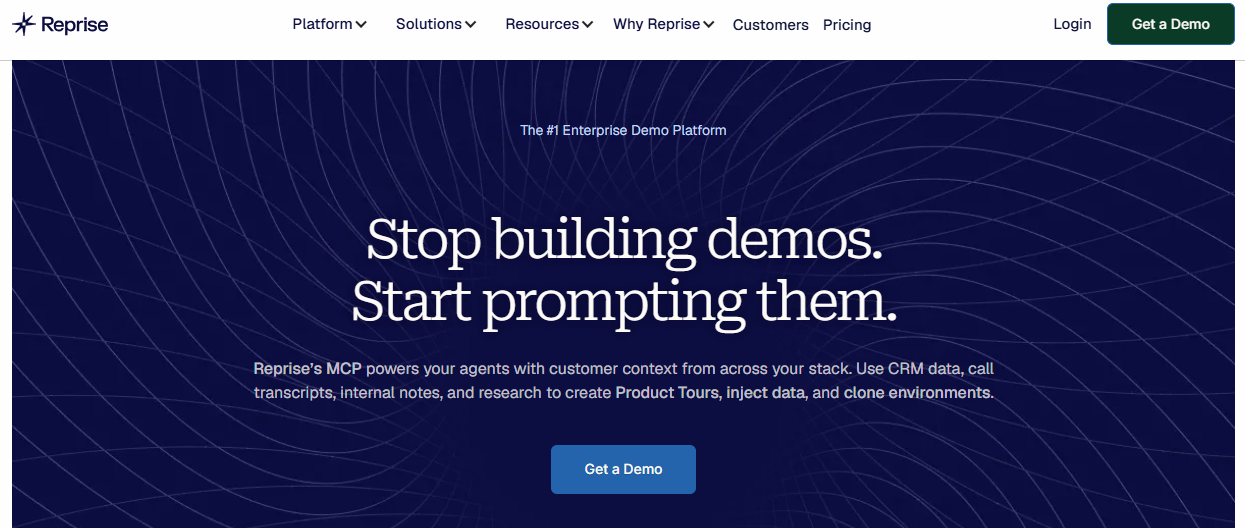
Reprise is built for enterprise sales and marketing teams and splits the demo problem across distinct products:
Reprise Reveal overlays and customizes live applications in real time.
Reprise Replay captures the product to build and share guided demos.
Reprise Replicate clones core functionality down to the code level for realistic sandbox and POC environments.
Its strength is depth and enterprise readiness, including SOC 2 Type II certification and the security posture larger buyers expect. The tradeoff is complexity: getting full value from data injection and deep customization can require HTML/CSS skills or developer support.
One note for 2026 evaluations: Reprise now positions itself as an agentic demo builder. In practice, "agentic" refers to automation in building demo environments, such as its AI Data Studio generating demo datasets from natural language prompts. It does not mean autonomous agents that present the product or talk to buyers in real time. Worth clarifying in any vendor call so expectations match the product.
Neither platform publishes pricing. Both are sales-led: you talk to sales, scope your use case, and receive a custom quote. Procurement data from Vendr has put Reprise's median contract at over $33,000 per year, with minimum commitments and setup fees reported.
For budgeting purposes, treat both as enterprise-tier investments and ask early about minimums, implementation fees, and which capabilities sit in add-ons.
For contrast, Demoboost publishes pricing on three of its four plans, starting at $375/month. See the full Demoboost pricing breakdown for what each tier includes.
It depends on how your presales team works.
If your SEs need a stable cloned environment for deep technical demos and POCs, Reprise Replicate is the closer fit. If your priority is fast, no-code customization of product stories for individual deals, Demostack's editing model is the easier path for mixed-skill teams.
Either way, ask a harder question in the evaluation: can your account executives use this without an SE in the room? Demo creation tools solve the SE's problem. Presales leaders also need to solve the dependency problem, where every early-stage call still pulls an SE in.
Both platforms are strongest at the creation layer: building realistic demo environments. The demo workflow does not end there, and this is where evaluations should dig deeper.
Seller support. Once demos exist, can sellers find the right one, personalize it for a deal, present it confidently, and follow up with it? Demo libraries, speaker notes, and structured flows decide whether demos get adopted or ignored.
Demo formats across the funnel. A cloned environment is one format. Real deal cycles also need guided product tours for the website, live demo overlays for calls, sandbox demos for hands-on evaluation, and mobile demos.
Revenue connection. Engagement data is only useful if it reaches lead, account, and opportunity records, and shows you who on the buying committee is engaging. This is not a hypothetical gap. In Demoboost's review of G2 feedback across demo AI platforms, Reprise's own customers repeatedly flagged analytics depth as a limitation, and one senior director described evaluating a second platform just to cover the top-of-funnel tracking their demo tool does not address. Two tools for one workflow is a real cost to factor in.
Neither platform is a bad choice. They're just built for a narrower job than most evaluations assume.
Skip Demostack if you need code-level environment control for complex POCs, formal security certifications like SOC 2 for enterprise procurement, or a platform that pushes demo engagement into your CRM workflows rather than keeping it in a separate analytics dashboard.
Skip Reprise if you don't have developer or HTML/CSS resources on hand. Getting full value out of Replicate's data injection and deep customization often needs that skill, and if your team is lean, the learning curve shows up fast. Reprise is also a good fit to reconsider if you want one platform for the whole workflow instead of stitching together Reveal, Replay, and Replicate for different use cases.
Skip both if the real problem you're solving isn't "how do we build demos," it's "how do sellers actually use the demos we already have." Cloning and capture tools are creation tools. They don't tell you whether an AE opened the demo before a call, which sections a buyer skipped, or whether the champion who has it internally ever shared it with their VP. That's a different layer, and it's the one most evaluations skip until they're six months into implementation and still can't answer "did this demo influence the deal."
Demoboost covers the creation layer with six demo formats (HTML product tours, screenshot demos, video demos, mobile demos, sandbox environments, and live demo overlays), plus distribution formats like demo playlists, Sales Rooms, and demo galleries. Then it builds the layers most platforms stop short of.
Seller Support gives sales teams demo libraries, speaker notes, and structured flows, so AEs run early-stage demos without pulling presales into every call. Demo engagement syncs natively to Salesforce and HubSpot from the Growth plan, so sellers see demo activity on the lead, account, and opportunity records they already work in. Demoboost's Revenue Intelligence layer builds on that engagement data, and it is the part of the platform moving fastest right now. Watch this space.
For enterprise security reviews: Demoboost is ISO 27001 certified, hosts all customer PII in the EU (AWS Frankfurt), and supports SAML 2.0 SSO. Full details are in the Demoboost Trust Center.
There is also a directly relevant migration story. Radiant Security ran Demostack for over two years before switching to Demoboost. Their demo had fallen six months behind the product, and a single significant update consumed two days of rebuild time, because compelling examples lived across multiple environments that the cloning model could not compose into one narrative. On Demoboost, the team builds by composition across tenants, maintains demos modularly, gets 10 to 20 hours back per update cycle, and cut demo maintenance time by 75%. The full Radiant Security story covers the architecture reasons in detail.
The practical difference shows up in outcomes elsewhere too. Spryker cut demo build time from 4 weeks to 1 to 2 days with Demoboost and increased sales effectiveness by over 100%. Demoboost plans also include professional services hours, not just support: one hour per month on Essentials, four on Growth, and a minimum of six on Enterprise, covering demo narrative, delivery, and distribution guidance.
If your evaluation is purely "clone our product for SE demos," compare Demostack and Reprise head to head. If the goal is a demo workflow your whole revenue team runs, from creation through seller adoption to revenue insight, put Demoboost on the shortlist.
Is Demostack or Reprise better for enterprise teams?
Reprise positions itself specifically for enterprise sales and marketing, with code-level cloning and SOC 2 Type II certification. Demostack also serves enterprise revenue teams with a simpler no-code model. Choose based on whether you need Replicate-level environment depth or faster no-code editing.
How much do Demostack and Reprise cost?
Neither publishes pricing. Both sell through custom quotes. Third-party procurement data has placed Reprise's median contract at over $33,000 per year. Expect enterprise-level commitments for both. Demoboost, by comparison, publishes pricing on three of its four plans, starting at $375/month. See pricing.
Do Demostack and Reprise offer sandbox demos?
Reprise Replicate creates code-level cloned environments suitable for sandboxes and POCs. Demostack's cloned environments serve a similar showcasing purpose. For sandbox demos combined with tours, overlays, and mobile formats in one platform, see Demoboost sandbox demos.
Which platform has better demo analytics?
Both report on demo engagement, though analytics depth is the most consistently flagged gap in Reprise's G2 reviews. The bigger differentiator is what happens to that data: whether it reaches CRM records and informs seller follow-up. Demoboost syncs demo engagement natively to Salesforce and HubSpot, and its Revenue Intelligence layer is built to take that further.
How does Demoboost handle enterprise security?
Demoboost is ISO 27001 certified, with all customer PII hosted in the EU (AWS Frankfurt), AES-256 encryption at rest, TLS 1.2+ in transit, and SAML 2.0 SSO. See the Demoboost Trust Center for full disclosure.
What are the main alternatives to Demostack and Reprise?
Demoboost, Walnut, Saleo, Storylane, Navattic, and Supademo are the most commonly evaluated alternatives, each with a different center of gravity across presales, sales, and marketing use cases.
How does Demoboost compare to both?
Demoboost matches the creation layer with six demo formats (HTML, screenshot, video, mobile, sandbox, and overlay demos), then adds Seller Support (demo libraries, speaker notes, structured flows for AEs) and CRM-connected engagement data. See the full Demoboost vs Reprise comparison.
Is Demostack better than Reprise for enterprise sales?
Both serve enterprise revenue teams, but they solve different parts of the problem. Reprise is built specifically for enterprise sales and marketing, with code-level cloning through Replicate and SOC 2 Type II certification. Demostack's no-code cloning model is faster to stand up and easier for mixed-skill teams, and it also serves enterprise accounts. The better fit depends on whether your priority is environment depth or speed of customization.
How much does Reprise cost compared to Demostack?
Neither publishes pricing. Both are sales-led with custom quotes based on team size and use case. Procurement data from Vendr puts Reprise's median contract at $33,100/year, with deals ranging from $21,000 to over $107,000 depending on seats and usage. Demostack doesn't have comparable published Vendr data at the time of writing. Demoboost, by comparison, publishes pricing on three of its four plans, starting at $375/month. [See pricing]
What's the difference between Reprise Replay and Reprise Replicate?
Replay captures your product to build and share guided, click-through demos. Replicate clones your product's core functionality down to the code level, built for realistic sandbox and POC environments. Reprise's third product, Reveal, overlays and customizes live applications in real time. Most Reprise evaluations end up choosing between Replay for guided demos and Replicate for hands-on sandboxes, or licensing more than one.
Which demo platform integrates with Salesforce?
Demoboost integrates with both Salesforce and HubSpot. Demo interactions can create new leads or opportunities directly in the CRM, and engagement data and form fills sync alongside them, so sellers see demo activity where they already work.
Book a live demo to see how Demoboost helps your team cut demo prep time, qualify buyers faster, and focus on real opportunities.
Book a Live Demo

.png)
.png)
