
.png)
Learn how presales is evolving and howyour team can stay ahead in atech-driven sales landscape.


Account executives become demo-ready without a sales engineer when they are given a demo they can run, rather than a product they have to explain. In practice that means a library of demos scripted for specific personas and use cases, with speaker notes built in and data they can adjust in minutes. The bottleneck is rarely AE skill or product knowledge. It is that nobody built the AE version of the demo. Celonis removed value engineers from 100% of top-of-funnel calls after building exactly that (Celonis customer story).
A sales engineer sitting in on an unqualified first call is not presales support. It is a scheduling problem wearing a demo.
Account executives can't run demos alone because product complexity gets treated as a reason to escalate rather than a reason to prepare. Once a product requires walking a buyer through workflows, integrations, or technical edge cases, sales leadership routes the presentation to whoever can field follow-up questions live: the sales engineer (SE) or value engineer (VE).
The data shows how deep that default runs. 93% of surveyed sales engineers say they are involved in the solution presentation and demo stage very often (Vivun, State of Sales Engineering 2025 Report, 110 respondents).
That habit compounds. Once an organization normalizes "the SE presents, the AE qualifies," AEs stop building the muscle to run a demo themselves, even a scripted one. The next deal, the next persona, and the next objection all get routed the same way, regardless of whether the call needed technical depth.
The staffing math makes it worse before it makes it better. 21% of surveyed teams run a 2:1 AE:SE ratio, 23% run 3:1, and 21% run 4:1 (Vivun, State of Sales Engineering 2025 Report). At 4 AEs per SE, pulling the SE into every intro call is not sustainable arithmetic. Something gives, and it is usually the SE's calendar, the deal's qualification rigor, or both.
It costs two things at once: SE capacity spent on calls that did not need a technical resource, and AE confidence that never gets a chance to develop. Both compound over a quarter, and neither shows up cleanly on a pipeline report.
Start with where SE time already goes. Sales engineers spend 26% of their working week on product demonstrations, including preparation and follow-up (Vivun, State of Sales Engineering 2025 Report). That is roughly a quarter of a fixed, expensive resource committed to demo logistics before anyone asks whether the call was worth attending.
Then look at qualification. Half of surveyed sales engineers say 21% to 40% of their activity goes to poorly qualified pursuits (Vivun, State of Sales Engineering 2025 Report). When the SE is the default presenter on intro calls, a meaningful share of that technical time lands on deals that were never going to close, because qualification happens after the technical resource already in the room.
Then the AE side of the ledger. An AE who never runs the demo never has to internalize how the product behaves under buyer questioning. That is not a gap more product training decks will close. It is structural.
The dollar figure per unqualified call depends too much on deal size, loaded SE cost, and cycle length to state as one industry number, so we won't invent one. The pattern underneath it is what matters: technical capacity is fixed, demand for it is not, and the intro call is the least defensible place to spend it.

Hiring more SEs relieves pressure temporarily without changing who is qualified to run the demo, so the same ratio problem returns at the next stage of growth. It is the intuitive fix and the most expensive one, because it scales cost linearly against a problem that is not really about headcount.
It is also slow. New sales engineers typically take 4 to 6 months to fully ramp, and the most common measure of that ramp is time to first prospect demo (Vivun, State of Sales Engineering 2025 Report). A hire made to solve this quarter's demo coverage problem is not presenting independently until two quarters from now.
A second common attempt is asking AEs to shadow more demos or study the deck harder. This rarely produces a repeatable outcome, because watching someone else run a complex product is not the same as being equipped to run it yourself under live buyer questions.
For a first call whose job is momentum rather than technical validation, an AE-led scripted demo gets a team demo-ready fastest, because the preparation work happens once, before the call, instead of repeatedly during it.
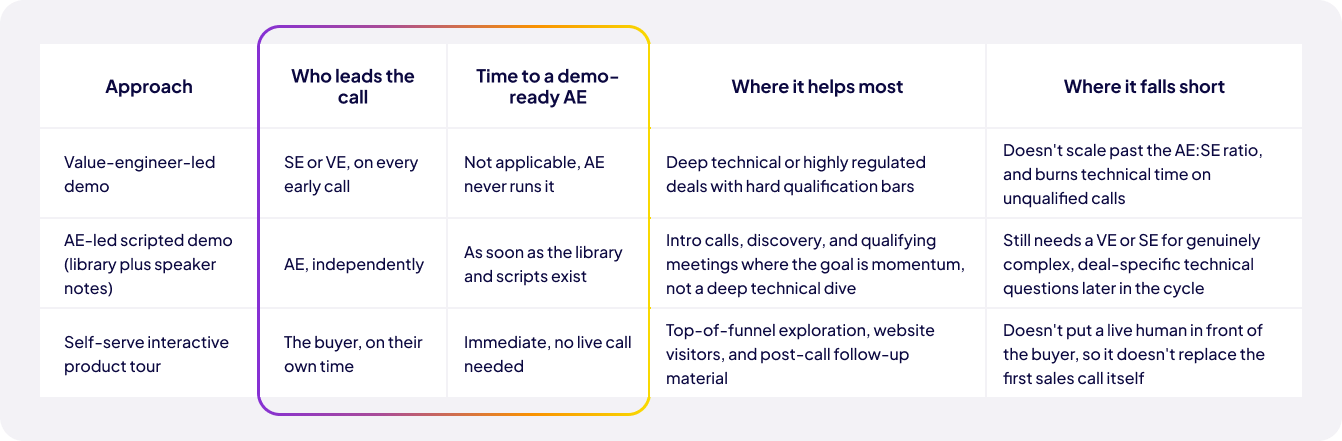
These are three jobs, not three competitors. Self-serve demos are the right answer for a buyer who wants to explore before talking to anyone, and they carry real volume when done well. GuideCX runs 35,000+ demo views a month through website demos (GuideCX customer story). Most teams need both: a self-serve path for buyers who are not ready to talk, and an AE-led live demo for the ones who are.
An AE-ready demo library includes demos scripted for specific personas and use cases, detailed speaker notes inside the demo, and the ability to adjust data and content quickly for a named account. That combination removes the two things that usually stop an AE from presenting: not knowing which version of the demo fits this buyer, and not knowing what to say while showing it.
The customization piece matters as much as the script. A library that cannot be adjusted quickly for a specific account becomes a set of generic walkthroughs nobody wants to sit through. Being able to change data and content in minutes, rather than requesting a custom build from a technical resource, is what keeps the AE independent instead of routing back to the SE anyway.
This is the seller support layer of demo automation: not building demos faster, but making sure the right person can find, personalize, and present the right demo without a queue in front of them.

Celonis is a useful proof point because the problem was never a shortage of technical talent. The Celonis sales team was not running demos in intro calls at all. Product complexity pushed most first meetings toward qualification and slides, and a call counted as a success if it earned a follow-up session with a value engineer. VEs were being pulled into early calls with leads that had not been properly qualified yet.
Celonis addressed it with Demoboost: a library of scripted demos built for specific personas and use cases, with detailed speaker notes so AEs and BDRs could present confidently while staying true to the script. The team could adjust data and content in minutes for a specific account, and share the same demos as follow-up material after the call.
The results, from the Celonis customer story: 100% of AEs always ready to demo, 100% of first calls including a demo, and 100% removal of value engineers from top-of-funnel calls.
Nash Cox, Account Executive at Celonis, described the shift this way: "I love the tool and wouldn't change a thing. I was a little transparently resistant at first because I'm a control freak. But it's really easy to let go of that control and just start reading and not having to think."
The preparation load moved too. As Elizabeth Boyle, Account Executive at Celonis, put it: "The biggest advantage of Demoboost, especially on busy days, is that it saves a lot of preparation time. For instance, when I have multiple customer calls, I wouldn't have time to practise every demo or feel fully prepared for each one."
Nobody made Celonis's AEs more technical. Celonis changed what an AE walked into the call holding.
The pattern repeats elsewhere. Spryker cut presales involvement in top-of-funnel calls by 95% and now includes a product demo in 100% of first calls (Spryker customer story).
It should keep working. The same scripted demo an AE runs live becomes the follow-up asset the buyer explores afterward and shares internally, which is exactly how Celonis used its library.
That matters for more than convenience. A demo that lives on after the meeting produces engagement data: which screens the buyer returned to, where they spent time, what they skipped, and who else in the account opened it. Demo analytics turns that into a product-level signal sales and presales can act on before the next call.
This is the difference between demo creation and a demo revenue system. Getting an AE demo-ready is the first step. Making the demo a reusable, trackable asset that feeds the revenue workflow is what makes the change hold.
In most cases it is not an AE skill problem. It is that the team never built a demo an AE could run: persona-matched, scripted, with speaker notes. 93% of surveyed sales engineers say they are involved in the solution presentation and demo stage very often (Vivun, State of Sales Engineering 2025 Report), which normalizes the escalation until AEs stop presenting altogether.
The terms are often used interchangeably, and both describe a technical presales resource who supports account executives with product depth, discovery, and demos on complex deals. The exact title varies by company.
Not on its own. More headcount relieves pressure temporarily, but the underlying pattern resurfaces at the next stage of growth, at a higher cost. New sales engineers also typically take 4 to 6 months to ramp (Vivun, State of Sales Engineering 2025 Report), so hiring is a slow answer to a this-quarter problem.
It replaces part of the buyer's early, asynchronous exploration, but it does not put a live person in front of the buyer during the first call. Most teams run self-serve demos and AE-led live demos at different points in the same funnel rather than as substitutes.
Demos scripted for specific personas and use cases, detailed speaker notes inside the demo, and the ability to adjust data and content quickly for a named account. Celonis built its library this way, which is what let AEs and BDRs present without a value engineer on the call.
There is no universal number, but survey data shows clustering at 2:1, 3:1, and 4:1 (Vivun, State of Sales Engineering 2025 Report). If SEs regularly join calls that later turn out to be unqualified, the ratio is being spent on the wrong calls before it is a headcount problem.
No. It changes what SEs and VEs spend their time on. Genuinely complex, deal-specific technical questions later in the cycle still need a technical resource. The goal is removing SEs from calls that do not need them, not removing the role.
The full Celonis customer story covers how the library was structured and what changed, including 100% of first calls now including a demo and full removal of value engineers from top-of-funnel calls.
Book a live demo to see how Demoboost helps your team cut demo prep time, qualify buyers faster, and focus on real opportunities.
Book a Live Demo

.png)
.png)
