.png)
Learn how presales is evolving and howyour team can stay ahead in atech-driven sales landscape.


When a computer vision safety platform outgrew its live demo environment, one solutions engineer turned a blank sandbox into a full-scale, industry-specific sales machine.
Voxel's computer vision platform monitors physical environments in real time — catching forklift near-misses, flagging improper technique, surfacing safety risks before they become incidents. The product is visually dramatic and deeply compelling. The demos, historically, were not.
Scott, Voxel's Solutions Engineer, was tasked with changing that. The company's existing demo environment was a live product instance — unpredictable, performance-sensitive, and entirely dependent on which engineer happened to be driving. Account executives were running what insiders called a "spray and pray" motion: walk prospects through every feature, every button, every admin screen, and hope something sticks.
Leadership wanted something better. Customers were asking for it. And Scott had a vision for what it could look like.

The answer was a fully custom sandbox demo — one that could tell Voxel's story with real customer footage, authentic workflows, and the kind of moments that make a safety platform sell itself.
What started as a supply chain vertical demo quickly became something much larger. Over several months of intensive work, Scott constructed a sandbox environment spanning hundreds of screens — organized by feature set, wired with custom interactivity, and populated with real customer video footage that captures Voxel's value in visceral, unmistakable ways.
Rather than building one monolithic demo, Scott took a modular approach: constructing mini-demos for each functional area — Actions, Boards, Browse, Reports, Dashboards — then assembling them into a master demo. This architecture made the project manageable and set the foundation for rapid duplication across industry verticals.
The scope was significant enough that Scott benchmarked his browser tab at peak build: 7.5 gigabytes of RAM. A 400-screen, custom-linked, video-rich sales environment that had to run smoothly on a sales rep's MacBook at a customer site.
The most persistent challenge was performance on multimedia-heavy screens — particularly the video playback screens that are the heart of Voxel's demo. These are the moments where a prospect sees a forklift near-miss flagged in real time, or a behavioral pattern surfaced across hundreds of hours of footage. They have to land.
The solution came in stages. Video screens were migrated to S3 hosting, cutting load times dramatically. A broader rendering engine update then shifted RAM load from the browser to server-side infrastructure — a fundamental architectural change that made the experience viable on the kind of devices a road-warrior AE actually carries. The old "this is taking longer than expected" blank screen was replaced with a smooth, unobtrusive progress indicator that doesn't break the flow of a live demo.
One of the most technically interesting breakthroughs came from Scott himself. Voxel's platform generates complex stacked bar charts — incident counts by type, broken down by camera zone, across rolling time periods. These were being captured as flat, static graphics, making individual bars unclickable and non-configurable.
Scott used AI to write a custom tool that parsed the demo's HTML, identified individual chart elements, and made each bar independently selectable — enabling click-through navigation to specific data points. Rather than clicking a static chart that links to a single next screen, AEs can now click individual bars and navigate directly to the relevant footage, the associated action items, or the trend analysis. It's the difference between showing a dashboard and demonstrating intelligence.
What began as a technical project evolved into something with significant strategic implications. By the time Voxel's QA team began testing in earnest, the sandbox had started to look less like a demo and more like the foundation for a new approach to sales entirely.
Voxel's leadership was asking the right questions: what if different buyer personas could have different demo experiences? An operations executive doesn't need to see the same screens as a safety professional. A prospect evaluating a single feature shouldn't sit through a full-platform tour.
The modular architecture Scott had built from day one made this immediately actionable. Each mini-demo — Actions, Boards, Reports, specific use cases like ergonomics or liquid spills — could be assembled into a guided playlist. Show the exec the value story. Show the practitioner the workflow depth. Let the product qualify the lead.
The emerging vision is a system where an AE's morning briefing — powered by AI, pulling from calendar, CRM, and LinkedIn — recommends a demo track tailored to the specific meeting. Executive suite? Playlist A, highlighting cost savings. Safety team? Playlist B, deep-diving into behavioral analytics and incident workflows.
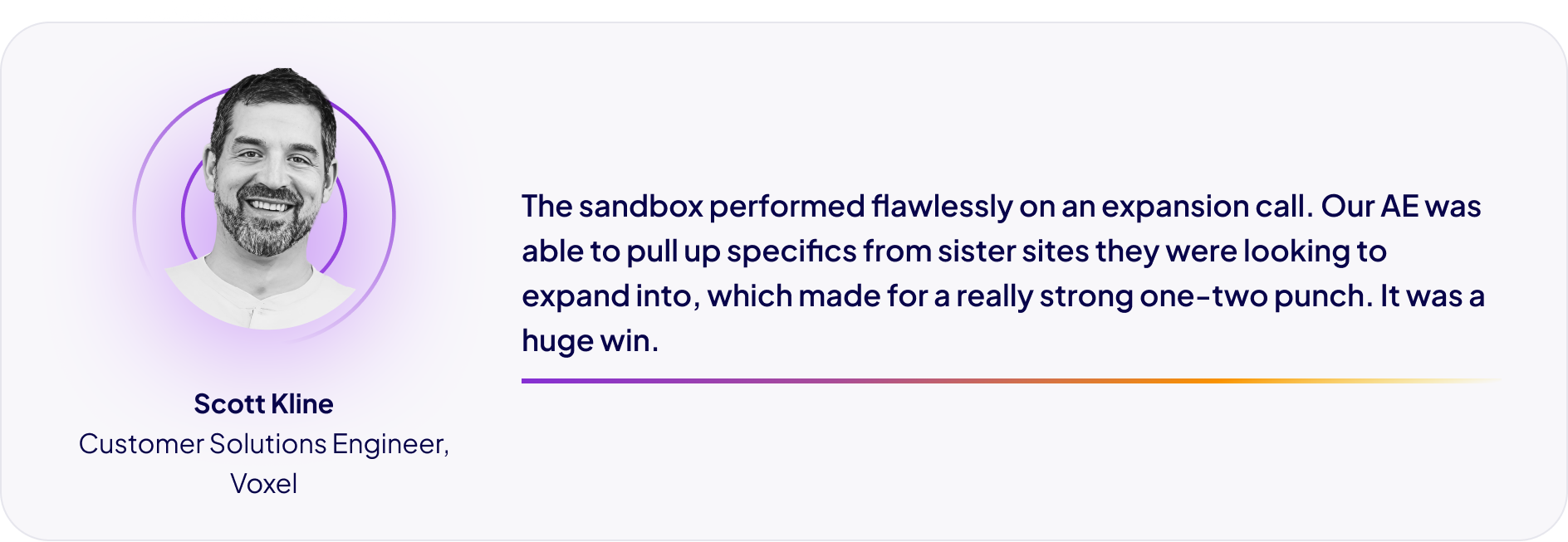
Before any formal rollout, the demo was already delivering. Voxel's Australia-based AE used it on an expansion call with an existing customer — a port operator evaluating new sites. He ran it directly from the sandbox, using real footage from sister facilities, and walked away with a win. He didn't need to be asked to spread the word. He told his peers. That kind of organic adoption — from a skeptical sales team that had been burned by flaky demo environments before — is the real signal that something has changed.
With the supply chain demo live and performing, Scott has turned his attention to the manufacturing vertical — a substantial project made dramatically faster by the modular architecture he established from the start. Ports and terminals are next.
On the horizon: AI-powered variable replacement that could automatically refresh dates, customer names, and data points across hundreds of screens at once. Global linking, which will let a single command replace hours of repetitive screen wiring. Guided tour experiences that let a prospect navigate the demo on their own terms, express what they care about, and receive a tailored experience before they've spoken to a single human.
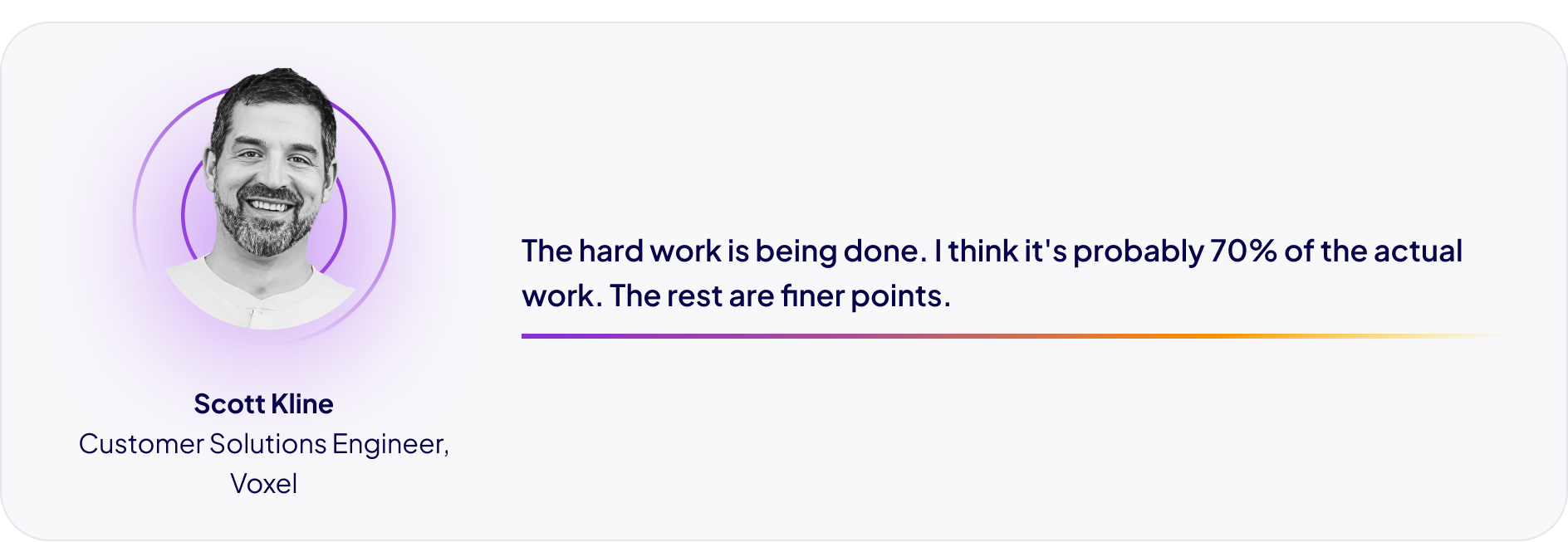
The foundation is there. A 400-screen, video-rich, custom-wired, industry-specific demo environment that performs on field hardware, tells a story executives respond to, and gives practitioners the depth they need to advocate internally. Built by one person, iteratively, over several months — with a platform that met him where he was and helped him get where he needed to go.
Book a live demo to see how Demoboost helps your team cut demo prep time, qualify buyers faster, and focus on real opportunities.
Book a Live Demo

.png)
.png)
