
.png)
Learn how presales is evolving and howyour team can stay ahead in atech-driven sales landscape.

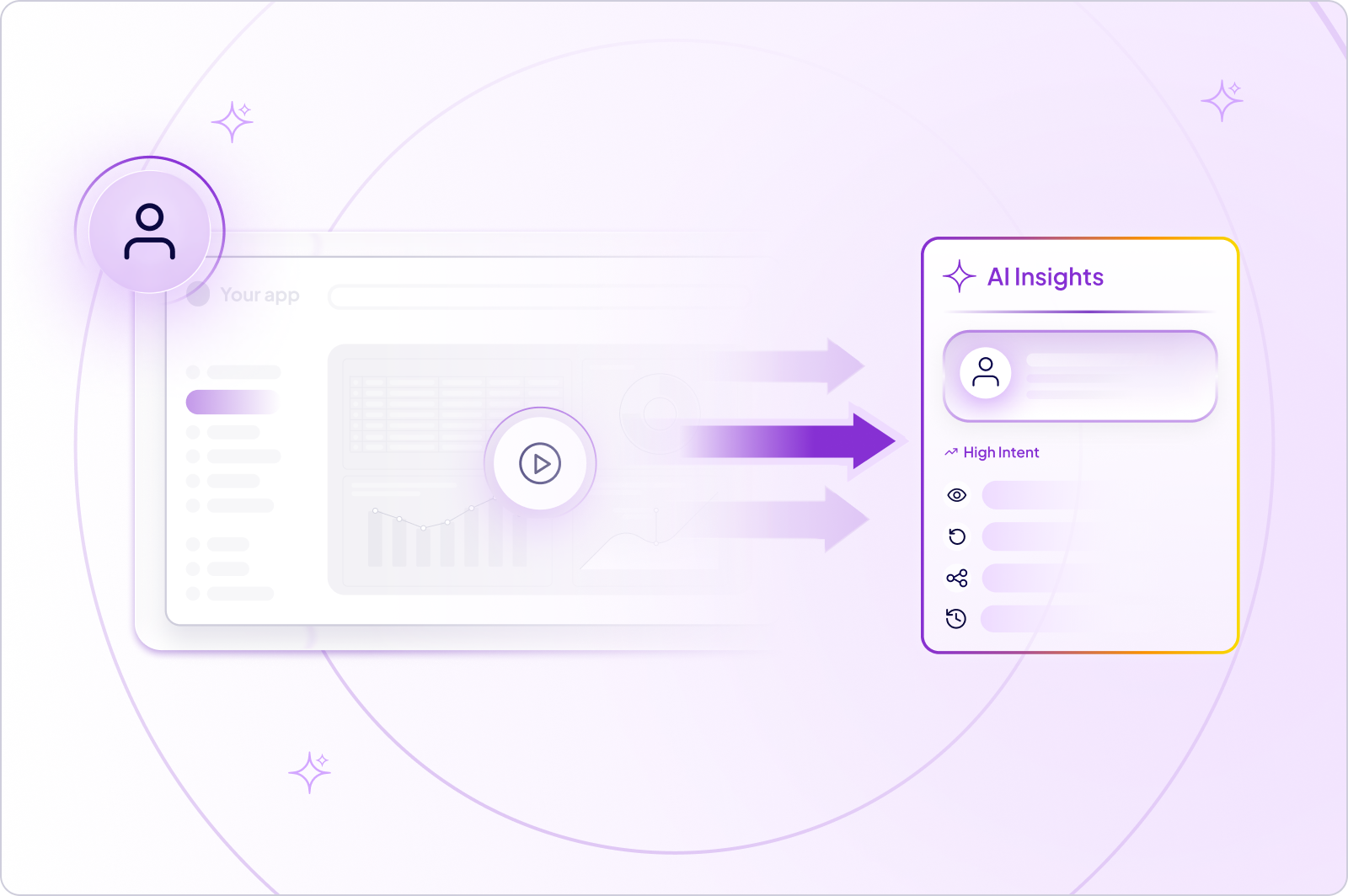
Every interactive product demo generates a stream of behavioral data: who opened it, which steps they viewed, where they slowed down, what they skipped, whether they came back, and who they forwarded it to. AI analyzes this data by scoring individual engagement events, detecting patterns across a buying committee, and converting both into prioritized, explained signals for sales and presales teams. The result is not a bigger dashboard. It is an answer to two questions reps actually have: which deals deserve attention today, and what should I say when I reach out.
This is the third post in our intent series. The first covered how to build an enterprise intent strategy using product demo engagement and the second covered how to surface buyer intent signals from demo engagement before sales calls. This one goes a level deeper: what AI actually does with those signals, and where its limits are.
TL;DR
Because the volume and structure of the data outgrew manual review.
A single enterprise deal can involve a large buying group. Gartner's 2024 buying research puts the typical B2B buying group at 6 to 10 people. Multiply that by dozens of active opportunities, each interacting with multiple demos across weeks, and no SE or rep can manually track who watched what, in which order, and what changed since last Tuesday.
The buying environment is also shifting toward self-directed evaluation, which means more of the buying journey happens inside content like demos rather than on calls. According to Gartner's survey of 646 B2B buyers (August to September 2025), 67% of B2B buyers prefer a rep-free experience, and 45% used AI during a recent purchase. When buyers do more evaluation on their own, demo engagement becomes one of the few windows revenue teams have into that hidden work. AI is what makes that window readable at scale.
AI works with the behavioral events an interactive demo platform captures. The main categories:
None of these signals require AI to exist. They require AI to be interpreted together, at account level, in time to matter.
The core mechanism is pattern matching against outcomes. AI models look at historical demo engagement across closed-won and closed-lost deals and learn which combinations of behavior preceded pipeline movement. A completion alone is a weak signal. A completion, followed by an internal share, followed by a return visit to the integrations step within 48 hours, is a pattern.
The practical output usually takes three forms:
Manual and AI-assisted are not enemies. The point of the table is that AI removes the parts reps were never going to do consistently, and leaves them the part only they can do: the conversation.
This is where demo engagement outperforms most other intent sources. Third-party intent data tells you an account is researching a category. Demo engagement tells you which specific people inside the account are evaluating your specific product.
AI stitches individual events into an account-level picture by grouping identified viewers by company domain, then reading the composition of the group. Three patterns matter most:
This is also why viewer identification matters. Buying committee analysis only works when engagement resolves to identified people, not anonymous sessions.
An honest answer, because vendors rarely give one.
AI interprets signals. It does not read minds. A replay of the pricing step could mean serious evaluation or a procurement analyst doing diligence on three vendors. AI narrows the interpretation. The rep confirms it in conversation.
The analysis is only as good as the input. If your demos are fragmented, untracked, or generic one-off recordings, there is nothing meaningful to analyze. AI-driven intent analysis assumes a governed demo library where engagement is captured consistently. This is the unglamorous prerequisite most teams skip.
AI does not replace the seller. It sets the seller up. Gartner's own follow-up research (May 2026) found that 69% of B2B buyers turn to sales reps to validate AI-generated insights. Buyers use AI to research, then use humans to confirm. The teams that win pair AI-analyzed demo intent with a rep who shows up already knowing what the buying group cared about.
Correlation is not a verdict. Intent scores are probabilities, not guarantees. Treat them as prioritization and preparation tools, not autopilot.
Demoboost captures demo engagement at the step and session level and identifies viewers through lead forms and personalized demo links, so engagement can resolve to real people, not anonymous sessions.
Revenue Intelligence turns that engagement into a working view of your pipeline at the lead level. You see identified leads ranked by engagement, each with a lead score (hot, warm, or cold), and can drill into any lead: demos viewed, visits, total time spent, and an activity timeline per demo showing screens completed, time spent, and CTA clicks. Key highlights surface the moments that matter, like the longest viewed screen, the drop-off screen, and who the lead shared the demo with. Filters, period comparison, and CSV export keep the data workable, and UTM source and medium travel with each lead, so you know which campaign produced the engagement. That is the input layer AI analysis depends on: complete, first-party engagement data rather than anonymous web activity.
Global Webhooks then move those signals into the tools where revenue teams already work. Three triggers are available today: demo created, demo completed, and lead form completed. Each one can route through Zapier, Make, or similar middleware into Salesforce, HubSpot, Slack, or your sales engagement platform to create a lead, post a notification, or fire a follow-up task. With matching rules configured in your middleware, events can also log against existing opportunity records. And because every event carries the demo's ID, routing stays precise: the AE hears about the completed follow-up demo, the SE hears about the technical one, not everything.
Demoboost's shipped analytics work at the lead level. The account rollup described earlier happens where those signals land, in your CRM or data stack, which is exactly why routing them there matters.
The engagement volume behind this is real. Celonis routes prospects through a structured gallery of 12 self-service demos, with an average of 4,300 prospects engaging every month, first-party signal at a scale no rep could track manually.
For the full set of workflows, from lead scoring to abandoned-demo campaigns, see How to Use First-Party Demo Data Across the Entire Revenue Team.
1. How does AI detect buyer intent from a product demo?
AI analyzes engagement events captured by the demo platform, including completions, time per step, replays, return visits, internal shares, and drop-off points. It scores these against behavioral patterns that historically preceded deal progression and rolls individual activity up to account level, so teams see buying committee intent, not just single-viewer stats.
2. Which demo engagement signals indicate the highest buyer intent?
Three signals consistently rank highest: full demo completion, an internal share that brings new stakeholders from the same account, and a return visit within 48 hours. Each on its own is meaningful. In combination, they indicate active evaluation.
3. Is AI intent scoring from demos more accurate than third-party intent data?
They answer different questions. Third-party intent data identifies accounts researching a category. Demo engagement is first-party and product-specific: it shows which people at an account engaged with which parts of your product story. Third-party data tells you which accounts to work. Demo engagement tells you what to say when you get there.
4. Can AI tell which buying committee members viewed a demo?
Yes, when viewers are identified through lead forms or personalized demo links rather than anonymous sessions. AI can then group activity by company, flag new stakeholders as they appear, and map section-level attention to likely roles, such as technical evaluators focusing on integration steps.
5. Does AI intent analysis replace sales conversations?
No. AI prioritizes deals and prepares the conversation; it does not have it. Gartner research from May 2026 found that 69% of B2B buyers turn to sales reps to validate AI-generated insights. AI-analyzed demo intent works best as preparation for a rep, not a replacement for one.
6. What do teams need before AI can analyze demo intent reliably?
Three prerequisites: a governed demo library so engagement is captured consistently across sellers, identified viewers rather than anonymous sessions, and a way to route demo signals into the systems where deals are worked, such as webhooks or workflow automation. Without these, AI has nothing reliable to analyze.
Book a live demo to see how Demoboost helps your team cut demo prep time, qualify buyers faster, and focus on real opportunities.
Book a Live Demo

.png)
.png)
