
.png)
Learn how presales is evolving and howyour team can stay ahead in atech-driven sales landscape.

Most advice about SaaS software sales assumes your problem is pipeline. Book more meetings, write better sequences, qualify harder at the top.
For teams selling complex software, the bottleneck is often further down.
Deals do not always die because nobody was interested. They stall in the weeks between a promising discovery call and a signature, while a group of people with different priorities try to agree on whether the product can actually do what they need it to do.
That middle stretch is where product evaluation happens, and the demo is one of its most important components.
This article is a diagnostic rather than an introduction. It assumes you already sell SaaS and looks at where deals stall, why the demo stage becomes difficult to scale, what to measure so you can see it happening, and how to run that part of the sales process differently.
SaaS software sales is the practice of selling subscription software, where the customer pays for ongoing access rather than purchasing a perpetual license.
That structure makes sales efficiency important. A deal that takes longer to close delays revenue and consumes more selling capacity against the same contract value. As deal size and complexity increase, so does the cost of an inefficient evaluation process.
The second structural difference is who you are actually selling to.
In complex B2B software, the decision rarely belongs to one person. A champion may bring you in, but security reviews the architecture, finance evaluates the commercial case, IT asks about integrations and identity providers, and eventual users decide whether the product will actually work for them.
Your champion also has to sell internally, in conversations you are not part of, using the evidence you leave behind.
Gartner reports that 75% of B2B buyers prefer a rep-free sales experience. That does not mean buyers want less information. It means they increasingly want to research and evaluate without needing a seller for every interaction.
For a product that needs to be seen to be understood, that creates an important question:
How do you give buyers enough access to the product story without requiring another live meeting every time?
Most SaaS sales cycles move through some version of the same path. What differs is where each team loses momentum.
Prospecting. The failure mode here is volume without fit. Teams fill pipeline with accounts that were unlikely to buy, then interpret poor downstream conversion as a closing problem. Often, it started as a targeting problem.
Discovery. The failure mode is a good conversation that produces little usable information. A discovery call that confirms interest but does not uncover the buying group, evaluation criteria, business impact, or competing priorities leaves the difficult questions for later.
Evaluation. This is where the product has to prove itself. The champion needs enough confidence to advocate internally. Technical stakeholders need to validate their requirements. End users need to understand how the product affects their work. Executives may need evidence that the solution justifies the investment.
Much of that evaluation happens after the live meeting, in conversations the seller cannot see, using whatever the buyer took away from the call.
Negotiation. The failure mode is often discovering an objection or stakeholder too late. Procurement, legal, security, finance, or an executive sponsor arrives with a requirement that could have been surfaced earlier. What looks like a negotiation problem may actually be incomplete evaluation.
Onboarding and expansion. The failure mode is a gap between what was demonstrated and what gets delivered. If the sales experience creates expectations that implementation cannot reproduce, the problem appears immediately after the contract is signed.
The evaluation stage sits in the middle of many of these problems. It is where product expectations are set, technical confidence is built, and stakeholders gather the evidence they need to support a decision.
That makes it worth examining separately.
The demo is structurally different from most other sales activities.
A strong presenter can make a deck more compelling. A confusing product experience is harder to recover from.
When buyers cannot follow the workflow, they may not distinguish between a weak demonstration and a difficult product. The demo becomes part of their judgment of the product itself.
Complex demos often rely on sales engineers or presales specialists because those people understand the product deeply enough to adapt the story to the buyer.
That expertise is valuable precisely because it is limited.
When the same specialists are required for standard first demos, technical evaluations, custom preparation, follow-up sessions, and demo maintenance, their calendars become part of the sales process.
If only a small group can confidently present the product, account executives have to wait for them.
That can create a queue around work that does not always require deep technical expertise.
The objective is not to remove sales engineers from the process. It is to concentrate their time where technical expertise materially improves the deal.
CRM data tells you that a meeting happened.
It rarely tells you whether the buyer revisited the product story, which workflows attracted attention, whether another stakeholder opened it, or where someone stopped exploring.
That creates a blind spot during one of the most important parts of evaluation.
There is also a less visible problem: products change.
A demo environment reflects the product at the point it was prepared. As new features, interfaces, workflows, and data models ship, the demo begins to drift.
Eventually, the seller either spends time rebuilding it or presents something that no longer represents the current product.
Radiant Security, an AI-powered Security Operations Center company, ran into exactly this problem. Its small sales engineering team supported a global sales organization, while meaningful product changes could require significant demo maintenance.
Its demo had fallen roughly six months behind the product. After moving to a modular demo approach, Radiant reduced demo maintenance time by 75% and recovered 10 to 20 hours per update cycle.
The most important number may not be 75%.
It is six months.
For that period, prospects were evaluating a version of the product that no longer represented what the team could actually deliver.
Most SaaS teams use some combination of live presentations, recorded walkthroughs, slides, and product environments.
Interactive demos add another model: a reusable product experience that can be delivered live or explored independently.
The biggest difference is not whether someone clicks the screen. It is what happens after the first presentation is over.
The final two rows are often underweighted.
A good live demo can win the people in the room. Enterprise deals also depend on what happens when those people take the story to everyone who was not.
A word on benchmarks first.
Published averages for SaaS sales cycle length, demo conversion, and demo-to-close rates vary widely by segment, ACV, product complexity, and methodology. Many secondary sources also repeat figures without showing the underlying research.
Your own baseline is therefore usually more useful.
Measure the current process, segment it appropriately, then watch whether it improves.
Of the accounts that receive a demo, how many become qualified opportunities?
A weak number can indicate several different problems: poor qualification, a generic demo, incorrect audience, or a product-value mismatch.
The important part is comparing the metric with other stages rather than treating it in isolation.
Track it by segment, deal size, and type of opportunity.
Then examine what happens inside that period.
How much time is spent waiting for another stakeholder call? How much is technical evaluation? How much is procurement? How much is simply silence?
That tells you whether improving product access could actually shorten the cycle.
A view by itself is a weak signal.
What did the buyer explore? Which screens or workflows attracted attention? Did they finish the experience? Did they return?
Engagement becomes useful when it provides context for the next action, not when it creates another vanity metric.
Repeated engagement can be particularly interesting in complex sales.
A champion who returns to a product experience or shares it internally may be doing the consensus-building work that sellers cannot see.
That does not automatically mean the deal will close. It does provide a stronger follow-up signal than a generic “just checking in.”
This is the internal metric many teams never measure.
Ask presales how much time is spent keeping demonstrations aligned with product releases.
If demo maintenance repeatedly consumes specialist capacity, the cost belongs in your sales-efficiency calculation even if it never appears in the CRM.
Demoboost's demo analytics can provide engagement data across interactive demo experiences. Revenue Intelligence adds a lead-level view, helping teams identify accounts with recent activity, repeat engagement, completion, and other buying signals.
Maintenance effort still needs to be measured internally, and it is worth doing.
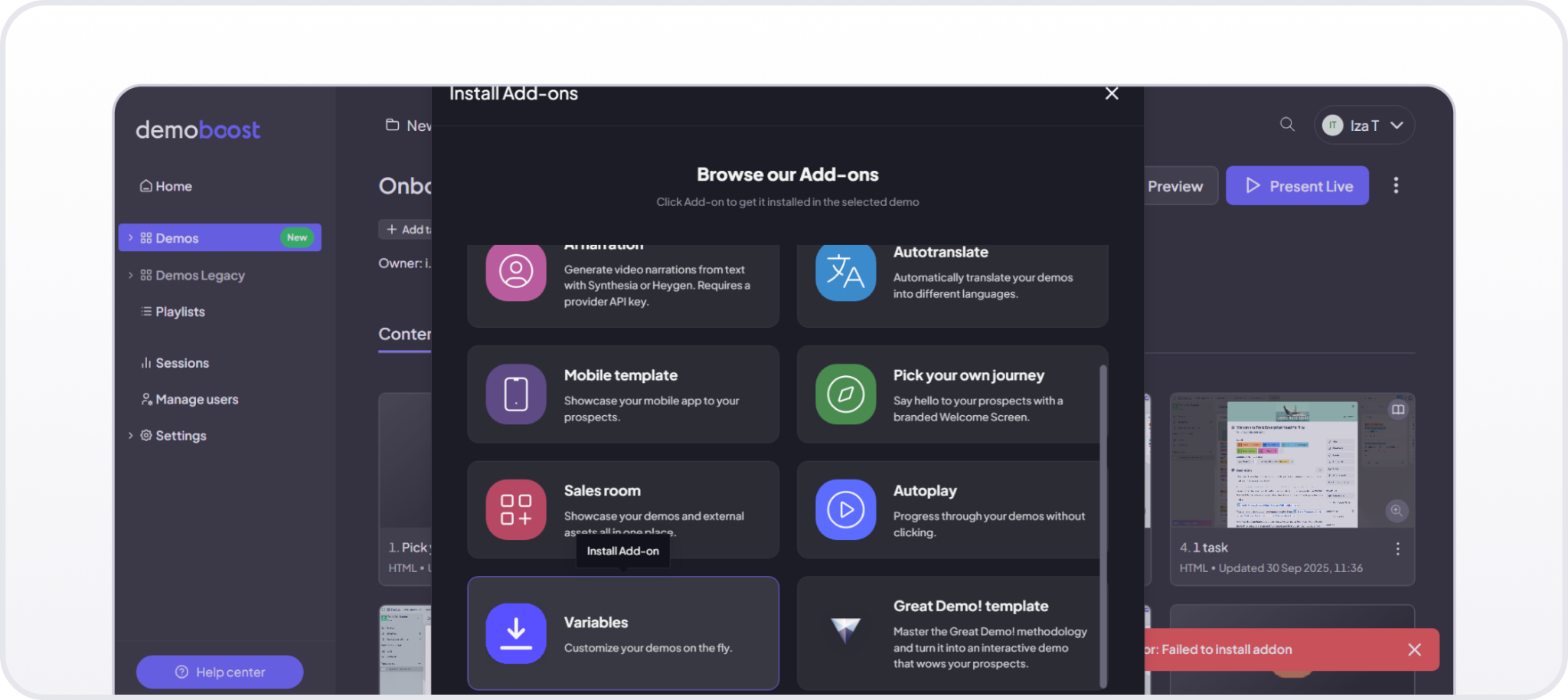
Teams often use the word “integration” to describe several different things.
They are not interchangeable.
An in-product dashboard shows demo activity inside the demo platform.
That is useful for the people building, managing, and analyzing demos. It becomes less useful if sellers need to leave their normal workflow every time they want to check buyer activity.
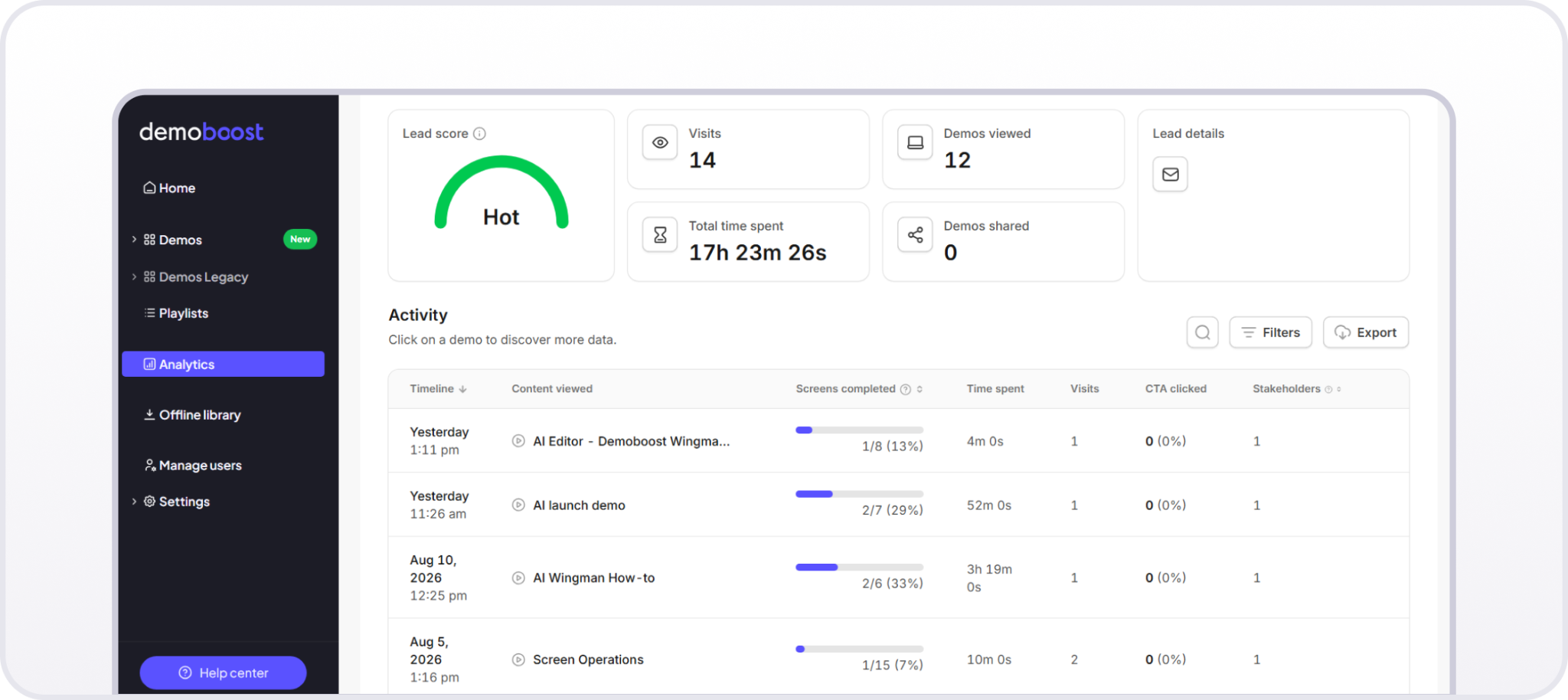
Demoboost analytics view
Webhooks send supported events from one system to another.
For example, a demo event can move through middleware such as Zapier, Make, or Workato and then into CRM, marketing automation, Slack, BI, or another workflow.
Demoboost Global Webhooks work at the organization level, so teams can configure supported event flows centrally rather than separately for each demo.
If the demo stops being something that exists only while a specialist is presenting and becomes a reusable sales asset, several parts of the SaaS sales process can change.
A prospect who has already explored a relevant product experience may arrive at the first conversation with more specific questions.
That allows the seller to spend less time on a generic overview and more time understanding the buyer's situation.
Not every product conversation requires a sales engineer.
When approved demo stories are reusable and supported by presenter guidance, account executives can handle appropriate lower-complexity demonstrations while presales focuses on technical discovery, strategic deals, and deeper validation.
ELMO Software reports that 100% of its SMB sales are now led without presales support, alongside a 32% conversion rate from marketing campaigns.
The point is not that every company should remove presales from SMB sales.
It is that product expertise can be packaged in a way that makes sellers less dependent on a specialist for repeatable conversations.
After the meeting, the buyer can receive the product experience you discussed rather than only a PDF or recording.
A champion can then share it internally, and different stakeholders can revisit the parts relevant to them.
The product remains part of the buying conversation even when the seller is not.
Self-guided demos also extend product education to buyers who are not ready to book a meeting.
MySolution turned its website demo into a product education and lead generation channel and reported a 30% increase in demo requests, alongside more than 6,500 demo interactions in the first two months.
This does not remove salespeople from SaaS software sales.
It moves sellers and presales specialists toward the parts of the cycle where their expertise changes the outcome, while giving buyers more freedom to explore the product independently.
You do not need an industry benchmark to find out whether your demo operation is slowing deals down.
Start with your own recent opportunities and answer these questions.
Pull recent closed-won and closed-lost opportunities and segment them by deal type.
You are looking for where time accumulates, not for one universal “good” number.
Look at how much specialist time is spent on standard product stories versus technical discovery and complex evaluation.
If specialists repeatedly deliver the same lower-complexity walkthroughs, there may be an enablement opportunity.
Measure the gap between requesting a demonstration or technical follow-up and actually receiving it.
If scheduling specialist time repeatedly creates delay, that is a process constraint worth addressing.
Ask when each important demo was last updated and compare it with what has shipped in the product since.
A demo that materially lags the product can affect both accuracy and buyer confidence.
Track the time needed to update a demo after a substantial release.
If the answer repeatedly consumes significant SE or product-marketing capacity, maintenance is part of your cost of sale.
Can you see only who attended the meeting?
Or can you also understand whether the product experience was revisited, which areas buyers explored, and whether engagement continued?
Enterprise buying groups grow as the deal progresses.
If every new stakeholder requires another full demonstration, each additional person introduces another scheduling dependency.
If engagement data exists only in a platform your sellers rarely open, its practical value will be limited.
Determine which signals actually matter and where the revenue team needs to see them.
The purpose of the audit is not to produce a perfect score.
It is to identify where your current demo process creates unnecessary waiting, repeated specialist work, outdated product experiences, or missing buyer insight.
Fix those first.
If your deals are stalling and you are not sure why, adding more pipeline is not always the first thing to fix.
Start by looking at the middle of the process.
Pull a sample of recent opportunities and measure what happened between the first meaningful product interaction and the final decision.
How long did buyers wait?
How many specialist calls were required?
How often did another stakeholder need the story repeated?
How much time did your team spend preparing or maintaining the demo?
And what could you actually see about buyer engagement once the meeting ended?
If the answers are unclear, you have found a part of the SaaS sales process worth instrumenting.
If the answers show repeated scheduling delays, duplicated demo work, outdated environments, and little visibility after the call, you have found something worth fixing.
1. What is SaaS software sales?
SaaS software sales is the practice of selling subscription-based software, where customers pay for ongoing access rather than purchasing a perpetual license. In complex B2B SaaS, the process often involves multiple stakeholders, product evaluation, technical validation, security review, procurement, and ongoing consensus building.
2. How long is a typical SaaS sales cycle?
There is no universally useful benchmark. Sales-cycle length varies significantly by contract value, market segment, product complexity, number of stakeholders, and procurement requirements. Measure your own baseline by segment and monitor where qualified opportunities spend unnecessary time.
3. How many demos does a SaaS deal need?
There is no fixed number. Complex B2B deals may require different product experiences for different stakeholders and stages of evaluation. The more useful question is how many of those interactions require another live meeting and specialist involvement.
4. What is the difference between a product tour and an interactive demo?
A product tour is typically a short, guided experience designed to introduce selected workflows or features. Interactive demos can support broader product exploration and may be used across website education, live selling, buyer follow-up, technical evaluation, and other stages of the sales process, depending on the platform and format.
5. What should we measure at the demo stage?
Useful metrics include demo-to-opportunity conversion, time from first demo to close, engagement depth, repeat visits, internal sharing where identifiable, and the time your team spends preparing and maintaining demos.
The goal is to understand both buyer behavior and the internal cost of delivering the product experience.
6. Can demo activity be tracked in a CRM?
Yes, depending on the platform and integration. Demo events can be routed through webhooks and middleware, while direct CRM integrations can surface supported engagement data in the systems revenue teams already use.
When evaluating a platform, ask which events and fields are supported rather than stopping at whether a CRM logo appears on the integrations page.
Book a live demo to see how Demoboost helps your team cut demo prep time, qualify buyers faster, and focus on real opportunities.
Book a Live Demo

.png)
.png)
