
.png)
Learn how presales is evolving and howyour team can stay ahead in atech-driven sales landscape.

The presales effectiveness problem is what happens when experienced sales engineers spend most of their week on repeatable demo work instead of the discovery, technical validation, and complex deal support they were hired for. The team looks busy. Demos get delivered. But deals wait on SE availability, first calls happen without a product demo, and the most expensive technical talent in the revenue org is rebuilding the same walkthrough for the fifth time this month. You fix it by separating repeatable demo delivery from individual SE calendars, not by adding headcount. This article explains why the pattern develops, what it costs, and how demo automation resolves it.
The takeaway: presales effectiveness is not a talent problem. It is a workflow problem, and you cannot hire your way out of a workflow problem.
The presales effectiveness problem is the mismatch between the seniority of presales talent and the repeatability of the work filling their calendars. Sales engineering has matured into a senior, well-compensated function with direct revenue accountability. The work, in many organizations, has not matured with it. SEs still hand-build demo environments, repeat near-identical product walkthroughs on early calls, and act as the only people in the company able to show the product.
Three symptoms usually confirm you have it:
Demo wait times gate the pipeline. If a buyer has to wait days or weeks between "we would like to see the product" and actually seeing it, deal momentum leaks away in the gap. Buyers evaluate other vendors while they wait.
First calls happen without the product. When only presales can demo, account executives run discovery calls empty-handed and book a second meeting to show the product. That is one extra meeting per deal, multiplied across the whole pipeline.
Senior people do junior work. The introductory walkthrough that an SE has delivered a hundred times does not require senior judgment. Custom proof-of-concept work for a strategic account does. When both compete for the same calendar, the walkthrough usually wins because it is scheduled first.
Presales effectiveness breaks down because demo delivery is coupled to individual availability while demand for demos keeps growing. A few structural forces drive it:
Buyers want the product earlier and more often. Gartner found that 67% of B2B buyers prefer a rep-free experience for at least part of their purchase, based on a survey of 646 buyers fielded in late 2025 (Gartner press release, March 2026). That figure is up from 61% the year before. Buyers who research independently expect to see the product on their terms, not after two qualification calls and a scheduling round.
Demo demand scales with pipeline, headcount does not. Every new AE, every new market, and every new product line adds demo requests. SE hiring lags all of them, so the same team absorbs more volume with the same hours.
Demo creation is manual and fragile. When each demo environment is built by hand, personalization means rebuilding, product updates mean rework, and only a small group has the skills to do either. Scarcity of demo-capable people becomes the bottleneck for the entire revenue team.
Demos die after the meeting. A live demo that exists only in a call leaves nothing behind for the buyer's colleagues who were not in the room. The champion retells the story from memory, and the SE gets pulled back in to repeat the session for a wider group.
None of these forces are about individual performance. That is why performance-management responses, more enablement, tighter call reviews, and better discovery checklists, rarely move the numbers on their own.
It costs deal velocity, SE capacity, and, over time, the retention of your most experienced technical talent. The costs compound quietly because each one looks like a normal operating expense:
Direct labor cost per demo. Hours of preparation and follow-up from highly compensated SEs, spent on every demo including ones delivered to opportunities that were never qualified. The scale is easier to see in reverse: after moving repeatable demos off SE calendars, each Spryker SE got back an average of 3 hours per week (Demoboost customer story). Run that across a team of ten and it is most of an additional headcount, recovered without hiring.
Opportunity cost of misallocated hours. Every hour an SE spends on a repeatable walkthrough is an hour not spent on discovery or technical validation for the deals that actually need expert judgment. Gartner research finds that B2B buyers are 1.8 times more likely to complete a high-quality deal when they use supplier-provided digital tools in partnership with a sales rep rather than independently (Gartner B2B Buying Report). The digital tools have to exist for that partnership to happen, and someone has to have the time to build them.
Stalled pipeline. Demo wait time is dead time in the deal. Before switching to demo automation, Spryker's buyers waited an average of 1.5 weeks for a demo (Demoboost customer story). A week and a half is long enough for a competitor to run their entire first meeting.
Burnout and attrition risk. Repetitive workload concentrated on senior people is a retention problem waiting to be scheduled. Replacing an experienced SE costs far more than fixing the workflow that pushed them out.
Most teams reach for one of two fixes, more hiring or a video library, and both address capacity without touching the workflow that consumed the capacity in the first place.
The table below compares the three approaches on the dimensions that determine whether the problem actually goes away.
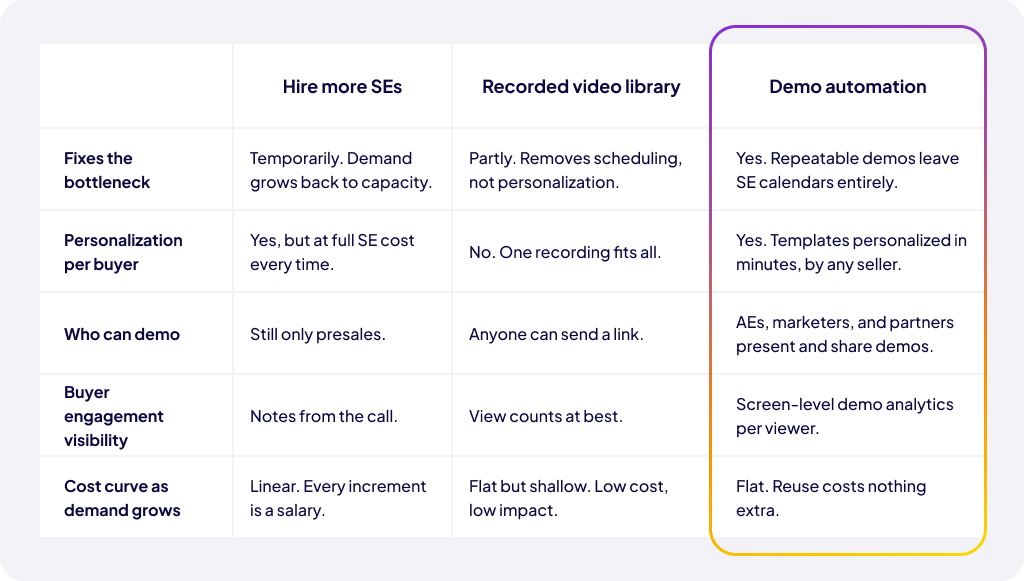
To be fair to the losing columns: hiring is still the right answer when the constraint is genuinely complex work that requires expert judgment, and video remains useful for one-way content like release announcements. Neither solves a workflow where repeatable demos consume senior capacity.
You fix it by separating repeatable demo delivery from SE availability, so senior talent is spent only where senior judgment is required. In practice that means four moves:
1. Turn repeatable demos into reusable assets. The introductory walkthrough, the vertical-specific tour, the feature deep dive: build each once as an interactive product demo, keep it in a governed library, and personalize copies per deal instead of rebuilding from scratch. AI-assisted creation with Demoboost AI collapses build time further.
2. Put demos in sellers' hands. When AEs can find, personalize, and present the right demo themselves, every first call can include the product, and presales joins only the calls that need them. The demo library does the work that used to require an SE on the invite, so the seller stops waiting and the SE stops repeating.
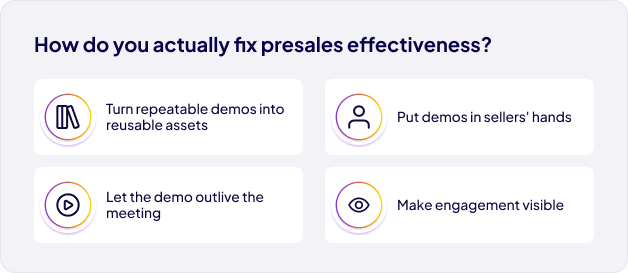
3. Let the demo outlive the meeting. A shareable demo becomes the asset your champion forwards to the rest of the buying committee. The story travels without an SE repeating the session for every new stakeholder, which matters more the larger the group gets.
4. Make engagement visible. Demo analytics shows which screens buyers viewed, where they spent time, what they skipped, and whether they returned. That turns demo engagement into an intent signal presales and sales can act on, instead of guessing which deals deserve SE hours.
Faster creation alone just produces more demos. The effectiveness gain comes from governance, seller access, distribution, and engagement data working together.
Spryker, an e-commerce platform company with around 500 employees across Berlin and New York, hit every symptom described above. Demo creation was complex and time-consuming. Only a limited group could conduct demos, which capped how many deals could see the product and when. Sharing demos with wider stakeholder groups was difficult, which slowed sales cycles.
The team implemented Demoboost to rebuild the demo workflow around reusable, personalized interactive demos. Demo creation went from weeks to days. More importantly, demoing stopped being an SE-only activity: team members beyond solution engineering could now personalize and present demos themselves.
The results, from the published customer story:
Edmund Frey, Chief Revenue Officer at Spryker, summarized it this way: "Demoboost Elevated Spryker's Efficiency and Effectiveness by the Power of Three."
Karl Bischoff, Team Lead Technical Solution Consulting and Demonstration at Spryker, pointed to the structural change behind the numbers: "Demoboost encourages a structured approach to demo building, prompting users to build the narrative in a strategic way."
Notice what did not happen: Spryker did not hire its way out. The same presales team now covers the full pipeline because the repeatable share of the demo workload no longer runs through their calendars.
Start with an audit, not a tool. List every demo delivered last quarter and sort it into two piles: demos that required senior judgment in the room, and demos that repeated a known story. The second pile is your recoverable capacity. For most teams it is bigger than they expect, and it is the pile demo automation was built for.

Presales effectiveness is how well a presales team converts its available expert hours into revenue outcomes: qualified deals advanced, technical wins, and buyer confidence built. It differs from raw activity. A team can deliver a record number of demos and still be ineffective if those hours go to unqualified deals or repeatable work.
Efficiency is doing the same work with less effort, for example building a demo faster. Effectiveness is making sure the effort goes where it changes outcomes, for example reserving SE hours for deals that need expert judgment. Demo automation improves both, but the larger gains come from effectiveness: shifting repeatable demos off SE calendars entirely.
No. Demo automation removes the repeatable share of demo work, the introductory walkthroughs and standard tours, so sales engineers can focus on discovery, technical validation, and complex deal support. AI can speed up demo creation, but it does not replace sales or presales conversations.
Track four numbers: average demo wait time, the share of first calls that include a product demo, SE hours spent on repeatable versus custom demo work, and the share of demos delivered to unqualified opportunities. If wait times are measured in weeks and repeatable work dominates SE calendars, the problem is active.
It depends on library size and product complexity, but the first effects appear as soon as the first reusable demos replace live walkthroughs. Spryker reduced demo wait times from an average of 1.5 weeks to zero and brought presales involvement in top-of-funnel calls down 95% (Demoboost customer story).
Demo automation is the practice of turning product demos into reusable, personalized, trackable assets that sellers and buyers can use without depending on live presales availability for every interaction. It covers demo creation, demo libraries, seller access, distribution formats like playlists and sales rooms, and demo analytics.
Book a live demo to see how Demoboost helps your team cut demo prep time, qualify buyers faster, and focus on real opportunities.
Book a Live Demo

.png)
.png)
