
.png)
Learn how presales is evolving and howyour team can stay ahead in atech-driven sales landscape.

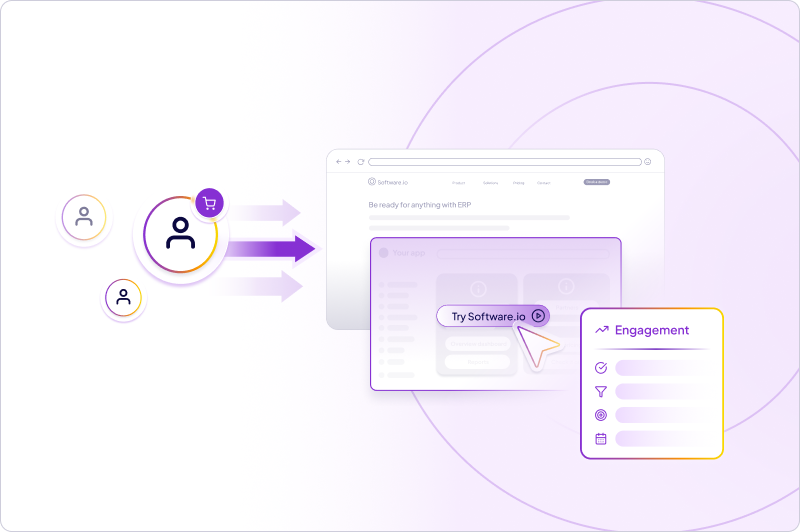
How to scale buyer engagement without adding headcount comes down to one shift: give every prospect on your website a way to experience the product before a sales rep is involved. Most B2B websites offer two options, static content or a live demo request, with nothing in between. That is why traffic climbs every quarter while demo requests stay flat. The fix is not more content or more reps. It is a self-guided interactive demo of the product itself, personalized by persona, sitting on the pages prospects already visit.
A gap in your funnel does not show up as lost traffic. It shows up as flat demo requests while traffic keeps climbing.
The engagement gap is the distance between how many people visit a B2B website and how many of them ever experience the actual product before talking to sales.
Marketing teams get good at filling the top of the funnel with blog traffic, paid campaigns, review sites, and organic search. Almost none of that traffic converts to a demo request, because a demo request is a far bigger ask than reading an article. A prospect who is not ready to hand over a work email and sit through a 30-minute call has nowhere else to go. They leave, and the team that built the traffic has nothing to show for the middle of the funnel.
This lands hardest on presales and sales engineering teams. Every prospect who does convert still needs a solution engineer (SE) to build or run that demo, which means headcount, not content, becomes the ceiling on how many prospects a company can engage.
Most websites offer only two experiences: passive content for browsing, and a live demo request for the small share of visitors ready to talk to a rep.
That design works against how buyers behave now. 67% of B2B buyers prefer a sales rep-free experience and 70% prefer a completely digital, self-service buying experience (Gartner, 2026). Buyers still want sellers involved at specific moments, mainly when they need judgment about fit. For general exploration and learning, they go digital first. A website that offers only "read more" or "book a call" asks a self-directed buyer to skip a step they do not want to skip.
There is a trust cost to the gap as well. 69% of B2B buyers report inconsistencies between information on the sales organization's website and what sellers tell them (Gartner, 2025). When the only place a prospect can see the product is a live call, the website and the product experience drift apart, and buyers notice.
A video cannot be explored, and a digital adoption overlay cannot guarantee the live product still looks the way the overlay promised.
Product videos are the default fallback for "something between content and a demo." They are easy to produce and easy to distribute, but they are passive. A prospect watches at the pace the editor set, not the pace they would choose, and there is no way to click ahead to the one capability they actually care about.
Digital adoption platforms solve a different problem. They overlay guidance on top of a live application, usually to onboard existing users. Using the same approach for prospect-facing demos carries risk, because the overlay depends on the live product staying exactly where the tour expects it. When the underlying app changes, a redesigned screen or a moved button, the overlay and the real product experience fall out of sync. A prospect who notices the mismatch loses confidence in what they are being shown.
Video and self-guided interactive demos solve different problems, and only one of them lets a prospect control the pace of their own exploration.
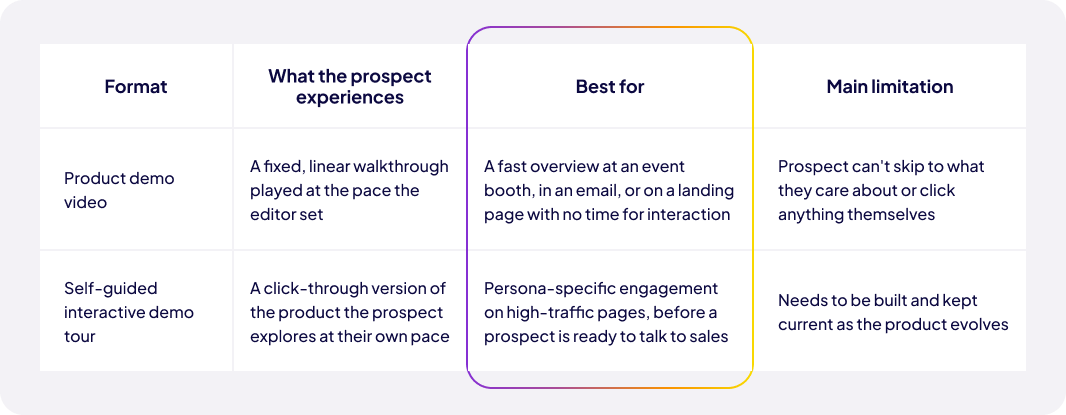
Video still wins when the goal is a two-minute overview a prospect can watch passively, at an event booth or in a follow-up email, without needing to click through anything themselves.
You replace the single "book a demo" button with persona-based, self-guided interactive demos placed directly on the pages prospects already visit.
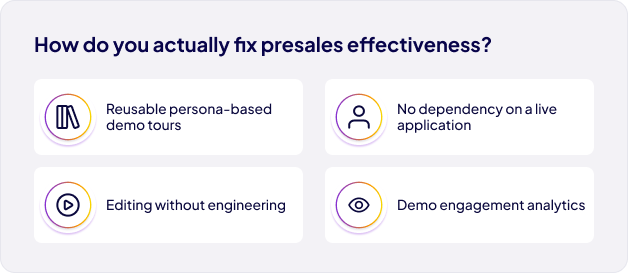
Four mechanics make this scale without new hires:
One demo, reused across pages and personas. A demo built once for the homepage can be adapted for a pricing page, a comparison page, or a persona landing page, instead of a rep rebuilding context for every visitor.
Self-contained formats that do not break when the product changes. HTML tours, screenshot demos, and sandbox environments are editable experiences rather than overlays on a production system, so they do not depend on a live application staying visually identical. That also means a complex integration can be shown through real-life examples instead of coordinating access to several live platforms for one call.
Editing without engineering. Marketing and presales teams can update copy, screens, or flows themselves when the product changes, instead of filing a ticket and waiting.
Engagement data on what is actually working. Demo analytics shows which screens prospects spend time on and where they drop off, which tells marketing and presales what to fix before the next campaign rather than after it.
Turn Website Traffic Into Product Engagement Without Adding Headcountf
GuideCX, a client onboarding platform, wanted to engage prospects before they ever booked a demo. They also needed to show how GuideCX integrates with third-party systems, which meant coordinating access to multiple live platforms just to run one demo. That made live demos slow to set up and hard to run consistently.
They had tried digital adoption tools first, and the risk was immediate.
"It was risky for us to do overlays in our live solution with digital adoption platforms. When you share it out with customers, the actual setup in their live solution might be dramatically different from the point you're trying to make. And so we switched from digital adoption platforms to Demoboost for our training. We were able to make it look real and credible, but we had so much more consistent control."
Chris Haleua, Vice President of Product and Marketing at GUIDEcx
GuideCX partnered with Demoboost to build short, interactive demos designed around their specific target personas, placed directly on the homepage where prospects were already landing. They also used Demoboost to show their third-party integrations with real-life examples, rather than trying to coordinate several live systems in a single call.
GuideCX's demos now generate 35,000+ demo views a month, with individual demos passing 10,000+ views each, and the interactive format drove a 10x increase in prospect engagement compared with the video they had used before (Demoboost customer story, GuideCX, 2026). Lead volume held steady, with no drop-off in bottom-funnel conversions once the self-guided step was added.
"We wanted to ensure that when we directed people to the website they got much more than just a basic video. They were able to experience self-guided tours where they could see the product in action. This approach played a key role in helping us achieve a 10x increase in engagement."
Chris Haleua, Vice President of Product and Marketing at GUIDEcx
The pattern repeats at enterprise scale. Celonis built a self-service gallery of 12 demos and now averages 4,300 monthly demo views with a 9-minute median time spent in a demo and a 4.4/5 average demo rating (Demoboost customer story, Celonis, 2026). Nine minutes of voluntary attention on a product story is not something a contact form produces.
The demo becomes a tracked buying signal, not a page view that disappears.
This is where a self-guided demo stops being a marketing asset and starts being part of a demo revenue system. Demo analytics records which screens a prospect viewed, how long they stayed, what they skipped, and whether they came back. When a prospect fills in a lead form inside the demo, Demoboost Global Webhooks can send that event to middleware such as Zapier, Make, or Workato, which routes it into your CRM, Slack, or a sales engagement platform. Three triggers are live today: demo created, demo completed, and lead form completed.
The practical outcome is that a self-guided demo does two jobs at once. It gives the prospect a way to evaluate the product without a call, and it gives sales a record of what that prospect actually cared about before the first conversation happens. Demo creation is getting easier for everyone. Connecting demo engagement to the revenue workflow is the part that still separates teams.
Yes. These terms describe the same category of experience: a click-through, self-paced simulation of the product that a prospect explores on their own, as opposed to a rep-led live demo or a passive video.
No. GuideCX's results came from adding a self-guided step earlier in the funnel, not from removing live demos. Buyers still want a rep involved for complex, fit-specific questions. The self-guided demo handles the general exploration stage instead.
Put a self-guided interactive demo on the pages prospects already visit, built once and adapted by persona, so that exploring the product no longer requires a rep's calendar. Headcount then limits only the deals that genuinely need a live conversation.
Track views per demo, time spent per screen, and where prospects drop off. GuideCX tracks demo views by demo and uses that data to confirm which ones are driving engagement.
Yes, and that was one of GuideCX's specific use cases. Instead of coordinating live access to multiple platforms for one call, the integration is shown through a built demo using real-life examples, which removes the setup dependency.
Not on Demoboost. Marketing and presales teams can build and edit demos themselves, which is part of why GuideCX could adapt demos by persona without pulling in engineering every time something changed.
Internal onboarding overlays run on top of an application your own team controls end to end. Prospect-facing overlays depend on the live product staying visually identical to what the overlay expects, and any product change can make the guidance and the real experience diverge in front of a buyer.
You already have the traffic. GuideCX's results came from giving that traffic somewhere to go besides a demo request form.
Book a live demo to see how Demoboost helps your team cut demo prep time, qualify buyers faster, and focus on real opportunities.
Book a Live Demo

.png)
.png)
