
.png)
Learn how presales is evolving and howyour team can stay ahead in atech-driven sales landscape.

TL;DR:
Because the people deciding your deal are not looking for the same thing.
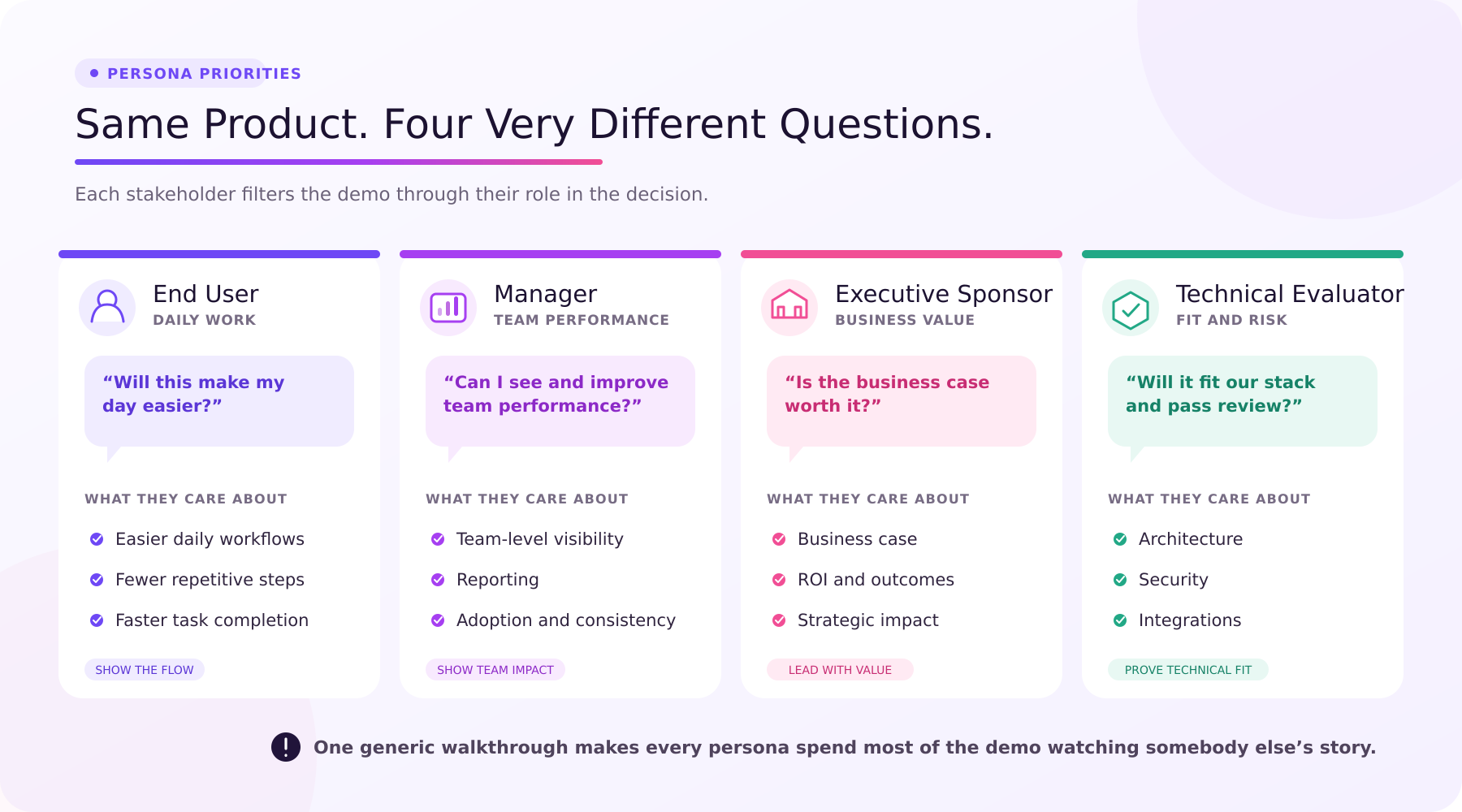
The end user wants to see their daily workflow get easier. Their manager wants team-level visibility and reporting. The executive sponsor wants the business case in the first two minutes. The technical evaluator wants architecture, security, and integrations, and skips everything else. Show all four of them the same thirty-minute generic walkthrough and each one spends most of it watching content built for somebody else.
The size of the problem is well documented. Gartner reports that a typical B2B buying group involves five to 16 people across as many as four different functions. Most of them will never attend your live demo. Whatever product experience they get arrives secondhand, through a champion's summary or a slide deck, unless you give them something built for their role that they can open on their own time. This is the reality sales engineering teams plan demo capacity around.
The math is simple and unforgiving. One product, four personas, and twenty active deals is eighty demo variants if you personalize properly. Built manually, each variant means a sales engineer or rep re-recording, re-configuring a demo environment, or rebuilding a deck.
Teams respond to that math in one of three ways, all bad. They build one generic demo and accept that it lands with nobody in particular. They personalize only for the persona on the next call and leave the rest of the buying group unserved. Or they burn SE hours on manual variants and turn the demo queue into the pipeline's bottleneck.
The problem is not effort or intent. It is that demo creation cost scales linearly with personas times accounts, while headcount does not.
Demo automation platforms change the cost structure. Instead of building each demo from scratch, you capture the product once and produce variants from that base, so the marginal cost of the fifth persona variant is minutes instead of days.
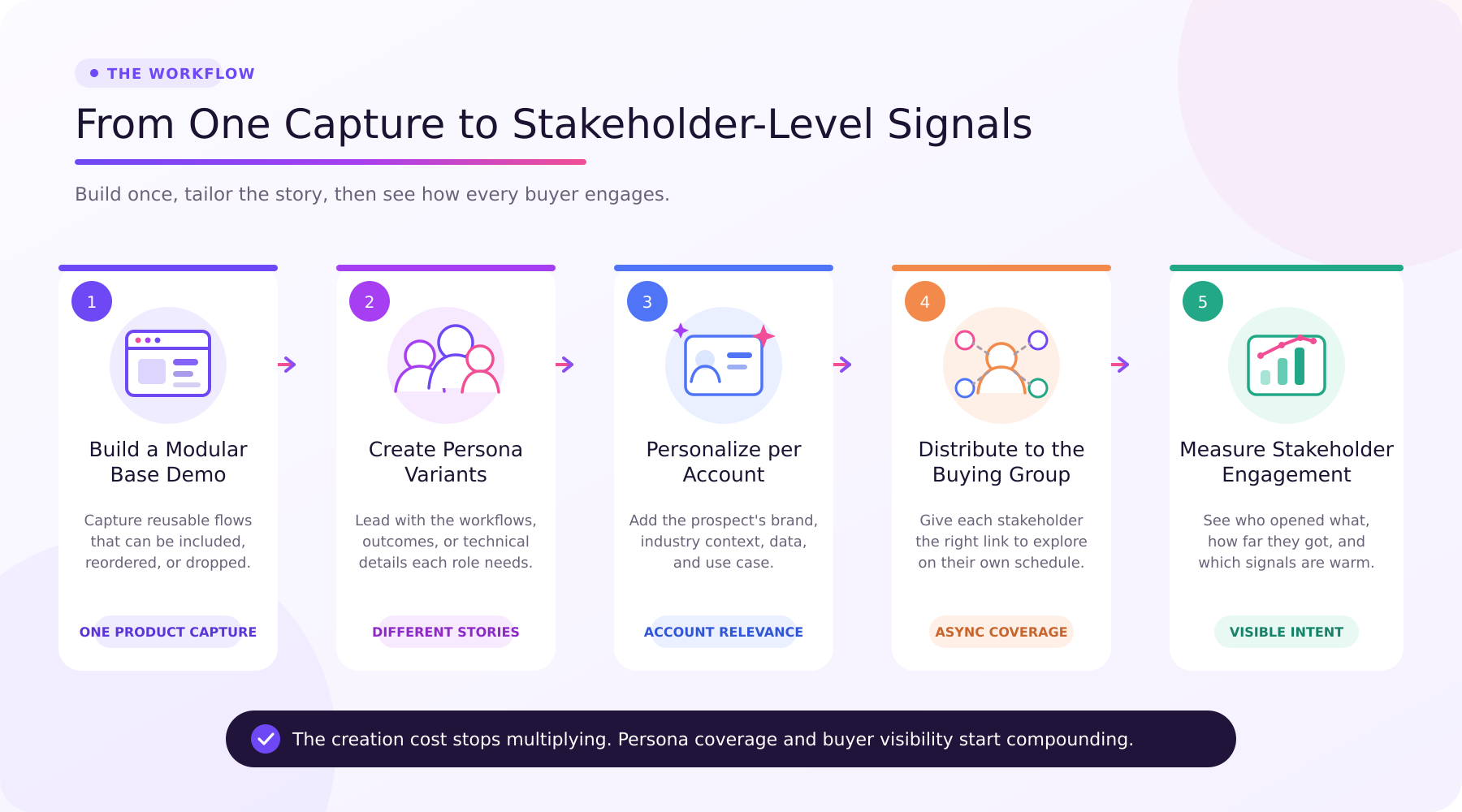
For the multi-persona use case specifically, the workflow the software needs to support looks like this:
Build a modular base demo. Capture the product's key flows once, structured as sections that can be included, reordered, or dropped, rather than one fixed linear path.
Create one variant per persona. From the base, assemble persona versions: the user variant leads with the daily workflow, the executive variant leads with outcomes and reporting, the technical variant leads with integrations and admin. Same underlying capture, different story per audience.
Personalize per account. Layer account-level personalization onto the persona variant: the prospect's name, logo, industry-relevant data, or use case. Persona variants get a buyer type right, account personalization makes it feel built for them specifically.
Distribute to the whole buying group. Share each variant through personalized demo links, so the champion can forward the executive version to their executive and the technical version to their architect, and every stakeholder evaluates asynchronously on their own schedule.
Measure engagement by stakeholder. The distribution only pays off if you can see who opened what and how far they got. Persona-level demos plus engagement tracking turn the invisible part of the buying group into named, scored signals.

Teams build interactive product demos without engineering help and tailor them to each prospect, which is what makes maintaining a set of persona variants practical for a team without spare SE capacity. Presales governs the demo templates, and sales customizes them for a specific persona, industry, or account. The customization itself is AI-assisted: with Demoboost AI, a variant is produced through prompt-based edits to screen elements, guide copy refinement, and adjustments to charts and KPIs inside the template, so tailoring a demo for a new persona is an editing task rather than a rebuild. Demos are shared through personalized demo links or lead forms, so a single champion can carry the right version to every member of their buying committee.
The measurement side runs through Revenue Intelligence. When viewers are identified through lead forms or personalized demo links rather than anonymous sessions, every engaging lead is scored hot, warm, or cold based on that engagement, with lead-level detail, filters, period comparison, and CSV export. In a multi-persona motion this is the payoff step: instead of guessing whether the CFO ever opened the business-case version, the deal team can see which identified stakeholders engaged and how warm each one is. That engagement data reaches the CRM and the rest of the stack through Global Webhooks, with five triggers (Demo Created, Demo Opened, Demo Completed, Demo Abandoned, Lead Form Completed) and Demo Tags included in the payloads, routed via middleware such as Zapier, Make, or Workato, alongside the built-in connections listed on demoboost.com/integrations. Tag each variant with its persona and the tag travels with every webhook event, so the CRM record shows not just that a stakeholder engaged but which persona version they engaged with.
Five criteria specific to the multi-persona use case, beyond the generic demo software checklist.
Variant economics. Ask the vendor to show you, live, how long it takes to produce a second persona variant from an existing demo. This single number determines whether persona coverage is realistic for your team.
Maintenance across variants. Products change. Ask what happens to your persona variants when the underlying product screens update. If every release means rebuilding each variant by hand, the library rots.
Personalization depth. Persona variants are the floor, account-level personalization is the ceiling. Check what can be customized per prospect and how much of it is manual.
Stakeholder-level analytics. Engagement data that stops at "the demo was viewed" is not enough for this use case. You need to know which person engaged, with which variant, and how deeply.
Data flow into your CRM. Confirm how engagement signals reach account and lead records, whether directly, via webhooks and middleware, or not at all. Persona-level insight that never reaches the deal owner changes nothing.
For a broader view of where demo automation sits among other presales categories, see our guide to sales engineering tools. When you move from workflow to vendor evaluation, our overview of interactive product demo software covers the category head to head.
Start narrower than feels natural. Pick your two highest-stakes personas, usually the champion's persona and the economic buyer, and build those two variants for your most common deal type. Run them across a handful of active deals, watch the engagement data, and let it tell you which persona to add third. Teams that try to launch a full persona matrix on day one usually stall in content production before any deal feels the difference.
A useful forcing question for each variant: what would this persona need to see to advocate for us in a meeting we are not in? That is the actual job of a persona demo. With Gartner putting the buying group at five to 16 people, most of the deciding conversations happen without a seller in the room.
1. What is persona-based demo automation?
Persona-based demo automation is the practice of using demo automation software to create and maintain a separate interactive demo variant for each buyer persona in a deal, from one underlying product capture. It replaces both the generic one-size demo and the unscalable practice of manually building custom demos per stakeholder.
2. How many demo variants do you actually need?
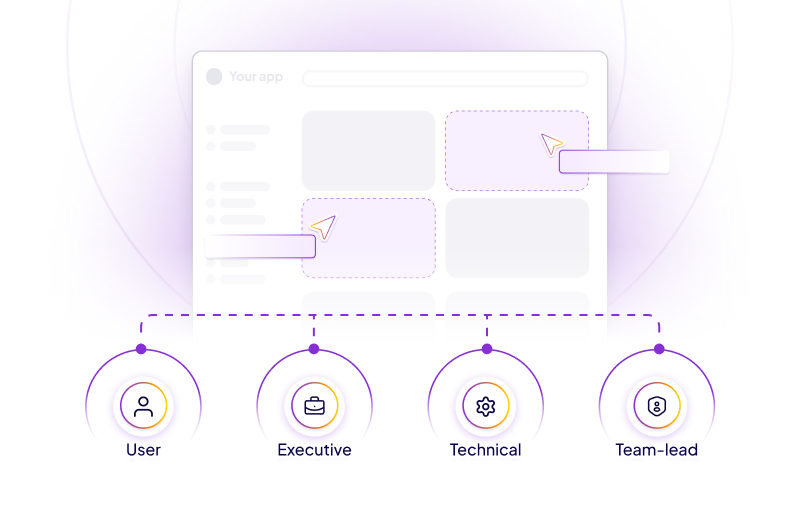
Fewer than a full persona matrix suggests. Most teams get the majority of the value from two to four variants: the primary user, the economic buyer, and where relevant a technical evaluator and a team-lead persona. Start with two and let engagement data justify each addition.
3. Can one demo work for a whole buying committee?
Rarely well. Gartner puts the typical B2B buying group at five to 16 people across as many as four functions, each with different priorities, and a single linear demo forces most of them to sit through content aimed at someone else. A base demo with persona variants serves the same committee without multiplying creation work.
4. How do you measure whether persona demos are working?
Track engagement at the stakeholder level: which personas open their variant, how far they get, and how that correlates with deals advancing. In Demoboost, when viewers are identified through lead forms or personalized demo links, Revenue Intelligence scores each engaging lead hot, warm, or cold with lead-level detail, which makes the comparison across personas and time periods direct.
5. Does persona-based demo automation replace live demos?
No. It replaces the repetitive share of demo work, the standard walkthroughs and the coverage of stakeholders who never join calls. Live demo time concentrates on deep technical evaluation and the conversations where an expert in the room changes the outcome.
Book a live demo to see how Demoboost helps your team cut demo prep time, qualify buyers faster, and focus on real opportunities.
Book a Live Demo

.png)
.png)
